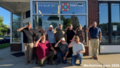
Bud Hassett and a couple of his very close friends. (Photo By Linda Galok)
Rivers know this: there is no hurry. We shall get there some day.
— “Pooh's Little Instruction Book,†inspired by A. A. Milne
Tim Gray and Francis (Bud) Hassett frequently have both oars in the water.
Gray has been canoeing since attending a camp as a young lad in the Adirondacks, where he won a Boy Scout merit badge for it, in spite of having to jump in the lake at 6:30 every morning to get started.
Hassett has been canoeing since he and a friend bought an old beat-up Grummond aluminum canoe, when he was just out of high school.
Gray works three or four jobs (depending on the season) and lives in Lee. Hassett is semi-retired and lives in Dalton.
Gray has a passion for the playing the hammer dulcimer, tending the plants and flowers at his family’s Golden Hill Nursery and parting PCBs from the Housatonic River. Hassett favors frog legs, fiddlehead ferns and family adventures.
While Gray races canoes sometimes, his most important win, he said, has been as the Housatonic “riverkeeper,†seeing progress being made on the river clean-up project when he takes his canoe out for a ride.
Hassett has raced canoes for years, including a couple of white-water races. He won a time or two, but he said the most important thing about canoeing is challenging his own abilities while enjoying the ride.
Gray canoes almost exclusively in the October Mountain State Forest and fish and wildlife management area of the Housatonic, but he will take his collection of canoes to give tours anywhere on the Housatonic, from New York to Massachusetts and Connecticut.
Hassett has canoed on the ocean off the coast of Alaska, the lakes of Maine and New Hampshire, the swamps of Florida, the ponds in the Berkshire hill towns and many of the rivers of the Northeast, including the St. John, the Deerfield — and, of course, the Housatonic.
Gray said staying dry can be a realistic option when one canoes. He said the most impressive canoeing moment he saw was the day John Lortie, a biologist with Woodlot Associates, reached over the side of his canoe and pulled a 36-inch snapping turtle from the river without falling out. But almost as impressive, he said, was U.S. Sen. John Kerry’s guided canoe tour about 10 years ago. Gray said Kerry was a pretty able canoeist for a politician — in other words, he moved forward rather than going in circles, as many beginner canoeists (and politicians) are prone to do.
Hassett said wet feet are to canoeing what webbed feet are to ducks, but if one doesn’t try to stand up too much and stays away from places with a lot of “blowdown (fallen tree limbs) and drops, one can stay drier than he usually does. “There are only about 10 things to understand and master to successfully paddle a canoe, but without knowing those things, you don’t make a lot of forward progress,†Gray said.
Hassett had some words of wisdom for beginning canoeists tooâ€
“Use a kayak,†he said with a laugh, “They’re lighter to carry and easier to maneuver if you’re going to learn by yourself.â€
In all seriousness, he said, the Housatonic isn’t the best place for beginners to learn, but some rules will help:
1.} Always wear a life jacket.
2.} Learning to canoe in the summer is best since the water in the Housatonic is warmer, lower and slower.
3.} When canoeing with another person, don’t both “paddle off the same side at the same time, unless the overall plan includes going for a swim.â€
3.} If canoeing alone when it’s exceptionally windy, move to the front of the canoe or weight it down with rocks or gear to make better progress.
4.} Make sure you and your wife (or husband) agree on the definition of left and right when direction-giving will be on the canoe outing agenda.
Both Gray and Hassett agreed that the Housatonic River is one of the best places in the Northeast to paddle a canoe. One can see all kinds of wildlife, from beaver, black bear and deer to ducks, osprey and, if lucky, otters and perhaps even a moose.
Gray’s favorite place to canoe is Woods Pond in October. Hassett’s favorite place to canoe is the Hinsdale Flats any time of year.
Gray’s future plans include making music, writing his book about the Housatonic that’s waiting in dozens of boxes to be written, giving canoe tours to educate and entertain eager and willing residents and tourists and seeing the Housatonic completely free of PCB contamination.
Hassett’s future plans: enjoying retirement, wintering in Florida, kayaking year-round and keeping an extra pair of socks handy for those days when dry feet are not an option.
Paddling the waterways is just part of a satisfying, unhurried lifestyle for both Gray and Hassett, a way to slow things down and look around once in awhile. They might both have read about a bear named Pooh.
If you would like to contribute information on this article, contact us at info@iberkshires.com.
Your Comments
iBerkshires.com welcomes critical, respectful dialogue. Name-calling, personal attacks, libel, slander or foul language is not allowed. All comments are reviewed before posting and will be deleted or edited as necessary.
No Comments
Lanesborough Town Meeting to Vote Budget, Bylaws & Vehicle Purchases
By Breanna SteeleiBerkshires Staff
LANESBOROUGH, Mass. — Tuesday's annual town meeting includes a $14 million operating budget, new short-term rentals, accessory dwelling units and sign bylaws, and free cash article appropriations.
Voters will gather at Lanesborough Elementary School on June 9 at 6 p.m. to decide on 20 warrant articles.
The fiscal 2027 budget is up a little over 10 percent. Some of the main increases are the Mount Greylock Regional School District and McCann Technical School: the McCann assessment is up more than 30 percent based on factors including enrollment and the school renovation project, and Mount Greylock's is up 11 percent.
Article 11 is for the town to vote to approve from free cash the sum of $16,298.48 for the McCann Technical School roof and window replacement project so as not to impact the budget. Article 3 is appropriate $7,586,284 for Mount Greylock Regional School assessment.
Another notable increase was in life and health insurance, showing an increase of about 26 percent.
Ambulance Director Jen Weber is planning 24-hour coverage, which means more staff and a hike in her budget. One of the articles asks the town to appropriate $234,100 to operate the Ambulance Enterprise Fund for salaries and expenses.
Many town departments are looking for new vehicles. The Fire Department is looking to replace its outdated 1996 fire engine. There are two articles related to the truck at a total of $813,366. Article 12 would transfer $225,000 from free cash into the Fire Truck Stabilization Fund; Article 13 would transfer $605,000 from the fund and authorize the borrowing of $208,366.08.
The total includes a $100,000 contingency cost to cover any additional costs if a 2026 model-year chassis cannot be secured before new emissions standards go into effect in 2027.
The board at its last meeting moved the $225,000 transfer to come before the borrowing article, changing the stabilization number. If the $225,000 is not voted on, then they will amend the next article's number on the floor, subtracting the $225,000. This shows the borrowing number significantly lower.
Article 17 asks for the transfer of $80,000 from free cash to replace a police cruiser.
Police Chief Rob Derksen's aim is to replace one vehicle every other year, meaning the oldest vehicle gets replaced about every 10 years.
He stressed that if delayed this year, the town may have to double up in a future year to get back on schedule, and that paying later usually costs more. The article will ask for $80,000 from free cash, the vehicles used to be funded by the BHRD.
Lastly, the Highway Department is looking to replace a 2014 International dump truck that will be a total of $330,000 and will take two to three years to receive.
Money will be used from last year's approval of $250,000 from free cash for the replacement of a 2012 highway front-end loader that was underspent $49,261. Town meeting is being asked to approve a transfer of $53,274.85 from free cash and the use of $227,464 from funds from the Sale of Town Real Estate to fund the balance.
Other free cash proposals include $1,200 to purchase software to support tracking and ongoing maintenance schedules of town-owned vehicles; $42,000 for the replacement of the Highway Department's storage shed roof, $200,000 to reduce the tax levy.
Cassidy Flynn scattered five hits in a complete-game effort in the circle as Lenox upset top-seeded Hoosac Valley, 3-2, in the quarter-finals of the Division 5 State Tournament. click for more
Brayden Durant struck out seven and walked one in a complete-game effort on the mound Saturday to pitch the Drury baseball team to a 6-0 win over Keefe Tech in the quarter-finals of the Division 5 State Tournament at Joe Wolfe Field. click for more
Jason Codey struck out 13, walked two and allowed just an infield single as the Generals earned a 7-1 win over Wahconah to claim their third straight regional title. click for more
Gracelyn Wright struck out eight, and Genevieve Lagess went 3-for-5 with four runs batted in as the Hurricanes beat Monson, 17-3, to claim their first Western Mass title in four years. click for more
For the boys, Ward Bianchi helped lead the way with a win in the shot put and a second place in the javelin as the Mounties finished 16 points ahead of runner-up Pittsfield (pending the results of the pole vault, which were unavailable at 11 p.m. Friday night). click for more