MCLA center, S. County projects get boost
By Linda CarmanPrint Story | Email Story
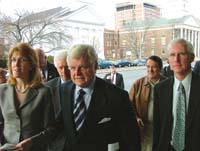
Senator Edward M. Kennedy walks to the Colonial Theatre on South Street in Pittsfield Monday, flanked by the theater's executive director, Susan Sperber, left, and Howell M. Palmer, Colonial Theatre Association board president, right.
Six county projects, including an environmental center for the Massachusetts College of Liberal Arts in North Adams and redevelopment efforts of a long-dormant commercial site in Great Barrington, will benefit with a total of $1.3 million from the $388 billion omnibus appropriations bill approved by Congress last week. U.S. Rep. John W. Olver, D-Amherst, announced the funding Tuesday. The bill includes $160,000 for MCLA to develop its Berkshire Environmental Resources Center in Adams, which would not only be home to the college’s environmental studies program and serve as a research and policy center but also would also be a community resource promoting environmental awareness and preservation. It would also serve as a local center for internships with organizations such as the Hoosic River Watershed Association, Williamstown Rural Lands Foundation, the Center for Ecological Technology and Nature’s Classroom in Becket. Olver said the center would help the college’s mission by strengthening its environmental studies program. “And the center would benefit the community and have the potential to become nationally known,” he said in a news release. MCLA spokeswoman Lori Gazillo hailed the announcement. “This certainly is good news,” Gazillo said. “We’re very excited and appreciative of Olver’s support. We’re in the very beginning stages of this. We’ve had an environmental sciences major for a few years now, and it’s definitely a goal of President Mary Grant’s and the faculty in the program to develop a center. It’s a perfect location for a center such as this.” In South County, a project to redevelop blighted property in Great Barrington for economic development and community revitalization received $194,000 in the bill. The funds will go toward redevelopment the 8-acre New England Log Homes site in the downtown center — dormant since 1993 — into 100,000 square feet of commercial space for local businesses. The brownfields site would be converted to office, retail and light industrial use in a contemporary building resembling a mill with river views. The vacant building was damaged by fire in 2001. Tim Geller, director of the Community Development Corp. of South Berkshire, called the announcement “terrific news.” “It’s going to be a terrific site. It’s been a very long process, but the best part of this news is that this kind of commitment will make it much easier to find the other parts of the financing,” Geller said. The CDC of South Berkshire has been working on the site for seven or eight years, he said. Demolition of the damaged building is estimated to cost between $800,000 and $900,000, with site remediation costing another $1.5 million. The site is contaminated with leftover petroleum distillates. Olver said in his release, “I’m pleased that this federal funding will assist the community’s efforts to revitalize a piece of property that has great potential. Not only will this project remove blight and improve safety in he surrounding neighborhood, it has the long-term goals of creating jobs.” The omnibus bill also contains $200,000 for the Weed-It-Now Initiative, a conservation measure to remove invasive species in the tri-state Southern Taconic Mountains in Berkshire County, western New York and northwest Connecticut. Weed-It-Now, a program of The Nature Conservancy and its local partners, will remove invasive plant species from about 9,000 acres of forest over five years. More than half the forest has been invaded by six different non-native weeds which, if allowed to proliferate, are likely to repress the regeneration of the forest and reduce the richness of native species, according to experts. This is the fourth year the program has received funding. “One of the healthiest and largest contiguous forests in the Northeast, this area has a vibrant population of rare specifes,” Olver said. “By removing invasive weeds, we can help ensure that the forest remains a major resource preserved for future generations.” The Nature Conservancy works with a broad coalition of public and private landowners to remove invasive weeds by pulling, cutting and, where necessary, treating with herbicides. Other community-based programs will provide native plants for private landscaping and keep areas weed-free. The bill also includes $100,000 to restore the Windsor Reservoir, the town of Dalton’s primary drinking water supply. The 62-acre reservoir in Hinsdale and Windsor was shut down in the summer of 2003 after damaging storms. Since then, Dalton has been using Pittsfield’s water supply. Storms on Aug. 11 and Aug. 12, 2003, caused a feeder brook to overflow its banks, severely eroding Wahconah Falls Road near its intersection with May Road north of the reservoir and causing the water to become turbid. The funding will go toward investigation, design and permitting for repairs to the reservoir. The bill also includes $485,000 for the Food Bank of Western Massachusetts to build a 17,000-square-foot expansion of its Hatfield facility, increasing its capacity for food storage and distribution. Construction will incorporate innovative ways to save electricity and solid-waste expenses, using help from the state Office of Alternative Energy and the Center for Ecological Technology. Local organizations receiving food from the food bank are Berkshire Community Action Council, South County, Pittsfield, and North Berkshire; People’s Pantry in Great Barrington; Berkshire Food Project in North Adams; Salvation Army community meals in North Adams; the Christian Center in Pittsfield; Tuesday’s Harvest Table meals site at First United Methodist Church in Pittsfield; Salvation Army in Pittsfield; St. Stephen’s Table in Pittsfield; Christian Assembly Church food pantry and Our Lady of Mount Carmel Church food pantry in Pittsfield; St. Mark’s Church and St. Joseph’s Church food pantries; Veterans Outreach Center, and St. Patrick’s Church food pantry in Williamstown. “We’ll be able to get more food out to more organizations in all four counties,” said Jillian Hanson, associate director of development. “It definitely has an impact on Berkshire County, no doubt about it.” The bill includes $150,000 for the Hilltown Community Health Center to expand its Huntington clinic, doubling the number of examination rooms from four to eight, building a larger outpatient laboratory and enlarging its waiting room. Also the two-story addition will increase offices for therapy for mental health and substance abuse counseling services. The House and Senate approved the bill Saturday night. It funds the majority of the federal government’s domestic activities and now goes to the president’s desk for his signature.
If you would like to contribute information on this article, contact us at info@iberkshires.com.

Dalton Announces New Supplier for Energy Program

DALTON, Mass. – The Town of Dalton has signed a thirty-four month contract with a new supplier, First Point Power.
 
Beginning with the January 2026 meter reads, the Dalton Community Choice Power Supply Program will have a new rate of $0.13042 per kWh. The Program will also continue to offer an optional 100 percent green product, which is derived from National Wind Renewable Energy Certificates (RECs), at a rate of $0.13142 per kWh.
 
For Dalton residents and businesses who are enrolled in the Town's Program, the current rate of $0.13849 per kWh will expire with the January 2026 meter reads and the new rate of $0.13042 per kWh will take effect. This represents a decrease of $5 per month on the supply side of the bill given average usage of 600 kWh. Additionally, this new rate is 3 percent lower than Eversource's Residential Basic Service rate of $0.13493 per kWh. Residents can expect to see an
average savings of $3 per month for the month of January 2026. Eversource's Basic Service rates
will change on Feb. 1, 2026.
 
Dalton launched its electricity program in January 2015 in an effort to develop an energy program that would be stable and affordable. From inception through June 2025, the Program has saved residents and small businesses over $1.7 million in electricity costs as compared to Eversource Basic Service.
 
It is important to note that no action is required by current participants. This change will be seen on the February 2026 bills. All accounts currently enrolled in the Program will remain with their current product offering and see the new rate and First Point Power printed under the "Supplier Services" section of their monthly bill.
 
The Dalton Community Choice Power Supply Program has no fees or charges. However, anyone switching from a contract with a third-party supplier may be subject to penalties or early termination fees charged by that supplier. Ratepayers should verify terms before switching.
 
View Full Story

More Stories