Coping with the unexpected
By Linda Scott GalokPrint Story | Email Story
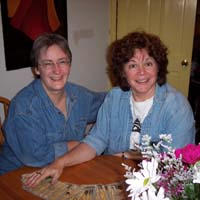
Jess Kielman, right, performs a Tarot card reading for her partner, Gayle Andrew. (Photo By Linda Scott Galok)
PITTSFIELD — “Being psychic doesn’t mean I can predict the future,” one of Berkshire County’s well-known psychics, Jess Kielman, said during a recent interview. “I can only tell you what MAY happen — what WILL happen is up to each individual.” Like a doctor who rarely takes time to check her own pulse, Kielman admits she doesn’t take much time for her own Tarot readings, except for occasionally asking her cards, “Can we afford a plumber this week or how can I make money more efficiently this year?” One quick personal reading in spring 2001 turned up a reversed devil card for the month of June. Although the cards’ negative reading indicated that something really difficult could happen, Kielman, who knew she would be on vacation in Cape Cod that month, said she didn’t pause to consider the negatives, instead thinking she would be spending time resting and reflecting. And so she did not predict the turn her life was about to take on a Sunday afternoon a week later. Things had not been easy to begin with for Kielman or her family that year. Her partner of 11 years, Gayle Andrew, was still recovering from a cancerous tumor in her right hand. Andrew’s ex-husband was battling a serious health problem of his own, and their children, Devin and Rebecca, were both having a hard time in school because of the stress and resultant turmoil in their daily routines, Kielman said. While she was filling in for a coworker at Canyon Ranch that Sunday afternoon, she said, Andrew was home in Pittsfield with Devin, then age 12, helping him study for finals, when they realized his French book was still at school. They decided it was a good time to take a break and go pick up his book at school in Williamstown. Kielman said the house was empty when she got home. She called Andrew’s mother to check in, but Gayle and Devin had not been there. Kielman said she was not worried until the phone rang. The Williamstown Police Department was calling. There had been a three-car accident on Route 7 in front of the state Highway Department Garage. There were multiple and serious injuries. The two people most seriously injured were Gayle Andrew and her son, Devin Shea. Kielman said she ran for her car in a panic to get to the emergency room of Berkshire Medical Center. “We were all where we needed to be that day,” she recalled. “If I had been home, I would have gone along for the ride, and Devin would have been in the backseat, which was ripped from the front and destroyed by the impact of the crash. I don’t think he would have survived it.” The emergency workers broke the passenger side window to remove Devin from the car, but he shrugged them off, refusing to move until he knew they were taking care of his mother. He lay on a stretcher by the ambulance, with 10 broken bones, but begged the EMTs to let him stay until they had gotten his mother out of the car. Kielman related that, in BMC’s emergency room, separated by a curtain — Andrew frequently losing consciousness, and doctors and nurses working over them both — Andrew and her son continually called out to one another, checking in to ask, “Are you okay? I’m okay,” never losing their connection of simple words of love and encouragement. Andrew, a professional acupressure therapist, had 123 breaks and fractures. She had broken bones in both hands, arms and legs; her hip was crushed, her femur shattered and the steering wheel had punctured a lung. The most extensive damage was to her right knee and foot, as she had instinctively tried to stop both her Ford Taurus and the Dodge Dakota truck that hit her head-on. Two sets of Jaws of Life used in tandem, helped extricate Andrew from the car. BMC admitted Devin, while Life Flight airlifted Andrew to Albany Medical Center. Kielman remembered trying to “multi-task, spiritually,” during that traumatic time. ”It really challenges your world view,” she said. “I heard myself tell Gayle, ‘You have to live!’ But then I would think, ‘What if it’s her destiny to die? What if that’s what she wants or needs on a soul level?’” So, she said she tried to prepare herself for either outcome. Andrew was in a drug-induced coma for three weeks, and the doctors were unable to predict the outcome. Held together with titanium pins, plaster casts and pain medication, Andrew later said she couldn’t imagine how it was possible to “feel so broken and still be alive.” Months later at Laurel Lake Nursing Home, she asked a nurse if a person could die from crying. When a doctor told her she would never walk again, Andrew found that unacceptable and knew her only alternative was to work toward healing, no matter how much it hurt. She recalled one of her toughest physical therapy sessions during a month’s stay at Spaulding Rehab in Boston. She baked chocolate chip cookies in order to start regaining the use of her hands. Bones were still healing, more surgery loomed, and standing up was still impossible. Her grip was weak, her hands trembled and twitched, and frustration and pain battled for attention. The measurements inexact, flour scattered on the floor, the batter perhaps a bit too salty, she persevered for more than two hours. Those cookies were for Devin, she said, and he ate every one. More than three years, 10 surgeries, hundreds of thousands of dollars and immeasurable hours of pain and physical therapy later, Andrew will need more surgery, still tires easily and needs to use her wheelchair at the end of many days. She may never fully recover from her injuries but she said she can’t fathom giving up. The whole family still suffers from post-traumatic stress, jumping at loud noises, which can be comical at times because, Kielman said, “Gayle tends to get excited over small things and shouts out when she sees a humming bird, bringing us all running to make sure she’s all right.” Andrew said, ”Jess put a bird feeder outside my window at the nursing home. It was good Feng Shui — something living to watch — the tough guys, the love stories. It was probably one of the smartest emotional things she could have done for me.” Although the experience has drained Kielman and Andrew, as well as their families, of time, money and emotion, they agreed they have grown from it. They said they are thankful for every well of prayers, support and help from family, friends and all the professionals they met. Climbing the stairs of their two-story house was impossible for Andrew, even with a friend’s borrowed rock climbing equipment. “That didn’t work but it was a hoot,” she said, laughing with Kielman. They needed a stair lift, but there was little insurance money from the accident and they couldn’t afford the equipment or the installation. Friends decided to have a tag sale to raise the money. Lynne Soldato, owner of Zucchini’s Restaurant on Route 7 in Pittsfield and Pasta’s on Route 8 in Cheshire, donated Zucchini’s parking lot and provided a considerable amount of food. Tailored Rental gave them a tent; local businesses donated things for a raffle, and one couple, planning their own tag sale, heard about the fundraiser and loaded their truck with all their own things, donating them to Kielman and Andrew to help them raise the money. “People came to buy things from us and brought their own things back so we could sell them. We had 15 helpers by the end of the day,” Kielman said. They raised enough money for the stair lift and had enough left over to build a wooden walkway so Andrew could get to their garden. When they were trying to find an inexpensive wheelchair, the United Cerebral Palsy Association, a national non-profit with offices on West Street in Pittsfield, stepped in with one to use “for as long as we needed it,” Kielman said. “They are wonderful, kind, and just there for everyone, even helping you find whatever they don’t provide.” All their experiences weren’t positive, of course, and psychic ability isn’t necessary to see that life will always hold special challenges for this family. “Government assistance programs don’t always assist; people don’t always tell the truth; some businesses care more about money than people, and, as hard as the staff might try, nursing homes can be badly understaffed and overworked,” Kielman said. Andrew can’t presently use her skills as an acupressure therapist to earn a living, but she and Kielman still offer Feng Shui lectures at Canyon Ranch. Andrew has learned to make beautiful jewelry, sun catchers, door hangers and dowsers, utilizing the art of Feng Shui. “I had to be in bed for several months after every surgery, and there is only so much television a person can tolerate. Jess built a tower on wheels for all my beads and supplies,” Andrew said. Two weeks ago, Andrew drove a car for the first time in almost four years, and she was gleeful when she talked about using snowshoes the past weekend, although she wasn’t able to go more than twice around the house and “needed a two day nap afterward.” “She can’t do the grocery shopping yet,” Kielman said, “but she can drive me to the store.” Kielman admitted she still doesn’t take time to tune in to herself and her own life’s possibilities. “Laundry, meals, making a living and taking out the garbage — all seem to use up the day.” “When get extra stressed and irritable, we know we have to stop and take time for ourselves and each other,” Andrew said. Kielman offers free Tarot readings at 8 a.m. the last Tuesday of every month with a call-in segment on WUPE radio station, 95.9 FM in Pittsfield, and has recently taught classes in Tarot and astrology through Berkshire Community College. Kielman and Andrew may be contacted at Canyon Ranch in Lenox, as well as through their Web site, www.berkshirefengshuiarts.com. With their little free time left at the end of every day, they are also writing a book, “Accidental Journey,” about the accident and their experiences along the road to recovery. It will include interviews with the people involved in the accident, rescue and recovery, what they did, how they felt and if and how it changed them in profound or simple ways. It will also include information about practical ways of dealing with the human side of the aftermath of trauma. The inspiration for the book came from the lack of resources for victims of trauma. They hope their book will help others by shedding light on what can be a long, dark road.
If you would like to contribute information on this article, contact us at info@iberkshires.com.

BRTA Focuses on a New Run Schedule

By Breanna SteeleiBerkshires Staff

PITTSFIELD, Mass. — The Berkshire Regional Transit Authority is still working on maintaining its run schedules after dropping the route realignment proposal.

Last Thursday's meeting was Administrator Kathleen Lambert's first official meeting taking over the reins; retiring director Robert Malnati stayed during a transition period that ended last month.

Lambert is trying to create a schedule that will lessen cancellations. There was a two-hour meeting the week before with the drivers union to negotiate run bids and Lambert is working with the new operating company Keolis, which is taking over from Transdev.

The board spoke about anonymous emails from drivers, which Lambert said she has not seen. iBerkshires was not able to see those letters, but has received some. 

"They were lengthy emails from someone describing themselves as concerning BRTA employee, and there was a signed letter from a whole group of employees basically stating their concerns. So, you know, to me, it was a set of whistleblowers, and that, what my understanding is that this really triggers a need for some type of process to review the merits of these whistleblowers, not going to call them accusations, but basically expressions of concern," said member Stephen Bannon.

A letter iBerkshires received spoke of unhappy drivers who were considering quitting because of decisions being made without "input from frontline staff," frustration and falling morale, and the removal of the former general manager shortly after Lambert came in.

Lambert said it's difficult to navigate a new change. She also noted many drivers don't want to do Saturday runs and it has been hard negotiating with drivers on the new runs.

"I would like you all to keep in mind that the process of change is super difficult. Transdev has been here for 20 years, and some of these drivers have never known any other operating company, the way some of the operations have been handled has been archaic," she said. "So getting folks up to speed on how a modern transit system works is going to be painful for them. So I don't want to say that I'm unsympathetic, because I am sympathetic, but I am trying to coax people along with a system that's going to seem very strange to them."

The board spoke about better communication between them and Lambert, citing cooperation will be best moving forward.

"There's just a lot of stuff in the air right now, and there are a lot of fires to put out to make this a coordinated effort. And if we don't keep our communications open and be straightforward, then you get blindsided about how you know the input that you could get from us about your position, and how you know what's going on in your direction, and we get blindsided. And I think that we have to make sure that this is a collaboration," said member Sherry Youngkin.

"Both sides have responsibilities, because in the long run, this advisory board is going to have to make decisions as to how we brought forward and if we've gone forward in a fair and helpful way. And I think that's hopefully what everybody is looking for also." 

Transdev and Keolis held a three-day recruiting event interviewing almost 40 candidates and offering jobs to eight, but only three stayed on to start training. Lambert said it was disappointing but she will keep trying to retain more people.

In her first report to the board, she noted that ridership dipped a little over 10 percent, but still remains higher than last year, adding that was because of cancellations of services because of the lack of drivers.

Like the last meeting, some of the advisory board members were torn over the start of the Link413 service, worried that the start of the service took drivers away and the numbers of riders are low.

Lambert, however, said the ridership has doubled from last month.

"As I've spoken before, we have, generally, a six-month adoption for brand-new service before you can really go in and evaluate, are you being successful based on the grant that my predecessor wrote along with the team for PBTA and RTA, we are ahead of schedule, which is pretty good, so I'm hoping that will continue to improve," she said.

Member Renee Wood said the board never approved the service, adding the only thing she could find in the minutes was a vote to accept the equipment. She said it was supposed to be put on the agenda to discuss.

"The Link413 service has been three years in the making. It's been a grant that was accepted and has been working with our partners, PVTA and FRTA, to put into place. So I don't have the entire history of how that process worked, but it's been three years in the making, and did we not understand that once we accept that grant that we were going to put in new service?" Lambert said.

The board discussed if Title VI, the Civil Rights Act, was followed with an accurate review and accurate amount of time for public comment period on the service changes and if its attorney should review if the  grant conditions were properly followed.

Lambert said changes had the 60-day comment period included in the proposed route realignment packet, giving the opportunity for the community to respond to that as well but will look into the legality of the situation with their attorney.

View Full Story

More Stories