Williamstown – The Williams College Museum of Art (WCMA) presents “Wal-Mart, China, and You,†a free, public lecture by Gary Hamilton, Professor of Sociology at the Jackson School of International Studies, University of Washington. The lecture will be held at Brooks Rogers Auditorium, Bernhard Music Center, Williams College on Monday, March 13, 2006. Wal-Mart is a firm that everyone has an opinion about. Some love it, some loath it. But what most people don’t realize is that Wal-Mart is one of a number of firms that is substantially changing the global economy. Wal-Mart is part of a retail revolution that started in the 1960s and that continues today. This revolution is not simply Wal-Mart’s doing, but rather Wal-Mart is part of a broad movement that has increasingly taken economic power out of the hands of manufacturers and put it in the hands of merchants. Who drives this revolution? You, the consumer. What is the consequence of your consumer choices? The concentration of global manufacturing in China and elsewhere in Asia. Who is the beneficiary this revolution? Wal-Mart and other global retailers. Is this revolution good or bad for Americans? That is for you to decide.
Gary G. Hamilton is a Professor of Sociology and the Jackson School of International Studies at the University of Washington. He specializes in historical/comparative sociology, economic sociology, and organizational sociology. He also specializes in Asian societies, with particular emphasis on Chinese societies. He has previous held teaching positions at the University of California, Davis, and Tunghai University in Taiwan. He is the recipient of numerous honors and research grants, including a Fulbright Fellowship, a Guggenheim Fellowship and a fellowship at The Center for Advanced Study in the Behavioral Sciences at Stanford University. He has received sizeable research awards from the National Science Foundation, the Ford Foundation, and the Chiang Ching-kuo Foundation. He has published numerous books and articles, including most recently Commerce and Capitalism in Chinese Societies (Routledge 2006), Emergent Economies, Divergent Paths: Economic Organization and International Trade in South Korea and Taiwan, with Robert C. Feenstra (Cambridge University Press, 2006), Cosmopolitan Capitalists: Hong Kong and the Chinese Diaspora at the end of the 20th Century, editor and contributor (University of Washington Press, 1999), and The Economic Organization of East Asian Capitalism, with Marco Orrù and Nicole Biggart (Sage 1997).
This lecture is presented in conjunction with the exhibition “Regeneration: Contemporary Chinese Art from China and the US,†which includes drawing, installation, painting, photography, video, prints, sculpture, and mixed media works by 26 contemporary Chinese artists. Merging Chinese art traditions with the global lingua franca of today’s art, their works are characterized by their monumental size and a bold, confident attitude that has propelled them to the forefront of the international art scene. Considering the effect of their country’s rapid urbanization on human relations, personal and collective identity, and the “rediscovery†of China’s glorious past in light of the manipulation of historic facts throughout the communist era, this diverse exhibition investigates and comments upon the social and cultural transformations of this extraordinary nation. On view at the Williams College Museum of Art through May 14, 2006.
If you would like to contribute information on this article, contact us at info@iberkshires.com.
Your Comments
iBerkshires.com welcomes critical, respectful dialogue. Name-calling, personal attacks, libel, slander or foul language is not allowed. All comments are reviewed before posting and will be deleted or edited as necessary.
No Comments
Williamstown Planning Board Narrowing in on Subdivision Bylaw Changes
By Stephen DravisiBerkshires Staff
WILLIAMSTOWN, Mass. — The Planning Board late last month discussed specific features of what it plans to pass as a new subdivision control bylaw this year.
The board long has discussed the complex set of regulations as being out of date and cumbersome to both potential developers and the board itself, which has needed to hear requests for waivers of outdated rules for the handful of residential subdivisions that have been proposed in town in recent years.
This spring, the town engaged consultants from Northampton's Dodson and Flinker Landscape Architecture and Planning to go through the existing bylaw, compare it to more contemporary regulations in other communities and help craft a revised bylaw.
Unlike the zoning bylaw, where amendments require approval of town meeting, the subdivision control bylaw is a creation of the Planning Board, which can make changes on its own after a public hearing process it hopes to complete this year.
At a special Planning Board meeting on May 26, Dillon Sussman of Dodson and Flinker and his colleagues walked the board through a dozen different decision points that the board must resolve — either by leaving the bylaw as is or making a change — and offered suggestions based on best practices.
All of the issues are technical and ranged from the fundamental, like how the bylaw will define types of subdivisions, to the highly specific, like what turning radii will be required in new streets that are constructed to serve planned developments.
One example of a topic that came up in the recent approval of a four-home subdivision off Summer Street is stormwater management.
Cassidy Flynn scattered five hits in a complete-game effort in the circle as Lenox upset top-seeded Hoosac Valley, 3-2, in the quarter-finals of the Division 5 State Tournament. click for more
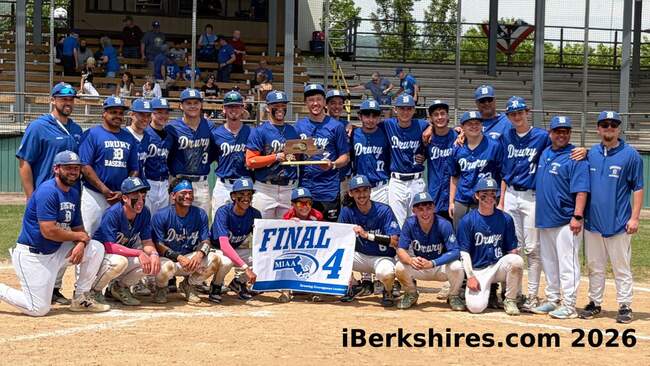
Brayden Durant struck out seven and walked one in a complete-game effort on the mound Saturday to pitch the Drury baseball team to a 6-0 win over Keefe Tech in the quarter-finals of the Division 5 State Tournament at Joe Wolfe Field. click for more