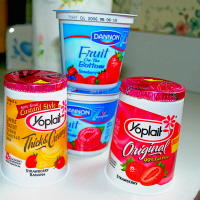
Carmine, a beetle-based red colorant, is listed as an ingredient in these food products.
Some foods are being deliberately "bugged," and many consumers have been none the wiser.
That may soon change.
The federal Food and Drug Administration is considering requiring food and cosmetic manufacturers that use a red dye made from crushed beetles to list the ingredient on product labels. Currently, the coloring, identified as "carmine" or "cochineal extract," may appear as "artificial color," "E120," "color added," or "natural color."
According to a summary of the FDA proposal, "The proposed rule responds to reports of severe allergic reactions, including anaphylaxis, to cochineal extract and carmine-containing food and cosmetics and would allow consumers who are allergic to these color additives to identify and thus avoid products that contain these color additives."
According to FDA media spokesman Michael Herndon, the proposed labeling regulation stops short of forcing product manufacturers to list the dye as "insect-based."
Truth In Labeling, Please
And that is unfair to consumers, according to a local woman who asked to remain anonymous.
The woman said she became aware of the beetle-based coloring when she read the ingredient label on a container of strawberry flavored yogurt purchased at a local market. Because she was not familiar with the term "carmine," she investigated, and was "disgusted" to learn that carmine is made from crushed beetle bodies.
A spot check of various products at local markets found "carmine" listed as an ingredient in specific Dannon and Yoplait yogurt flavors as well as some Tropicana juice varieties. The absence of a "carmine" or "cochineal extract" listing does not mean that the ingredient is not in the product because at present, manufacturers are not required to specifically identify it.
Beet It, Just Beet It
A review of additional products that are red in color found that in many cases, the red hue is derived from sources including beet juice and red cabbage juice. The woman said that she believes those types of dye should be used in foods instead of carmine.
The woman provided a copy of an e-mail communication she sent to Yoplait's consumer services division.
"Please stop using carmine in your strawberry products," she wrote. "I recently purchased a lot of your yogurt and while eating a strawberry one, I read the ingredients. Not knowing what carmine is, I looked it up. I was disgusted to find it in your product. Use beet juice like you do in cherry and raspberry. I've returned all the strawberry for other flavors."
The woman received a reply from the company.
"Thank you for contacting Yoplait regarding carmine used in Yoplait yogurt. Carmine is a naturally derived red color extracted from the dried shells of the cochineal beetle. Carmine is an FDA approved ingredient and is commonly used in many foods such as ice cream, soft drinks, sweets, and candies. We appreciate the opportunity to share this information with you and we will forward your comments to the appropriate individuals."
The presence of carmine may pose a problem for vegetarians and those who "keep kosher" as well as those with specific allergies.
Public Comment Period Ends May 1
The FDA action is a result of several reports of severe allergic reactions allegedly involving the dye. And eight years ago, in 1998, the Center for Science in the Public Interest submitted a petition asking that the FDA act and require product manufacturers to list the ingredient on its labels. The CSPI has asked that manufacturers be made to include the phrase "insect-based" as well.
A public comment period focused on the FDA proposal is currently active. Consumers may submit comments about carmine and its' inclusion on ingredient labels until May 1. Electronic submissions may be sent via a federal rulemaking portal:
http://frwebgate.access.gpo.gov/cgi-bin/leaving.cgi
Written submissions may be faxed to 1-301-827-6870.
Comments may be mailed to Division of Dockets Management [HFA-305], Food and Drug Administration, 5630 Fishers Lane Room 1061, Rockville, Maryland, 20852.
All comments must include the agency name, a docket number and a regulatory information number. The docket number for the carmine proposal is "Docket No.1998P-0724" and the RIN number is "0910-AF12."
Here is a link to the proposed rule:
www.fda.gov/ohrms/dockets/98fr/E6-1104.htm
Susan Bush may be reached via e-mail at suebush@iberkshires.com or at 802-823-9367.
If you would like to contribute information on this article, contact us at info@iberkshires.com.
Your Comments
iBerkshires.com welcomes critical, respectful dialogue. Name-calling, personal attacks, libel, slander or foul language is not allowed. All comments are reviewed before posting and will be deleted or edited as necessary.
The fact that I may have been eating BUGS and did not know it actually disgusts me. If I wanted to eat bugs I would go into my backyard and dig me up some. So, if there are beetles in my yogurt and juice, what else is in there that I don't know about or want to consume? I would never have imagined that a company as big as yoplait, dannon, and tropicana would actually put bugs in their products. So if they are using insects in their products and supposedly it is legal, why do restaurants get fined by the health department for having bugs? No matter how you look at it, a BUG IS A BUG! Get them out of my food!
First I would like to say that cochineal is NOT a beetle but rather a scale bug from the order Hemiptera (Coleoptera is the order of beetles). Secondly cochineal extract began being used as a commercial food dye after synthetic dyes were found to be carcinogenic; cochineal is relatively healthy in comparison.
I do support additive being labeled as an insect product as it is not kosher, vegans may want to avoid it, and some people have allergic reactions to cochineal extract. However, I would not compare its use to insects in restaurants. Cochineals are bred in controlled environments and are relatively clean feeding only on cactus, while insects in restaurants can carry diseases.
Tina Packer, Founder of Shakespeare & Company, Dies at 87
Staff Reports
LENOX, Mass. — The doyenne of Shakespeare's plays, Tina Packer, died Friday at the age of 87.
Shakespeare & Company, which Packer co-founded in 1978, made the announcement Saturday on its Facebook page.
"It is with profound sadness that we announce the passing of Tina Packer, Shakespeare & Company's founding artistic director and acclaimed director, actor, writer, and teacher," the company said on its post and in a press release.
Packer, who retired a the theater company's artistic director in 2009, had directed all of Shakespeare's plays, some several times, acted in eight of them, and taught the whole canon at more than 30 colleges, including Harvard. She continued to direct, teach, and advocate for the company until her passing.
At Columbia University, she taught in the master of business administration program for four years, resulting in the publication of "Power Plays: Shakespeare's Lessons in Leadership and Management with Deming Professor John Whitney" for Simon and Schuster. For Scholastic, she wrote "Tales from Shakespeare," a children's book and recipient of the Parent's Gold Medal Award.
Most recently her book "Women of Will" was published by Knopf and she had been performing "Women of Will" with Nigel Gore, in New York, Mexico, England, The Hague, China, and across the United States. She's the recipient of numerous awards and honorary degrees, including the Commonwealth Award.
"Our hearts are heavy with the passing of Tina Packer, a fiery force of nature with an indomitable spirit," said Artistic Director Allyn Burrows. "Tina affected everyone she encountered with her warmth, generosity, wit, and insatiable curiosity. She delighted in people's stories, and reached into their hearts with tender humanity. The world was her stage, and she furthered the Berkshires as a destination for the imagination.
The Wildcats marched 84 yards in a drive that consumed 11 minutes, 17 seconds of the third quarter for a critical touchdown in a 48-36 win over Boston’s Cathedral High in the quarter-finals of the Division 8 Tournament. click for more
Evelyn Julieano and Leanne Maschino each put down seven kills, and the Lenox volleyball team came out strong in advancing past Whitinsville Christian in three sets in the Division 5 State Tournament quarter-finals on Friday.
click for more
Kofi Roberts and Everett Bayliss remained tied for the team lead with 14 goals apiece, and Lucas Burrow notched his second goal as Mount Greylock (11-6-1) won for the fourth time in five games and earned its third shutout victory in the Western Mass tournament. click for more
GG Nicastro scored in the 37th minute to break a 1-1 tie, and the Mount Greylock girls soccer team Wednesday went on to a 2-1 win over Monson in the Western Massachusetts Class C Championship Game at Berkshire Community College.
click for more
Primary setter Grace Julieano had 22 assists – 10 of them to her sister Evelyn and eight to Sara Isby in Saturday's three-set win over Mount Greylock. click for more
Darius Taliaferro and Cameron Coon each scored a goal on Friday to lead the Mount Everett boys soccer team to a 2-1 win over Gateway Regional. click for more