Harvard University Professor of Economics Michael Kremer will deliver the Biannual Henry George Lecture at Williams College. His talk on "Improving Health and Education in the Developing World" will be held Monday, October 16, at 8 p.m., in The Science Center's Wege Auditorium.
Kremer is the Gates Professor of Developing Countries at Harvard and a senior fellow at the Brookings Institution. He is co-chair and co-founder of The Bureau for Research and Economic Analysis of Development and a consultant to the Development Economics Research Group of The World Bank.
Kremer has won numerous awards including a MacArthur Fellowship, and most recently the Kenneth J. Arrow Award for Best Paper in Health Economics in 2005 by the International Health Economics Association and the Association of American Publishers Award for Best Professional/Scholarly Book in Medical Science for his book "Strong Medicine: Creating Incentives for Pharmaceutical Research on Neglected Diseases," in 2004.
Recent work has focused on issues of Advance Market Commitments for Vaccines against Neglected Diseases: Estimating Costs and Effectiveness, The Illusion of Sustainability, and Long-Term Educational Consequences of Secondary School Vouchers: Evidence from Administrative Records in Columbia.
In his most recent paper, Kremer discusses how "an advance market vaccine commitment may be sufficient to stimulate substantial research towards a desired vaccine, and from a public health perspective still be extremely cost effective." According to him, "the larger the commitment, the more biopharmaceutical firms will enter the search for a vaccine, and the faster a vaccine is likely to be developed."
He elaborates on this topic in Creating Markets for Vaccines. "Advance purchase commitments for vaccines for diseases concentrated in poor areas," writes Kremer, "have considerable appeal across the ideological spectrum as a market-oriented mechanism that brings the resources of the private sector to address the health needs of the world's poorest countries."
Kremer received his A.B. in social studies from Harvard College and his Ph.D. in economics from Harvard University.
If you would like to contribute information on this article, contact us at info@iberkshires.com.
Your Comments
iBerkshires.com welcomes critical, respectful dialogue. Name-calling, personal attacks, libel, slander or foul language is not allowed. All comments are reviewed before posting and will be deleted or edited as necessary.
No Comments
Williamstown Planning Board Narrowing in on Subdivision Bylaw Changes
By Stephen DravisiBerkshires Staff
WILLIAMSTOWN, Mass. — The Planning Board late last month discussed specific features of what it plans to pass as a new subdivision control bylaw this year.
The board long has discussed the complex set of regulations as being out of date and cumbersome to both potential developers and the board itself, which has needed to hear requests for waivers of outdated rules for the handful of residential subdivisions that have been proposed in town in recent years.
This spring, the town engaged consultants from Northampton's Dodson and Flinker Landscape Architecture and Planning to go through the existing bylaw, compare it to more contemporary regulations in other communities and help craft a revised bylaw.
Unlike the zoning bylaw, where amendments require approval of town meeting, the subdivision control bylaw is a creation of the Planning Board, which can make changes on its own after a public hearing process it hopes to complete this year.
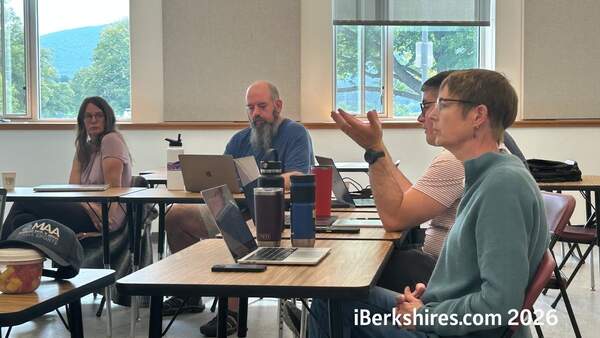
At a special Planning Board meeting on May 26, Dillon Sussman of Dodson and Flinker and his colleagues walked the board through a dozen different decision points that the board must resolve — either by leaving the bylaw as is or making a change — and offered suggestions based on best practices.
All of the issues are technical and ranged from the fundamental, like how the bylaw will define types of subdivisions, to the highly specific, like what turning radii will be required in new streets that are constructed to serve planned developments.
One example of a topic that came up in the recent approval of a four-home subdivision off Summer Street is stormwater management.
Cassidy Flynn scattered five hits in a complete-game effort in the circle as Lenox upset top-seeded Hoosac Valley, 3-2, in the quarter-finals of the Division 5 State Tournament. click for more
Brayden Durant struck out seven and walked one in a complete-game effort on the mound Saturday to pitch the Drury baseball team to a 6-0 win over Keefe Tech in the quarter-finals of the Division 5 State Tournament at Joe Wolfe Field. click for more