Barn, Bylaw Spark Heated Debate in Williamstown
 |
At the heart of the debate was a bylaw protecting local wetlands, and its future effects on town growth, as well as $60,000 of public money earmarked for Williamstown Rural Land Foundation's preservation of Sheep Hill Barn.
The deadline to submit additional warrant articles for town meeting is March 31. The Selectmen will vote whether to recommend each article, but final approval rests with voters at town meeting. Currently, there are 28 articles for fiscal 2009, ranging from the affordable housing on Cole Avenue to school operating budgets.
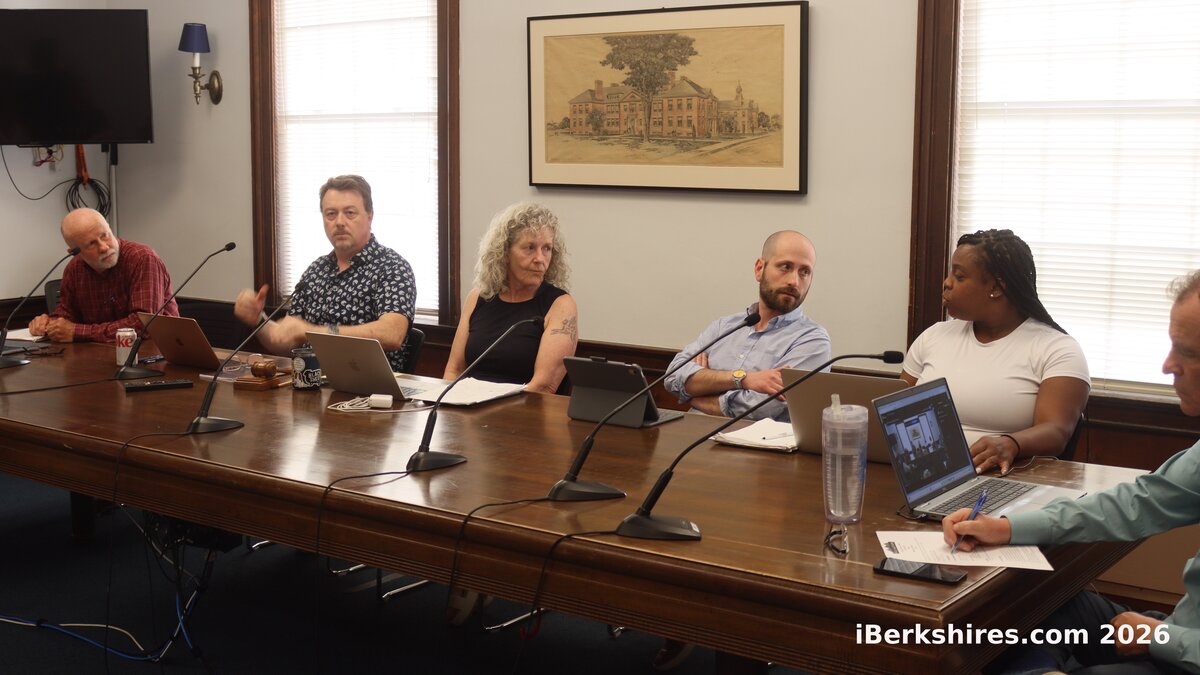
Selectman Thomas Costley opened by questioning the use of Community Preservation funds for private restoration projects, particularly for the Williamstown Rural Land Foundation.
"We're taking $60,000 for a barn, and that's real money," he said, referring to the Sheep Hill project. He later added "I worry about public money going to — I don't want to say wealthy, I don't know their finances — but a well-off organization."
Selectman Ronald Turbin noted that the restoration would benefit the town, as Sheep Hill provides public access to its land, while remaining privately owned. Town Manager Peter Fohlin pointed out that Williamstown "invested money in this fashion in Caretaker Farm."
Costley, an acknowledged supporter of the Land Foundation, still raised concerns, citing residents barely able to afford the taxes on their current homes. "I may be [King] Lear yelling to the wind here ... but those marginal dollars are important."
Both Chairman David Rempell and Selectman Richard Steege said further information and discussion were in order. "There's reason to ask what purpose is being served by putting $60,000 into a barn," said Steege. Rempell then added: "I would raise the question even broader ... should public funds go to private organizations? It's legal, but are we comfortable with it? That's the question to ask."
Rempell was referring, in part, to warrant Article 24, which would siphon $800,000 from the same Community Preservation Fund for "no less than eight units of deed-restricted affordable housing at ... 201-207 Cole Avenue." These Church Corner Apartments would be privately built by Church Corners LLC and seemed to have the unanimous support of the Selectmen.
Wetlands Bylaw Fears
However, it was the Wetlands Protection Bylaw (Article 25) that sparked the longest debate of the night, primarily between Turbin and Costley.
As written, the purpose of the bylaw "is to protect wetlands, water resources, and adjoining land areas in the Town of Williamstown by regulating activities deemed by the Conversation Commission likely to have ... adverse effect upon resource area values."
Costley's objections were less with the law's intent than its language and future ramifications, which he had raised at previous meetings.
"It's a broadly written law and in the hands of an agenda-driven Conservation Commission could become very anti-development," he said.
Praising the current commission (represented at the meeting by Richard Schlesinger) for its hard work and prudence, Costley feared how the bylaw might be applied by a less judicious commission.
"It's meant to be a conversation law, but because it's a non-zoning bylaw, it's just words on paper," he said. He went on to say "74 percent of the town is already preserved" and as more land is earmarked for preservation, young families will be priced out of the market.
"I don't want our schools to be empty ... and I want our cops to live in town," he said. "When will enough to enough?"
Turbin, however, responded that "we have a concern about affordable housing, but we also have an environmental problem." He likewise expressed thanks to the Conservation Commission for its work, but did not share Costley's fears about future zealots in its ranks.
"In the small chance that you had an agenda-driven Conservation Commission, the town could bring a warrant article to the town meeting. There is recourse," he said.
At one point the exchange grew heated, with Costley turning to Turbin and saying, "you didn't come here to live in a retirement community," then reading an e-mail from a resident who asked, "How many people are unable to live here because of Williamstown's restrictions?" Such costs, the anonymous resident claimed, could never be known.
Other selectmen weighed in as well. Jane Allen said "it's hard to argue against this bylaw, [wetland protection] is apple pie," while Steege conceded some of Costley's argument: "We do have a problem in Williamstown: it's unaffordable."
Rempell again took the long view, noting that "What we're really talking about is what this community will look like in 10 years. We're losing children in our schools.
"I would rather cheat on the side of letting us grow, to have options, than not," he continued.
Copies of all the proposed articles are available on the town Web site, and can be printed out.
Solar Fees
In other business, Christopher Kilfoyle of Berkshire Photovoltaic Services, a company specializing in the installation of solar panels, asked the board for a break in fees.
Kilfoyle said he hoped the board might reconsider the fee structure for installations, citing relatively low costs of neighboring Berkshire towns. "I'm asking for a graduated scale and a break for the groups that are trailblazing this."
According to Kilfoyle, Williamstown has "one of the densest photovoltaic [outputs] in the country," but the permit costs remain prohibitive. The board seemed receptive to a change but needed more information. Rempell, Steege, and Turbin said the high costs were news to them.