Williamstown Man Finds Lightning Hits Close to Home
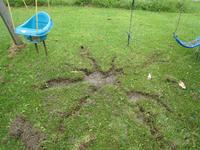 |
| Thomas Mahar of Williamstown took pictures of the hole in his back yard left by lightning. |
A not unusual event, but he thought it looked like it hit pretty close to his home.
It did. Right in his back yard.
Mahar went home at lunch to find a spidery crater directly under the swing set his grandchildren play on. "It blew the [swing] seat about 20 feet," said the Williams College project manager. "I measured one of the spikes at 16 feet."
His home sits at the top of Pine Cobble Road with sweeping views southward over Williamstown. Thunder and lightning play along the range as storms move eastward toward Vermont.
"It is really loud up there. It echoes," said Mahar. Wednesday morning, the noise was so loud it shook his 17-year-old son out of bed at 8:30.
But it wasn't until Mahar went out in the back that they realized how close the strike had been.
 Luckily, nothing more than a swing was hurt in the incident but others haven't been so lucky. Twenty people have been killed by lightning already this year, according to the National Weather Service. Lightning strikes killed 45 people last year and injured hundreds of others. The numbers are likely larger because of the underreporting of strikes.
In Boston over the weekend, 10 people were injured, four seriously, when a storm ripped through Dorchester. That prompted the state's Emergency Management Agency to urge residents to take care during summer storms.
"There have been many different incidents of individuals being stuck by lightning this summer," MEMA Director Don Boyce said in a press release. "Most recently, 10 soccer players and fans, who sought safety from an approaching storm under a large tree, were severely injured and hospitalized."
How do you keep safe? Well, it might help to be a woman who stays inside. The majority of people hit by lightning — 89 percent— are men, nearly third of them ages 20 to 25. And 98 percent of all those struck had been outside when it happened.
Researchers think the numbers reflect the fact that men are more likely to be involved in recreational activities (like boating and playing golf) that place them in dangerous territory when lightning strikes.
It helps to be aware when bad weather is forecast; keep an eye on the sky and consider getting off the golf course, beach or playing field if the wind picks up and the sky darkens. If you can hear thunder, you're close enough to be affected by lightning; it can strike up to 10 miles ahead of or after the arrival of the storm. Seek shelter inside immediately.
If you can't get inside:
- Go to a low-lying, open place away from trees, poles, small and isolated structures or any metal objects, which can serve as a natural lightning rod.
- Make yourself the smallest target possible by squatting low to the ground. Don't lie flat; this will make you a larger target!
- If boating, or swimming, get to land immediately; in a forest, seek shelter in a low area under a growth of smaller trees.
- If indoors, avoid metallic objects and fixtures, including using the shower or bath.
- Avoid using a corded telephone, except for emergencies. Cordless or cell phones are safe.
- Power surges from lightning can cause serious damage: unplug appliances and other electrical items such as computers and turn off air conditioners.
- Rubber-soled shoes and rubber tires provide NO protection from lightning. However, the steel frame of a hard-topped vehicle provides increased protection, if you are not touching metal. Although you may be injured if lightning strikes you car, you are much safer inside a vehicle than outside.
.JPG) The advice is timely as thunderstorms continue to rock the county and rain is expected to continue through Friday. On Wednesday, clusters of lightning struck South County and to the east of the Berkshires.
The advice is timely as thunderstorms continue to rock the county and rain is expected to continue through Friday. On Wednesday, clusters of lightning struck South County and to the east of the Berkshires. Scientists have disproven the old adage that lightning never strikes twice. It's certainly true in Mahar's case, even though separated by years and geography.
It was while he was in the service, pouring concrete along a metal trough, that another lightning strike tingled through him. It must have hit close because the driver of the mixer felt it, too.
They wondered if it was lightning. "The driver, he said, 'Well, your hair's standing on end,'" Mahar said.
In case it strikes three times, Mahar laughed that he might buy a lottery ticket. But the rain will keep him off the golf course. No sense tempting fate by swinging a metal club in a storm.