Council, Grant Support Creative Economy
By Jen ThomasPrint Story | Email Story
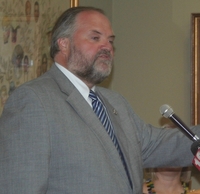
Rep. Daniel Bosley discusses the impact of the creative economy on the Berkshires at a Thursday press conference.
Stockbridge - As part of the continuing cultural renaissance of the county, members of the Berkshire legislature, the Massachusetts Cultural Council (MCC) and business and community leaders announced Thursday two components to help move the creative economy forward. Held at the Norman Rockwell Museum, the simultaneous announcement of a $100,000 MCC grant and the official formation of the Berkshire Creative Economy Council signals a commitment in the region to expanding and investing in the “creative cluster” - which includes nonprofit institutions, individual artists and commercial businesses that produce and distribute creative products and services. Officials feel this investment in the Berkshires’ creative efforts will stimulate job creation and economic growth. “The key to our economy is innovation and creativity,” said Rep. Daniel Bosley (D-North Adams), the House Chairman of the Joint Committee on Economic Development and Emerging Technologies. “We have a creative economy here and it enriches our lives, makes our lives better because we live out here.And, it’s a great place to be.” The announcements come following a March unveiling of the Berkshire Creative Economy Report, which outlined a strategy for developing and maintaining the Berkshires’ growing creative economy. The co-chairwomen of the Berkshire Creative Economy Project - Ellen Spear, president and CEO of Hancock Shaker Village and Laurie Norton Moffatt, director and CEO of the Norman Rockwell Museum - have created the Council from the project’s steering committee of entrepreneurs, artists and educators from the both profit and nonprofit sectors. The mission of the Berkshire Creative Economy Council (or Berkshire Creative) is to “spark innovative collaborations between artists, designers, cultural institutions and businesses with the goal of stimulating new job growth and economic opportunity in the region.” “The creative economy is about financing and capitalizing on Berkshire County’s unique strengths,” said Norton Moffatt. She said those strengths included the “sheer size and scope of the creative cluster,” the balance of rural beauty with proximity to cities and links to other key industries, like tourism, technology, education. The $100,000 MCC Adams Art Program grant will be used to support the Berkshire Creative’s efforts to stimulate economic development through the advancement of the creative cluster. “You’ve worked relentlessly, creating a vision for this region and I’m hoping this investment will help fuel that vision, make a reality, bring your vision to life,” said Anita Walker, the executive director for the MCC to the residents of Berkshire County. “You are a model for the state and your work is incredibly important for Massachusetts and this region.” Rep. Christopher Speranzo (D-Pittsfield), Rep. William “Smitty” Pignatelli (D-Lenox) and Sen. Benjamin B. Downing (D-Pittsfield) attended the press conference. “Art means business in the Berkshires. This was the key finding of the Berkshire Creative Economy Project. Creativity is a core competency and competitive advantage of a vibrant Berkshire economy that is recognized internationally for its creative brand,” said Norton Moffatt. Jen Thomas may be reached via email at jthomas@iberkshires.com or at (413) 663-3384, ext. 23
If you would like to contribute information on this article, contact us at info@iberkshires.com.

MassDEP Talks Pollution Plans for Pontoosuc Lake

By Breanna SteeleiBerkshires Staff
LANESBOROUGH, Mass. — The state Department of Environmental Protection has some options for restore a polluted Pontoosuc Lake back to health.
 
These were reviewed last Wednesday at a public information session.
 
Holly Brown, an analyst with MassDEP's Watershed Planning Program, said the lake is showing signs of nutrient pollution and eutrophication — a condition which promotes algae blooms, fish kills and dead zones — and cited recent algae blooms that resulted in public health advisories.
 
Matt Ladewig, principal scientist with TRC Companies of Windsor, Conn., explained the two different avenues Pittsfield and Lanesborough can take to help restore Pontoosuc Lake.
 
The two potential avenues include determining the lakes capacity for pollution (Total Maximum Daily Load) and developing a Nine Element Wastershed-based plan.
 
"The TMDL process is more formal and allocates pollutant loads to contributing point and non-point services in a way that will allow the water body to meet water quality standards," said Ladewig. 
 
A TMDL plan would identify the impairment, the causes and the pollutant load reductions. Following public comments, it would have to approved by the U.S. Department of Environmental Protection Agency to be eligible for grants. 
 
View Full Story

More Stockbridge Stories