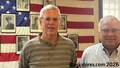
Roger Rees worked with Danielle Steinmann, Erica Lipez and Stephen Sanders to organize "The Unknown Monet Revealed," a dramatic reading of the painter's letters.
WILLIAMSTOWN - As part of a collaboration of two powerhouse arts organizations, the Sterling and Francine Clark Art Institute hosted nearly 150 people for "The Unknown Monet Revealed" on Monday night.
The Williamstown Theatre Festival’s Artistic Director Roger Rees joined actor and violinist Erica Lipez and the Clark’s assistant curator of education Danielle Steinmann for a dramatic reading of painter Claude Monet’s personal letters, written between 1864 and 1926.
“We really just wanted to explore Monet’s reasons for creating art,†said Stephen Sanders, the assistant to the creative director and general manager at WTF.
One of the most recognizable painters of the 19th and 20th centuries, Monet is considered one of the founder’s of impressionism, an artistic movement that centered on representing movement and light in artwork. The “Unknown Monet: Pastels and Drawings,†the Clark’s summer exhibition, displays more than 80 pieces of Monet’s work and challenges traditional ideas about the painter and his methods.
Rees gave life to Monet’s letters, which chronicled the journey of a man plagued by financial woes and struggling with acceptance both in his personal and professional lives. Using Monet’s own words, Rees revealed a truly emotional man who loved passionately, despaired deeply and wrote dramatically. Most famous for his tranquil paintings of nature scenes, Monet lived a tumultuous yet full life, dedicated to artistic pursuits until his last days.
“These are real letters by a real man,†said Rees after the performance. “He lived a rather poignant life and it’s truly moving to read his letters.â€
Collaborating for the third summer, WTF and the Clark aim to place art in context in a unique form, allowing viewers to create new connections and looking at art in a new way.
“The educational value of an event like this is priceless,†said Steinmann, who framed the reading of the letters by providing biographical information about the painter. “What we try to do at the Clark is to understand the human experience and allow people to get to know artists as humans.â€
“Going into the gallery and seeing a piece of art, I wonder ‘What motivates artists to create it?’ After a reading like this, you can go and see the human element in the painting,†said Sanders.
"The Unknown Monet" will be on display at the Clark through Sept. 16. The Clark is at 225 South St. The galleries are open daily from 10 to 5, and closed Mondays September through June. Admission is $12.50 for adults, free for children 18 and under, members, and students with valid ID. For more information, call 413-458-2303 or visit www.clarkart.edu
Jen Thomas may be reached at jthomas@iberkshires.com or at (413) 663-3384, Ext. 23.
If you would like to contribute information on this article, contact us at info@iberkshires.com.
Your Comments
iBerkshires.com welcomes critical, respectful dialogue. Name-calling, personal attacks, libel, slander or foul language is not allowed. All comments are reviewed before posting and will be deleted or edited as necessary.
No Comments
Williamstown Studying Major Overhaul for Main Street
By Stephen DravisiBerkshires Staff
WILLIAMSTOWN, Mass. — The town is working with a Worcester civil engineering firm to redesign Main Street with an eye toward a major project sometime in the next decade.
Community Development Director Andrew Groff was before the Select Board on Monday night to talk about Town Hall's use of a $500,000 state grant to do preliminary design on major improvements to that portion of Route 2 that runs from Water Street west to the Field Park rotary, through the middle of Williams College's campus.
Groff introduced the elected officials to Amanda Bazinet of Worcester's Vanasse Hangen Brustlin, who is helping the town to develop a plan for Main Street that would align with the commonwealth's Complete Streets Program.
"Our project goals, in addition to the increased pedestrian and bicycle accommodations, is just, in general, improving the sightlines and improving the intersection geometry," Bazinet said.
"Complete Streets … has a lot of different facets to it. As Andrew had mentioned, the goal is to improve the safety for all of the roadway users — not just the motorists. We're looking at improving it for pedestrians, bicyclists, anyone using a mobility device. We want to create streets that are safe for all ages and abilities to use. So, while bicyclists will still be allowed, legally, to use the roadway, we want to look at providing a separate bicycle accommodation along the corridor, whether it's a shared use path along both sides of the streets that is a little more accessible to young children or older people with disabilities to look at all transportation options."
One goal is to encourage "active transportation." The Massachusetts Department of Transportation, who the town hopes one day might fund the construction, has a "healthy transportation policy," Bazinet said.
That MassDOT funding would come through the Transportation Improvement Program, which is managed locally by the Berkshire Regional Planning Commission. The design work underway now is being done with an eye toward going after TIP funding years down the road.
The town is working with a Worcester civil engineering firm to redesign Main Street with an eye toward a major project sometime in the next decade.
click for more
The elevated bridge between the Clark Art Institute's main museum and the Manton Research Center is being transformed into new gallery space and storage, and the permanent home of the Aso O. Tavitian collection. click for more
Nearly 90 towns and cities across the commonwealth have voted in favor or replacing the seal, which depicts an arm holding a sword above the head of a Native American. click for more