Going, Going, Gone ... Brown St. Mill Bites the Dust
By Tammy DanielsPrint Story | Email Story
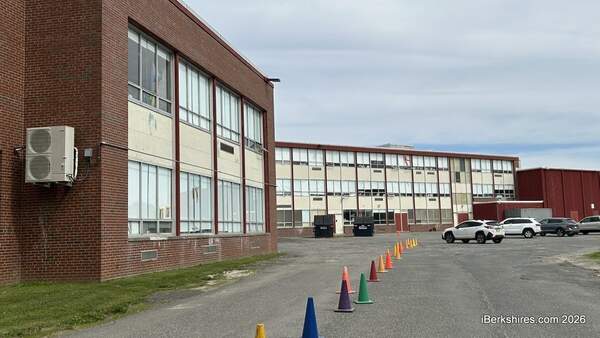
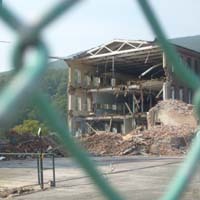
The old Sprague Electric mill on Brown Street is being demolished.
NORTH ADAMS - The former Sprague Electric Co. plant on Brown Street has slowly been disappearing over the past several months, taking with it a chunk of the city's industrial history. •Watch the video here The brick mill buildings are being demolished by owner Great American Financial Resources, which has no immediate plans for the property other than leaving it a vacant lot. The buildings have been empty since 2001, when Commonwealth Sprague - one of the last vestige's of the city's manufacturing titan - departed for Mexico. The polluted three-acre site has had environmental remediation done in the mid-1980s and over the last decade or so under the state Department of Environmental Protection. Most of that work has been completed. The structures were built in the 1870s as a textile mill; Sprague Electric took the property over before World War II and produced gas masks there. Later, the company manufactured metalized film paper for capacitors. Part of the property was used as an industrial landfill and, from the 1950s to the 1970s, drummed wastes containing trichloroethylene, or TCE, were dumped there. A 1983 preliminary assessment filed with the federal Environmental Protection Agency reported that 55,000 gallons of acids, solvents, TCE degreaser, ceramic sludge, aluminum oxide sludge, oily solid resins, paints, fly ash, and titanium and uranium oxides were dumped in the landfill on the property. Surface soil samples collected from the property between 1983 and 1995 indicated the presence of polychlorinated biphenyls and volatile organic compounds, all toxic materials. Contamination was found in homes on the outer edges of the property along Alton Avenue and Avon and West Main streets in the late 1990s. Great American, then known as American Annuity Group, bought and demolished 17 homes in the area. The toxic plume of groundwater seeping west from the site continues to be monitored. Sprague Electric once operated in the Beaver Street and the Eclipse mills, now both owned by artist and developer Eric Rudd, and in the main plant on Marshall street that is now the Massachusetts Museum of Contemporary Art. Hundreds of area residents worked over the years in the Brown Street plant for Sprague and its successor there, Commonwealth Sprague. The mill will soon be history so we are inviting local residents to post their memories of it on iBerkshires - what room did you work in? How many years were you there? What was it like? Click on the link below to post your memories of Brown Street.

If you would like to contribute information on this article, contact us at info@iberkshires.com.

BAAMS Students Compose Music Inspired By Clark Art

By Jack GuerinoiBerkshires Staff

BAAMS students view 'West Point, Prout's Neck' at the Clark Art. The painting was an inspiration point for creating music.
 
NORTH ADAMS, Mass. — The Berkshires' Academy for Advanced Musical Studies (BAAMS) students found new inspiration at the Clark Art Institute through the "SEEING SOUND/HEARING ART" initiative, utilizing visual art as a springboard for young musicians to develop original compositions.
 
On Saturday, Dec. 6, museum faculty mentors guided BAAMS student musicians, ages 10 to 16, through the Williamstown museum, inviting students to respond directly to the artwork and the building itself.
 
"As they moved through the museum, students were invited to respond to paintings, sculptures, and the architecture itself — jotting notes, sketching, singing melodic ideas, and writing phrases that could become lyrics," BAAMS Director of Communications Jane Forrestal said. "These impressions became the foundation for new musical works created back in our BAAMS studios, transforming visual experiences into sound."
 
BAAMS founder and Creative Director Richard Boulger said this project was specifically designed to develop skills for young composers, requiring students to articulate emotional and intellectual responses to art, find musical equivalents for visual experiences, and collaborate in translating shared observations into cohesive compositions.
 
"Rather than starting with a musical concept or technique, students begin with visual and spatial experiences — color, form, light, the stories told in paintings, the feeling of moving through architectural space," said Boulger. "This cross-pollination between art forms pushes our students to think differently about how they translate emotion and observations, and experiences, into music."
 
This is a new program and represents a new partnership between BAAMS and the Clark.
 
"This partnership grew naturally from BAAMS' commitment to helping young musicians engage deeply with their community and find inspiration beyond the practice room. The Clark's world-class collection and their proven dedication to arts education made them an ideal partner," Boulger said. "We approached them with the idea of using their galleries as a creative laboratory for our students, and they were wonderfully receptive to supporting this kind of interdisciplinary exploration."
View Full Story

More North Adams Stories