Judge Decides for MoCA in Artwork Dispute
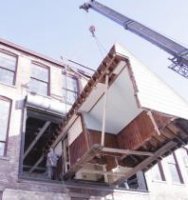 |
| The Houghton Street house is moved into Mass MoCA last year. (Vanessa Badino/Mass MoCA) |
NORTH ADAMS, Mass. — A federal judge ruled Friday that Massachusetts Museum of Contemporary Art has the right to show the unfinished work of Swiss artist Christoph Buchel.
Buchel had requested an injunction to stop the museum from letting the public see "Training Ground for Democracy," a massive work that includes a house removed from the bottom of Houghton Street. His attorneys indicated to The Boston Globe that an appeal is likely.
Judge Michael A. Ponsor of the U.S. District Court in Springfield cited Mass MoCA's financial investment in the artwork — some $300,000, double its original budget — and its help installing the work in his decision.
Buchel's attorneys had filed for an injunction based on the Visual Artists Rights Act of 1990, which is designed to protect artists' rights to their work and reputation.
Posnor, in his opinion, stated showing the unfinished installation would not harm Buchel's reputation.
"To show a work in an unfinished state contrary to the artist's wishes is a distortion of the highest order," Buchel attorney Mark Elliott told The Globe on Friday.
"We appreciate the thoughtful consideration that went into this complex case, and we are pleased with the court's decision," Mass MoCA director Joseph C. Thompson told The Berkshire Eagle on Friday. "We've exercised great care in dealing with these materials, and we are happy that the judge has granted us the right to continue to do so."
"Training Ground" has been wrapped up under yellow tarps for months in Building 5 after Buchel stopped work on the piece in a dispute over cost and materials. In addition to the two-story house, the exhibit includes a wrecked police cruiser, a section of the old North Adams Cinema from Curran Highway and hundreds of items donated by residents last summer. Mass MoCA spent some $30,000 installing a large exterior door on the second-floor of Building 5 to get some of the larger pieces into the building.
The work was to be Buchel's first major American installation. As the installation came together, the demands for materials and costs soared, say museum officials. Originally estimated at $160,000, the budget ballooned to twice that. Then Buchel reportedly demanded the fuselage of a 737 jetliner, which museum officials said they tried but were unable to acquire. Worked stopped when Buchel refused to return and finish the exhibit that was slated to open last December.
The pieces of the installation were wrapped in tarps and left sitting in the huge Building 5 gallery. Buchel claims the museum failed to hold up its end of an agreement that was apparently hammered out in conversations and emails. There was no single contract outlining the responsibilities for either party for the commissioned work.
In addition, Buchel says the museum violated his rights by allowing the public to see the unfinished work, specifically when officials escorted Gov. Deval Patrick through the installation this past winter. In May, the museum opened an exhibit, "Made at Mass MoCA," that could only be reached by walking through the tarp-wrapped Buchel installation and asked the court to allow the tarps to be removed. Buchel quickly filed a counterclaim, saying uncovering the work would violate his rights.
The art world has been keeping a close watch on the dispute between artist and museum, wondering if the court will set a precedent on which has the greater rights.
In an article published Sunday in The New York Times, art critic Roberta Smith came down hard on Buchel's side after viewing the covered detritus: "In the end it doesn't matter how many people toil on a work of art, or how much money is spent on it. The artist's freedom includes the right to say, 'This is not a work of art unless I say so.'"
Ponsor, who viewed the exhibit on Tuesday, said an unfinished work doesn't qualify for protection under the VARA.
"I approached this exhibition skeptically," he was reported saying in The Globe. But "I was extremely moved by this piece of art. It is very powerful. It is not particularly pleasant to walk through. It is the kind of art that wakes you up in the middle of the night."
The museum will have to post a disclaimer explaining that the work is incomplete if it opens the space. Buchel has until Monday at 5 p.m. to let the court know what else he would like included in the disclaimer. He also has until Monday to appeal the decision. Mass MoCA will decide Tuesday if it will show the unfinished work. The ruling also clears the way for removing the installation and making the Building 5 gallery available for upcoming exhibits.
Tags: mass moca,