State House News Service
BOSTON - Casino opponents and supporters pounced Thursday on Gov. Deval Patrick's plan to bring as many as three gambling resorts to Massachusetts, questioning Patrick's numbers and the mechanism he envisions for industry oversight.
Rep. Daniel E. Bosley, the House's leading gambling opponent, said the Legislature would seek "outside economic analysis" to compare against the governor's figures, which promise $450 million in annual net revenues and 20,000 permanent jobs.
"Every time we hear somebody talk about this, we hear something more added on," the North Adams Democrat said, pointing to promises of local aid, infrastructure, property tax relief, local mitigation and, jokingly, "cure intestinal disorder. This bill just does everything."
Patrick said he expects the 27 percent tax rate required of casino bidders under his 77-page bill will rise during the auction process, as the administration seeks to leverage the "highest and best value" clause in its casino bill to find the best deal for the state.
During a press conference in his office Thursday, after a herd of reporters was ushered in to find the governor and advisers sitting around a table hammering out final details, Patrick said he was unsure how a new casino network here would affect the existing racing industry.
"I don't know what the impact on the tracks will be," he said, adding that he expected some or all four of the eastern Mass. tracks to enter the license auction. Patrick downplayed suggestions he was facing a battle in the House. "I don't think it's true that the House is reluctant," Patrick said, adding that he saw both "skeptics" and "supporters" there.
House Speaker Salvatore DiMasi, D-Boston, has said he remains "skeptical," and Thursday laid out questions on cost-benefit lines.
Patrick demurred when asked about a possible Mashpee Wampanoag tribe effort to seek land in trust, saying he didn't think it "the right time to talk about that." A spokeswoman said the tribe may participate in the commercial auction, but believes the "best route" is to seek federal land in trust through its "sovereign rights."
Patrick said he expects $450 million in net revenues after setting aside funds for mitigation, public health, public safety, compensating for Lottery declines, and local communities. Casinos would be charged an initial fee over $200 million, and have to pledge at least 5,000 jobs.
DiMasi quickly outlined his own approach to the gambling proposal, of which he's been skeptical, publicly doubting whether Massachusetts should embrace a "casino culture." DiMasi said hearings on the bill would occur next year, and has said he is unsure whether a vote would happen before a new legislature takes office in 2009.
In a statement released by his office, DiMasi said, "The legislation filed by the governor today to allow casino gambling in the commonwealth will go through the normal, deliberative process in the House of Representatives. It will get a full, fair hearing and be properly analyzed and vetted, a process that cannot and should not be done hastily."
DiMasi added, "And why would we want to do something of this nature that will so dramatically change the landscape and image of our commonwealth?"
He said, "As we look toward hearings on this bill next year, the House will build on the success of programs like our economic stimulus and streamlined permitting laws that are already helping our economy grow. We will continue to focus on sustainable economic development options for the commonwealth, including targeted investments in emerging industries like life sciences and renewable energy."
Senate President Therese Murray, D-Barnstable, released a tempered statement in favor of casinos, but called Patrick's bill "just the starting point of a very long process."
She said, "We cannot continue to watch so much revenue moving out of the state. But any casino plan must protect local businesses and traditional cultural attractions that make the commonwealth a unique and desirable place to live and visit ... The bottom line is that we must proceed with caution. It is my intention to work with both the speaker and the governor to try and craft casino legislation that meets everyone's concerns and expectations."
Municipalities would have to approve casino plans through ballot referenda before a prospective owner entered the auction.
Administration officials would not be allowed to work in the casino industry until the end of a three-year cooling-off period. Authority officials and employees could not have an interest in the gaming industry for three years on either side of their service.
In keeping with Massachusetts law, smoking would be banned in the casinos, Patrick said.
A seven-member authority board would oversee the auction process and the industry's conduct, comprised of Patrick appointees, the state treasurer and auditor. A 12-member advisory council tied to the authority board, Patrick said, would be populated by "good, strong, stable citizens who understand this industry."
Touting policy benefits like property tax credits for almost 1 million homeowners of roughly $200, along with sustainable funds for transportation infrastructure, the administration is hoping to cobble enough support together to overwhelm the legislative leadership's coolness. Patrick aides are eyeing geographic strategies to build support, but the administration is still hoping a prominent state representative will emerge to champion the bill effectively.
Lawmakers who have held back on critiquing Patrick's plan until the bill was filed, which it was shortly after 5 p.m. on Thursday, began pressing their concerns.
Rep. Michael Costello, the Newburyport Democrat and House chairman of the Committee on Public Safety and Homeland Security, said he wants guarantees of "a great deal" and strong oversight, but would still harbor concerns over the fate of the race tracks. Costello said he would prefer that Patrick designate casino funds for public education, noting that his city recently closed an elementary school.
"Clearly, I understand that's an issue he campaigned on and believes in," Costello said of the governor's property tax relief plan. "For me, the local issue that matters more is education funding."
Treasurer Timothy Cahill, a casino supporter who has expressed skepticism about serving on the seven-member board Patrick envisions overseeing the industry, said in a statement released by his office that local aid provided through the Lottery was his priority, and that he knew the bill "could look quite different" after clearing the Legislature.
"In general, I'm not in favor of elected officials serving on the casino oversight board," said Cahill. "As Governor Patrick said, this should be a non-political authority, and the presence of elected officials automatically politicizes the board."
Several lawmakers said they were frustrated not to see a bill during business hours Thursday. "They hold a lot of press conferences," said Bosley, who worked briefly for the administration before opting to stay in the House. "It takes a while for us to get the bills, it seems like."
During a press availability in his office, Bosley told reporters he was surprised Patrick aides hadn't consulted further with lawmakers during the formulation of their plan, questioning their "back-of-the-envelope" calculations. He said he hoped an outside academic would conduct a "purely intellectual exercise" unbiased by prior leanings.
Bosley said Patrick aides have conveyed greater interest in a $1 billion life science plan that also sits in the Committee on Economic Development and Emerging Technologies, which he co-chairs and is likely to receive the casino bill.
"His No. 1 priority, they've told me time and time again, is the life science bill. The life science bill needs a tremendous amount of work," said Bosley.
Patrick has said he understands concerns with opening the state, which currently allows a Lottery, bingo games and racing, to casinos. His announcement in favor of casinos came in early September, after months of internal deliberation.
The League of Women Voters circulated documents Thursday citing analyses purporting to undercut Patrick's claims of economic benefits, including the assertion that $3 in associated costs account for every $1 in revenue.
If you would like to contribute information on this article, contact us at info@iberkshires.com.
Your Comments
iBerkshires.com welcomes critical, respectful dialogue. Name-calling, personal attacks, libel, slander or foul language is not allowed. All comments are reviewed before posting and will be deleted or edited as necessary.
No Comments
Springfield Man Charged for Murder in Friday Night Pittsfield Stabbing
PITTSFIELD, Mass. — A Springfield man is being charged with murder in the stabbing death of a 36-year-old city man on Friday night.
Zyrus Jaynes, 24, was charged with one count of murder, and is expected to be arraigned in Central Berkshire District Court on Monday, June 1.
Police did not release the name of the stabbing victim.
According to a police report by Lt. John Soules, officers responded to a report of an assault at a residence on Hall Place at about 10 p.m. on Friday.
The found the Pittsfield man "suffering from a life-threatening stab wound." First responders treated him and transported him to Berkshire Medical Center, where the victim died of his injuries.
As a result of the ensuing police investigation, which included cooperation from a number of witnesses, a suspect was identified and arrested the following morning.
While a suspect has been arrested, police say the incident is still under investigation in conjunction with the Berkshire County District Attorney's Office. Anyone who wishes to provide information is asked to contact Detective James Losaw at 413-448-9700, Ext. 572. Information can also be provided anonymously by texting PITTIP and your message to TIP411 (847411.)
Jason Codey struck out 13, walked two and allowed just an infield single as the Generals earned a 7-1 win over Wahconah to claim their third straight regional title. click for more
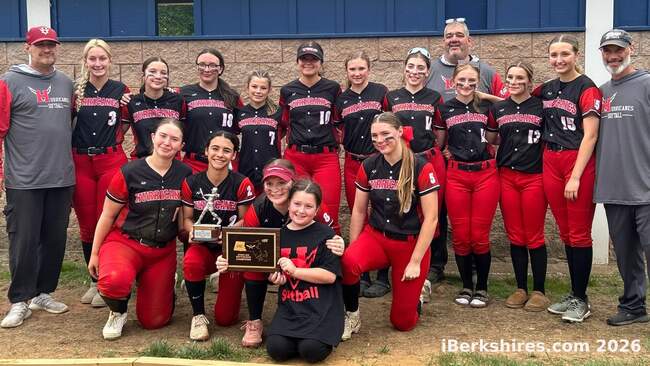
Gracelyn Wright struck out eight, and Genevieve Lagess went 3-for-5 with four runs batted in as the Hurricanes beat Monson, 17-3, to claim their first Western Mass title in four years. click for more
For the boys, Ward Bianchi helped lead the way with a win in the shot put and a second place in the javelin as the Mounties finished 16 points ahead of runner-up Pittsfield (pending the results of the pole vault, which were unavailable at 11 p.m. Friday night). click for more
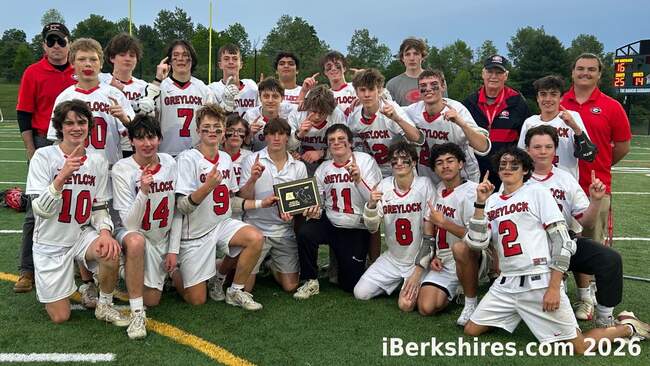
Brady Auger Friday scored five goals to lead the Mount Greylock boys Lacrosse team to a 16-14 win over Hoosac Valley in the title game of the Western Massachusetts Class C Tournament. click for more
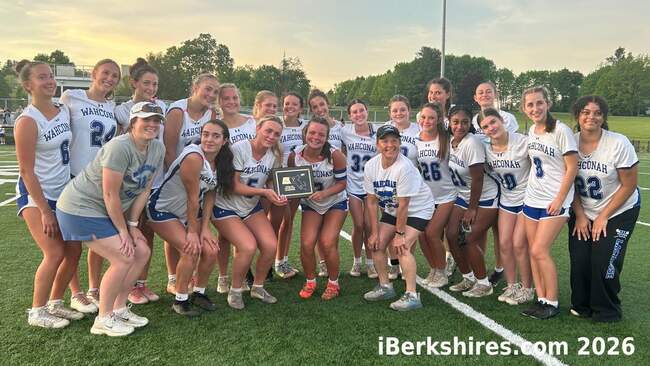
Brooke Harrington scored four goals, and Abigail Rodhouse had a hat trick as Wahconah won its second straight Western Mass title and the rubber match against the Mounties in the third one-goal game between the teams this spring. click for more