State House News Service
BOSTON - You can't always get what you want.
It's a lesson Gov. Deval Patrick is learning as lawmakers tinker with his life sciences initiative and continue to vet a number of his other initiatives, both low-profile (a volunteer corps) and high (destination resort casinos).
Over the summer, Patrick asked the Legislature to help him to lay the groundwork for his education reform effort. But the "mini-budget" he signed Friday after lawmakers sent it to his desk gives him about a fifth of what he asked for.
Patrick had asked for $4.6 million in education-related initiatives when he sent his request to lawmakers in June. In a $278 million budget bill that doesn't appear to fully account for last fiscal year's budget surplus, the Legislature included about $1 million worth of the initiatives Patrick had requested.
The budget bill includes $200,000 for a teaching and learning survey for teachers; $200,000 for the Readiness Project, the group Patrick established to craft his 10-year "cradle-to-career" education reform effort; and $600,000 in professional development funds for early education teachers, down from the $1.2 million Patrick requested.
The so-called mini-budget did include raises for the state's constitutional officers, including Patrick, and about $454,000 to satisfy his request to expand the state's Washington, D.C., office. Patrick, in a note to the Legislature, said he and Lt. Gov. Timothy Murray would refrain from taking the raises until an advisory board recommends it.
Left on the cutting-room floor: $2 million for dual enrollment, allowing high school students to begin college level course work in a college setting; $500,000 for a competitive grant program to stem the rapid rate of teacher turnover, a $350,000 job vacancy survey and $150,000 for a college readiness assessment grant program.
But the tone exuded by both sides, at least in inquiries over his education requests, is generally cordial.
Paul Reville, an education policymaker whom Patrick recently appointed to the state Board of Education and to the top of the Readiness Project's leadership, described the paring back of education initiatives from the "mini-budget" as a "balanced response."
Reville added the Legislature regularly exercises discretion in budget matters. The "key components," like the Readiness Project and the teachers' survey, were funded, he noted. "I think the Legislature was responding to what they thought was immediate and the most urgent," he said. "I think the important thing is it gives the governor the ability to move forward in several different areas. I'm sure the administration is grateful for that."
Others said it indicated the moves could represent how much traction the governor's education reform efforts are having. "In some respects, it is a gauge of the level of support for the governor's education policies in the Legislature," said Jamie Gass, director of education research and programs at the Pioneer Institute for Public Policy Research, a conservative-leaning think tank.
Lawmakers and their aides said that wasn't the case.
"In no way are the initiatives we're not including off the burner, so to speak," said Jim Eisenberg, spokesman for the House side of the Joint Committee of Ways and Means. "We certainly aren't making a statement for or against the policy of those initiatives that we did not address in the supplemental."
Added Rep. Patricia Haddad, D-Somerset, House chair of the Committee on Education, in a recent interview, "The things we did not address, we did not think they weren't good ideas."
Haddad, who is on the Readiness Project's 18-member leadership council, said the $2 million for dual enrollment was better suited for state's fiscal year budget, which won't be completed until next summer, instead of a mini-budget. The items that were left in were determined to directly affect education reform, she said.
Before Patrick signed the bill, his spokeswoman, Becky Deusser, noted in an e-mailed statement, "We are still reviewing the bill, but there are a number of shared priorities included in this budget. The governor looks forward to working with the Legislature as the Readiness Project continues to take a hard look at our education system and put together recommendations on how best to fulfill his vision for a world-class education starting before kindergarten through higher education and beyond."
Haddad said programs dealing with teacher turnover are included in a pair of bills before the committee, which also contain pilot programs for mentoring and other professional development. The bills (H.451 and S.284) establish a teacher, principal and superintendent quality endowment fund.
Funds for professional development for early education teachers, necessary as the state's moves toward a universal prekindergarten model, were reduced to $600,000 because that was what lawmakers thought the state could afford, she said, instead of the $1.2 million Patrick had originally requested.
Commonwealth Corp., a quasi-public agency, had recently done its own job vacancy survey, rendering Patrick's unnecessary, Haddad added. The funding in the mini-budget Patrick filed would have authorized the Executive Office of Labor and Workforce Development to create and administer a survey to 10,000 state employers to find gaps in the workforce and assess future demand for the secretariats.
In the meantime, the Readiness Project held its first public meeting earlier this month in Quincy, and a video of it is available on the governor's Web site as a podcast.
The education reform effort's leadership council met Oct. 16 at the Museum of Science. Patrick aides say the meeting of the council, which is expected to deliver recommendations to Patrick for next year's budget by December, was to be closed to the public.
If you would like to contribute information on this article, contact us at info@iberkshires.com.
Your Comments
iBerkshires.com welcomes critical, respectful dialogue. Name-calling, personal attacks, libel, slander or foul language is not allowed. All comments are reviewed before posting and will be deleted or edited as necessary.
No Comments
Lanesborough Town Meeting to Vote Budget, Bylaws & Vehicle Purchases
By Breanna SteeleiBerkshires Staff
LANESBOROUGH, Mass. — Tuesday's annual town meeting includes a $14 million operating budget, new short-term rentals, accessory dwelling units and sign bylaws, and free cash article appropriations.
Voters will gather at Lanesborough Elementary School on June 9 at 6 p.m. to decide on 20 warrant articles.
The fiscal 2027 budget is up a little over 10 percent. Some of the main increases are the Mount Greylock Regional School District and McCann Technical School: the McCann assessment is up more than 30 percent based on factors including enrollment and the school renovation project, and Mount Greylock's is up 11 percent.
Article 11 is for the town to vote to approve from free cash the sum of $16,298.48 for the McCann Technical School roof and window replacement project so as not to impact the budget. Article 3 is appropriate $7,586,284 for Mount Greylock Regional School assessment.
Another notable increase was in life and health insurance, showing an increase of about 26 percent.
Ambulance Director Jen Weber is planning 24-hour coverage, which means more staff and a hike in her budget. One of the articles asks the town to appropriate $234,100 to operate the Ambulance Enterprise Fund for salaries and expenses.
Many town departments are looking for new vehicles. The Fire Department is looking to replace its outdated 1996 fire engine. There are two articles related to the truck at a total of $813,366. Article 12 would transfer $225,000 from free cash into the Fire Truck Stabilization Fund; Article 13 would transfer $605,000 from the fund and authorize the borrowing of $208,366.08.
The total includes a $100,000 contingency cost to cover any additional costs if a 2026 model-year chassis cannot be secured before new emissions standards go into effect in 2027.
The board at its last meeting moved the $225,000 transfer to come before the borrowing article, changing the stabilization number. If the $225,000 is not voted on, then they will amend the next article's number on the floor, subtracting the $225,000. This shows the borrowing number significantly lower.
Article 17 asks for the transfer of $80,000 from free cash to replace a police cruiser.
Police Chief Rob Derksen's aim is to replace one vehicle every other year, meaning the oldest vehicle gets replaced about every 10 years.
He stressed that if delayed this year, the town may have to double up in a future year to get back on schedule, and that paying later usually costs more. The article will ask for $80,000 from free cash, the vehicles used to be funded by the BHRD.
Lastly, the Highway Department is looking to replace a 2014 International dump truck that will be a total of $330,000 and will take two to three years to receive.
Money will be used from last year's approval of $250,000 from free cash for the replacement of a 2012 highway front-end loader that was underspent $49,261. Town meeting is being asked to approve a transfer of $53,274.85 from free cash and the use of $227,464 from funds from the Sale of Town Real Estate to fund the balance.
Other free cash proposals include $1,200 to purchase software to support tracking and ongoing maintenance schedules of town-owned vehicles; $42,000 for the replacement of the Highway Department's storage shed roof, $200,000 to reduce the tax levy.
Cassidy Flynn scattered five hits in a complete-game effort in the circle as Lenox upset top-seeded Hoosac Valley, 3-2, in the quarter-finals of the Division 5 State Tournament. click for more
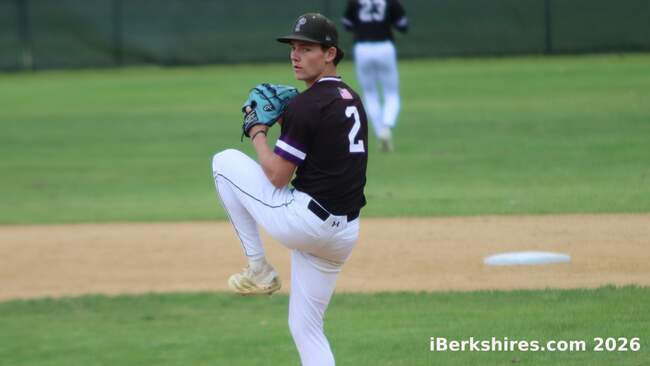
Brayden Durant struck out seven and walked one in a complete-game effort on the mound Saturday to pitch the Drury baseball team to a 6-0 win over Keefe Tech in the quarter-finals of the Division 5 State Tournament at Joe Wolfe Field. click for more
Jason Codey struck out 13, walked two and allowed just an infield single as the Generals earned a 7-1 win over Wahconah to claim their third straight regional title. click for more
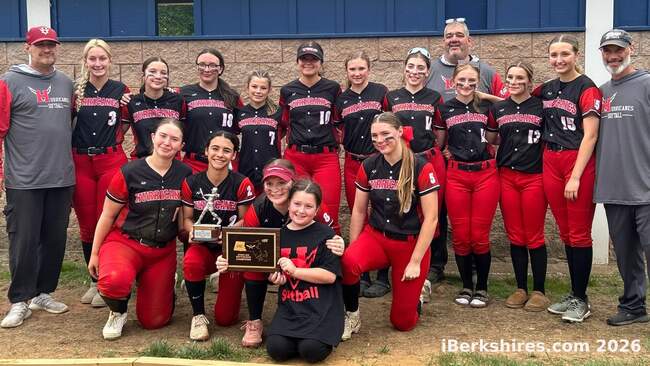
Gracelyn Wright struck out eight, and Genevieve Lagess went 3-for-5 with four runs batted in as the Hurricanes beat Monson, 17-3, to claim their first Western Mass title in four years. click for more
For the boys, Ward Bianchi helped lead the way with a win in the shot put and a second place in the javelin as the Mounties finished 16 points ahead of runner-up Pittsfield (pending the results of the pole vault, which were unavailable at 11 p.m. Friday night). click for more