State House News Service
BOSTON - One of the state's most promising industries got a boost Thursday as officials approved $20.2 million in funds for life sciences initiatives and announced plans to hire a health care industry policy veteran.
Movement on the state's fledgling life sciences initiative signals a kick-start for Gov. Deval Patrick's 5-month-old proposal to pump $1 billion of state funds into the Bay State's life sciences industry over the next 10 years.
Massachusetts is in a race with other states - including Connecticut and California - that have already doled out state funds to life sciences initiatives and that threaten to pull Bay State talent away.
"I am very cognizant of that threat," said Daniel O'Connell, secretary of the Executive Office of Housing and Economic Development, during a meeting of the state's five-member Massachusetts Life Sciences Center board. "We don't have to match [California] dollar for dollar but we have to show we are committed."
The board of the state's emerging quasi-public life sciences agency approved $12 million in research grants and $8.2 million to further two
University of Massachusetts stem-cell initiatives.
The Life Sciences Center plans to launch three, three-year grant programs by Dec. 2, said Patrick Larkin, deputy director at the Massachusetts Technology Collaborative. The grants, worth up to $250,000 annually, are
available to individual researchers, universities and industry, he said.
"The objective of these programs is to receive as many competitive applications as we can," said Larkin.
In addition, the board voted to approve $7.7 million for one year toward the establishment of a stem-cell bank at the University of Massachusetts Medical School in Worcester.
University officials hope that researchers from across the globe will agree to store stem-cell lines at the planned UMass central repository.
Harvard University and Children's Hospital of Boston have already pledged to store stem-cell lines at the bank, according to state officials.
UMass will also receive $570,000 to establish a stem-cell registry designed to establish a Web-based, searchable library listing of available stem cell lines for researchers.
The board also approved plans to staff up the center while it conducts a national search for a new executive director.
Board members voted to authorize O'Connell, who is also the chairman of the Life Sciences Center board, to hire Melissa Walsh, an associate at Partners HealthCare, as the center's new chief of staff. O'Connell is in the midst of negotiations on Walsh's salary and start date, said Kofi Jones, spokesman for the Executive Office of Housing and Economic Development.
The executive director's post remains open since Aaron D'Elia, a Mitt Romney appointee, resigned earlier this year. Representatives from recruiting consultants Russell Reynolds Associates, which was hired by
the board earlier this year, said they plan to meet with potential executive director candidates next month.
O'Connell said it will be "several months" before an executive director is hired.
Life-sciences industry supporters, including members of the Massachusetts Biotechnology Council who attended today's meeting, hope the state funding will attract federal research funding while sprouting biotechnology companies and creating jobs.
Kevin Casey, senior director of federal and state relations at Harvard University, said the combination of the grants, the stem-cell bank and
the stem-cell registry will make Massachusetts a "scientific tourist spot."
But there are a few roadblocks. Lawmakers in Connecticut and California have the same idea and began handing out state-sponsored life sciences grants earlier this year.
"This is [Massachusetts'] the life-science moment. The amount of money being distributed by other states is extensive," said Michael Collins, chancellor of UMass Medical School.
Hearing Set
Bay State lawmakers have yet to move on a $1 billion life sciences bill introduced by the governor in July. The bill is sitting in the Committee on Economic Development and Emerging Technologies, which is co-chaired by Rep. Daniel Bosley, D-North Adams, and Sen. Jack Hart, D-Boston. A public hearing on the bill is planned next week.
House lawmakers are looking to move on the bill "as quickly as possible," said David Guarino, spokesman for House Speaker Salvatore DiMasi, D-Boston. "We're looking at making a significant investment in the life sciences industry but we're also looking beyond that," he told the News Service.
The center was established as part of a 2006 economic stimulus law. The center is overseen by a board of directors that includes UMass President Jack Wilson and Jay Gonzales, undersecretary for administration and finance.
If you would like to contribute information on this article, contact us at info@iberkshires.com.
Your Comments
iBerkshires.com welcomes critical, respectful dialogue. Name-calling, personal attacks, libel, slander or foul language is not allowed. All comments are reviewed before posting and will be deleted or edited as necessary.
LANESBOROUGH, Mass. — Town meeting on Tuesday approved an almost $14 million fiscal 2027 budget, and approved bylaws for short-term rentals and signage, and for public safety vehicles.
Of the 20 warrant articles, one, Article 7, to use free cash to pay prior fiscal year bills of $941.27 was indefinitely postponed by Moderator David Rolle because the bills were for the fire association.
Some 247 of the town's more than 2,600 registered voters filled Lanesborough Elementary School, debating articles during a meeting that lasted more than three hours.
The town's 2027 spending plan is up more than 10 percent, with the main increases from higher enrollment in the regional schools and the McCann Technical School renovation project.
Voters approved the assessment of $7,586,284 for Mount Greylock Regional School. They also approved Article 11, which was the use of $16,298.48 in free cash for the McCann's roof and window replacement project so as not to impact the budget.
Ambulance Director Jen Weber is planning 24-hour coverage, which means more staff and a hike in her budget. Article 5 asked the town to appropriate $234,100 to operate the Ambulance Enterprise Fund for salaries and expenses, which passed.
Fire Chief Jeff DeChaine spoke to the audience on his articles and the need for a new truck to replace the 1996 fire truck, listed on the warrant articles for a total $813,366, which includes a $100,000 contingency cost on whether a 2026 model-year chassis can be secured before new emissions standards in 2027. If they get the 2026 chassis, that contingency likely won't be needed.
Cassidy Flynn scattered five hits in a complete-game effort in the circle as Lenox upset top-seeded Hoosac Valley, 3-2, in the quarter-finals of the Division 5 State Tournament. click for more
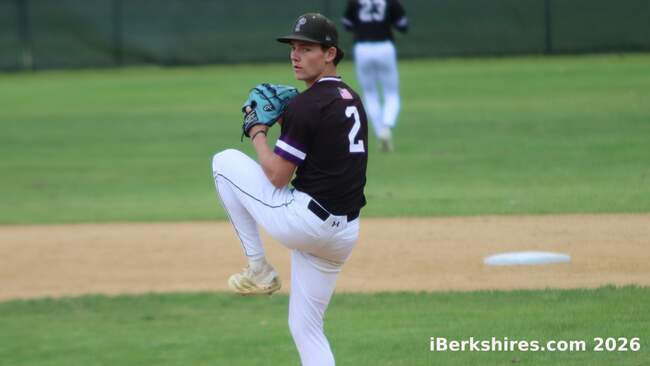
Brayden Durant struck out seven and walked one in a complete-game effort on the mound Saturday to pitch the Drury baseball team to a 6-0 win over Keefe Tech in the quarter-finals of the Division 5 State Tournament at Joe Wolfe Field. click for more
Jason Codey struck out 13, walked two and allowed just an infield single as the Generals earned a 7-1 win over Wahconah to claim their third straight regional title. click for more
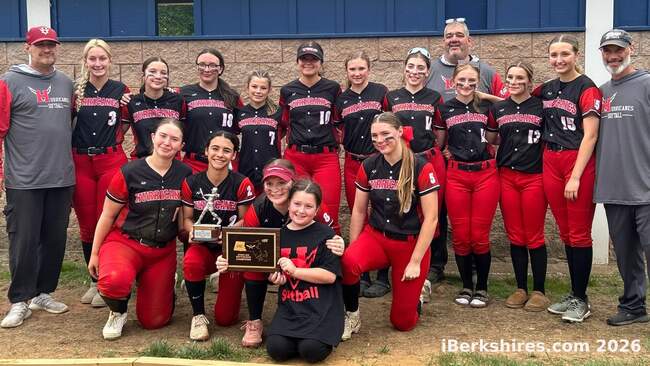
Gracelyn Wright struck out eight, and Genevieve Lagess went 3-for-5 with four runs batted in as the Hurricanes beat Monson, 17-3, to claim their first Western Mass title in four years. click for more
For the boys, Ward Bianchi helped lead the way with a win in the shot put and a second place in the javelin as the Mounties finished 16 points ahead of runner-up Pittsfield (pending the results of the pole vault, which were unavailable at 11 p.m. Friday night). click for more