WILLIAMSTOWN - Williams College's collection of rare documents of the nation's founding will be moving to a temporary home soon.
The Chapin Library, where the Declaration of Independence is exhibited, will close Jan. 1 in preparation for the estimated $55 million expansion of Stetson Hall.
The archives and special collections in Stetson will be packed up and the bulk stored at the college's off-site shelving facility being built at the former Berkshire Ivy Gardens property on Simonds Road. The Declaration and other historic documents will be exhibited at the Williams College Museum of Art during the three years of construction on the new facility.
College Librarian David Pilachowski said a relatively small, "working" portion of the archives will be available at the former Southworth School, which is used as housing by the college. Several vacant apartments will be used for storage, offices and a reading room that will be ready by the fall semester.
"Then, in 2011, we will return about 75 percent of the Chapin and archive collections to the new library building," said Pilachowski on Friday.
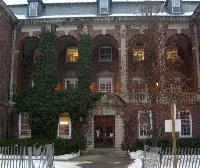
They will return to an airy, five-story, glass-enclosed library and technology center being built on the back of historic Stetson Hall. The new structure will replace the increasingly obsolete Sawyer Library, which will remain open during the construction.
In a recent presentation to the college community, Pilachowski said, "what we've tried to do is make a building that's very logical, to make the building people-friendly."
The layout of Sawyer and the accumulation of books and other resources were pushing the people who use the library out of the picture, he said. The new building is designed to address Sawyer's "chopped up" collection and make the library more efficient and user-friendly.
Pilachowski was joined by architects from the building's designer, Bohlin Cywinski Jackson, including Russell Roberts, principal of the project, and Lee Clark.
Instead of being faced with the daunting stairway entrance of Sawyer, the new building will be entered through a soaring atrium on the first floor of Stetson, leading into the new space past a circulation area.
Four stories will include a consolidation of the college's information technology services, meeting, classroom and study areas, a cafe and computer labs. The fifth floor will basically be a seating balcony overlooking the fourth-floor, described as the "catbird" seat for readers seeking privacy and a great view out the floor-to-ceiling windows.
Utilities, elevators and restrooms will be placed in a core area running parallel to Stetson. The archives and special collections will be situated in Stetson and in the new structure. Nearly half the second floor will be used by the Center for Media Initiatives, which offers computer, printing and multimedia services.
The building will take advantage of the steep slope behind Stetson to keep its profile low relative to the older building. While the building's back, or east, glass-fronted face will be dramatic, the architects have tried to keep its front face from overpowering the 1923 Stetson Hall.
The approximately 180,000 square-foot structure would extend out from either side of Stetson, farther on north side than the south. From the perspective of someone walking toward the entrance, the south side would almost disappear, lessening the visual impact.
The front exterior of the new building will likely be faced with green slate and the "core slice" extending beyond it, with brick.
"There seems to be wide support to use the grey-green slate," said Pilachowski on Friday.
The three-decade old Sawyer will be demolished to create an open space linking the new Paresky Student Center to Stetson and the two new office and classroom buildings that frame the Stetson entrance. Those buildings are now under construction; the entire project is estimated at about $128 million.
The facility on Simonds Road, expected to be completed in May, will be used to store much of the college's periodical and government documents collections after the new library is completed.
"The next step is for the architects to do detailed drawings," Pilachowski said. Cost estimates will based on those drawings. The college will review the estimates and make changes where necessary before the final plans are approved, he said.
Construction is expected to start by next fall. For more information, http://library.williams.edu/newlibrary/
If you would like to contribute information on this article, contact us at info@iberkshires.com.
Your Comments
iBerkshires.com welcomes critical, respectful dialogue. Name-calling, personal attacks, libel, slander or foul language is not allowed. All comments are reviewed before posting and will be deleted or edited as necessary.
No Comments
Mount Greylock School Committee Moving Superintendent Evaluation to Fall
By Stephen DravisiBerkshires Staff
WILLIAMSTOWN, Mass.—The Mount Greylock Regional School Committee this month discussed moving its evaluation of the superintendent from the spring to the fall starting in 2027.
Chair Julia Bowen brought the idea to the table as part of her proposed calendar for the committee's work during the 2026-27 academic year, saying that a move to the autumn will allow the committee to factor data from the preceding year into its evaluation.
"To the extent that [Superintendent Joseph Bergeron's] goals are tied to school performance and, specifically, MCAS [scores], we don't get that or other end of school year summative information until the fall," Bowen said. "Many schools I've worked with and know of actually moved their school leader evaluation to the fall so they can take advantage of all the data that's actually available, rather than doing it in the June time frame.
"The other point on that is, as it is, we otherwise vote for Joe's goals in September/October and evaluate him in May, and that's not a year. If we can do it fall to fall, we actually get a full year of work from when we agree on the goals."
The committee's most experienced member, Carolyn Greene, raised a concern about breaking with the practice of completing the evaluation process in May and June.
"It feels natural to evaluate a superintendent at the close of a school year, not the beginning of a school year," Greene said. "We're still in it in May and June. We're still in it in terms of our mindsets. Sometimes we don't meet in July. We come back in August and do a ‘retreat.' We're now meant to hit the ground running with an evaluation in September based on the work of the previous school year. And the reason is we don't get all the data from the previous school year until September.
"The rhythm is off for me. But it could just be that I'm so used to the previous rhythm. I don't want to oppose it. I just do have some reservations about it."
Umlauf and fellow veteran Charles Roberts sat down at the Michael Kennedy American Legion Post 152 headquarters to talk about what the Hometown Heroes banner program means to them and how much they look forward to seeing the program come to the northwest corner of the commonwealth. click for more
Hoosac Valley High School has postponed this weekend’s football games following a reported alleged hazing incident involving a large number of football players, the athletic director announced Friday afternoon. click for more
Dozens of Muslim Americans were among people killed in the Sept. 11 terrorist attacks. Untold numbers of Muslim Americans have suffered countless acts of discrimination in their aftermath.
click for more