Patrick Touts Education Plan at Allendale
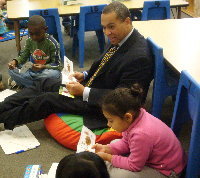 |
| Gov. Deval Patrick reads in kindergarten. |
The investment is worth it, said Patrick, for the students, for economic development and for quality of life in the state. He again called on the Legislature to push through his education and economic initiatives.
"It's about the importance of considering in this and all other cases the cost of inaction," said the governor, repeating a theme from his State of the Commonwealth speech last week. "What it means if we don't take advantage of some of the opportunities in front of us."
Patrick's brief comments to the media followed a visit to several classrooms at Allendale to see pupils and teachers at work.
Sitting on the floor with Nancy Knauth's kindergarten class, the governor learned a few words along with children in his circle and took his turn in reading aloud from "Peg the Hen."
<L2>In Marcia Cassavant's third-grade class, the children each recited a stanza of the state's official poem, "Blue Hills of Massachusetts" by Katherine E. Mullen, to the governor. The school had only found out Wednesday that he was coming, said Cassavant, so the children had worked very hard to memorize the verses.
They made it through with only a few stumbles, and four of the children recited their "I Have a Dream" for making the world a better place. Hope Daniels, who is visually impaired, presented Patrick with a card and bracelet with the help of classmate Rachel Martindale.
It was all work in Susan Dabson's class. The fourth-graders showed Patrick how they worked through a problem using three different methods. "And you all come up with same answer?" asked the governor. Oh yes, they assured him.
While the governor was interested in their lessons and whether they liked what they were doing, some of the children were more interested in getting his autograph than asking him questions.
Fourth-grader Matt Barry got a double coup when Patrick signed a picture of himself signing Matt's arm cast at last year's Fourth of July Parade.
"I was playing soccer and fell down and twisted my arm," explained Matt as he carefully placed the 8x10 into an envelope. The cast is long gone, but the autograph remains.<R3>
The pupils lined the halls as Patrick walked out, occasionally stopping to shake hands or say word or two to a particular child.
"The time he spent in this school, you can't put a price on that," said state Sen. Benjamin B. Downing, D-Pittsfield, adding that maybe there were kids here who didn't know the heights they could reach in life before the governor came through.
It's "remarkable young people" like these that the administration's initiatives are designed to help succeed, said Patrick.
"There will be those who say that it is money we should not spend," he said. "But consider for every poor kid who has an opportunity to experience high-preK, they are 40 percent less likely to need special education services or repeat a grade, 30 percent more likely to graduate high school and twice as likely to graduate from college.
"If we invest on the front end we save substantially on the back end."
His education plan also includes creating an Executive Office of Education headed by a secretary of education that will, Patrick said, provide a more coherent policy coordination from prekindergarten through college.
<L4>Also in the spending plan is a $368 million increase in overall funding and $3.9 billion in Chapter 70 education aid. He proposes investing another $5.5 million for underperforming schools and districts and an additional $2 million toward MCAS support programs. There is funding to help high school students gain college credits, $234 million for the Circuit Breaker fund to alleviate special education costs and $81.7 million for charter school reimbursements.
Beyond education, Patrick said initiatives such as the $1 billion life science bill and $25 million broadband bill will drive investment and help the state become at least "recession resistant."
Legislative leaders, while open to the governor's education program, have balked at his budgeting of $300 million in licensing fees for casinos that do not yet exist.
Patrick said part of the fees would fill a one-time gap in lottery aid to cities and towns; his budget is balanced on a half billion in cuts in other areas and the closing of corporate loopholes.
"I am calling on the Legislature to engage with us," he said. "We have put ideas on the table. If you have better ideas, bring them to the table."
Mayor James Ruberto said he was "particularly pleased" with the governor's plans for Chapter 70 aid, and for a municipal act that would allow cities and towns to set meals and hotels taxes.
"The municipal act offers an opportunity to try to move revenue streams in other directions than on property owners," he said. As for gambling, "I think Palmer is a great place to put a casino - and send the money back to Pittsfield."
Downing said there was a need to work together for the benefit of all.<R5>
Patrick wrapped up his visit with a grilling from two fifth-graders chosen to ask questions that their class had worked on.
"Don't hide your light under a barrel," he told Megan Pedersen after she asked what one thing he would say them. It was an expression, he explained to her, that his grandmother often used. "Let that passion out, make the most of your opportunities and let people see what you care about."
But Thomas Koslaw made him pause, for the young boy asked what Patrick wanted to be remembered for once he was out of office.
"That's a hard question. ... What you're really asking ... is what I want my legacy to be," said Patrick, who is beginning his second year in office.
"I hope it is, in general, that the people of Massachusetts, including the young people of Massachusetts, have raised their own expectations of themselves in education ... and the way we act as members of the commonwealth."