Wireless Initiative Reaches $1M Goal

Staff reportsPrint Story | Email Story
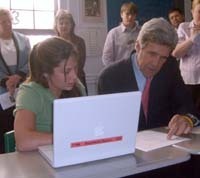
Conte student Stephanie Sacco shows Sen. John Kerry her math assignment using a wireless laptop last fall.
PITTSFIELD - Three years after its inception, the Berkshire Wireless Learning Initiative has reached its private sector fundraising goal of $1 million.

With a final donation of $100,000 from Burger, run by Spice restaurant owners Joyce Bernstein and Lawrence Rosenthal, the initiative has raised $1,040,650 in total since January 2005. BWLI is also funded with state dollars and money from each participating school district.

"The local business community has provided very generous support to the Berkshire Wireless Learning Initiative," said Perri Petricca, co-chairman of BWLI's fundraising committee and president and CEO of Petricca Industries, in a statement released Tuesday. "They recognize the value of giving our students the tools they need to solve problems, conduct research and communicate effectively. These are skills that will serve students well throughout their education and as members of the work force."

The initiative has distributed laptops to more than 2,300 students at Reid, Herberg, St. Mark middle schools and St. Joseph's High School in Pittsfield and Conte Middle School in North Adams as part of a pilot program that "tests a 1:1 approach (one laptop for every student and teacher) of using laptop computers and wireless communication to transform teaching and learning."

Born from a collaboration of Berkshire Connect Inc., Massachusetts College of Liberal Arts, the Massachusetts Technology Collaborative and the Berkshire Chamber of Commerce, BWLI aimes to improve students' academic and research skills, help them learn to work more effectively in groups and enhance their creativity.

Announced on Tuesday night at a ceremony at Spice restaurant, reaching the fundraising goal allows BWLI to complete its pilot program.

Following this school year, after the pilot program has concluded, the participating schools plan to continue using laptops on a 1:1 basis in the middle schools, according to the statement. High schools are also being considered for future laptop initiatives.


BWLI utilizes Boston College's Technology and Assessment Study Collaborative, part of the Lynch School of Education, to evaluate the pilot program in the following areas:

  • Enhanced student achievement as shown through test scores, grades, and assessments;

  • Increased student engagement as shown through attendance, disciplinary data, and classroom participation;

  • Fundamental changes in teaching strategies, curriculum delivery methods, and classroom management;

  • Enhanced capabilities among students to conduct independent research and collaborate with peers.

    According to a news release, to date, BWLI evaluation results show that middle school students regularly use technology to take notes in class, complete practice tests, write and edit papers, create spreadsheets and find information on the Internet. The release further states that teachers report that the increased access to technology has resulted in improved student engagement and enthusiasm, a willingness of students to write more frequently, and an overall improvement in students' work across all major subject areas.
  • If you would like to contribute information on this article, contact us at info@iberkshires.com.

    Social Service Organizations Highlight Challenges, Successes at Poverty Talk

    By Brittany PolitoiBerkshires Staff

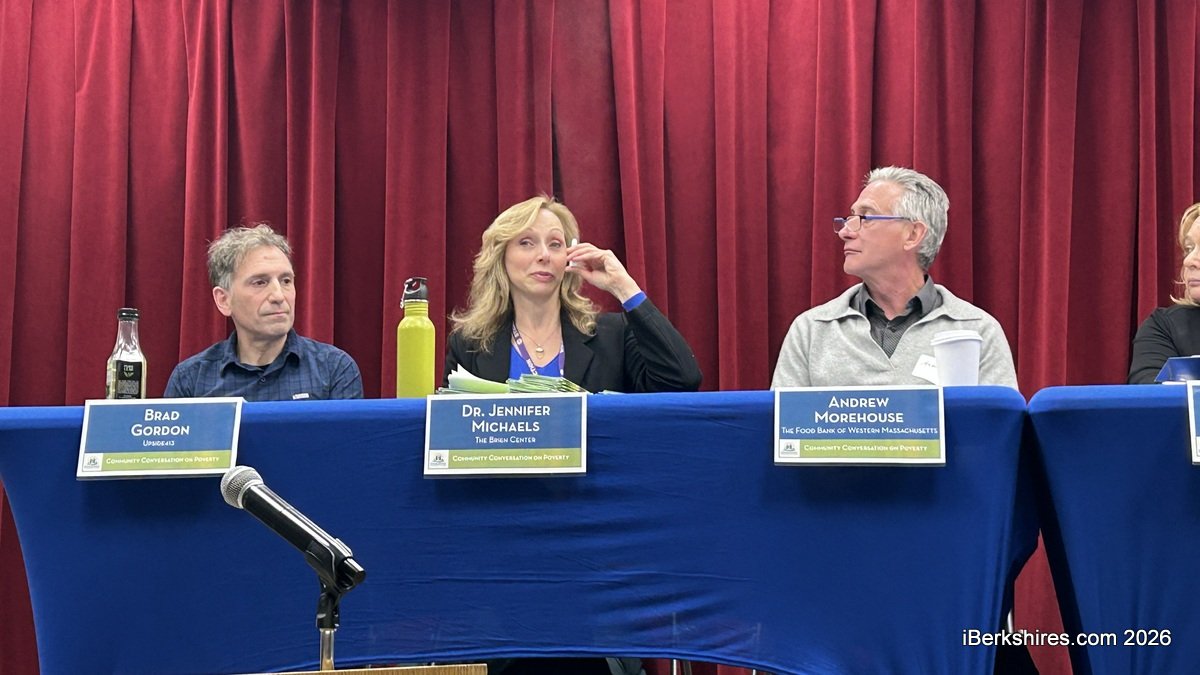
    Dr. Jennifer Michaels of the Brien Center demonstrates how to use Narcan. Easy access to the drug has cut overdose deaths in the county by nearly half. 

    PITTSFIELD, Mass. — Recent actions at the federal level are making it harder for people to climb out of poverty.

    Brad Gordon, executive director of Upside413, said he felt like he was doing a disservice by not recognizing national challenges and how they draw a direct line from choices being made by the Trump administration and the challenges the United States is facing. 

    "They more generally impact people's ability to work their way out of poverty, and that's really, that's really the overarching dynamic," he said. 

    "Poverty is incredibly corrosive, and it impacts all the topics that we'll talk about today." 

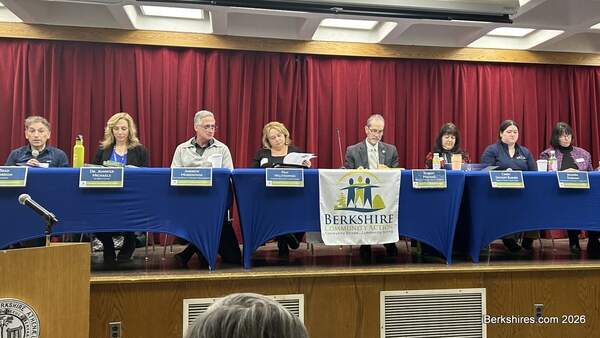
    His comments came during a conversation on poverty hosted by Berkshire Community Action Council. Eight local service agency leaders detailed how they are supporting people during the current housing and affordability crisis, and the Berkshire state delegation spoke to their own efforts.

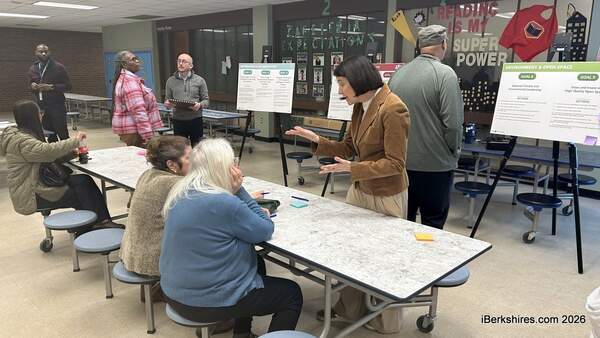
    The event held on March 27 at the Berkshire Athenaeum included a working lunch and encouraged public feedback. 

    "All of this information that we're going to gather today from both you and the panelists is going to drive our next three-year strategic plan," explained Deborah Leonczyk, BCAC's executive director. 

    The conversation ranged from health care and housing production to financial literacy and child care.  Participating agencies included Upside 413, The Brien Center, The Food Bank of Western Massachusetts, MassHire Berkshire Career Center, Berkshire Regional Transit Authority, Greylock Federal Credit Union, Massachusetts College of Liberal Arts, and Child Care of the Berkshires. 

    The federal choices Gordon spoke about included allocating $140 billion for the U.S. Immigration and Customs Enforcement, investing $38 billion to convert warehouses into detention centers, cutting $1 trillion from Medicaid over 10 years, a proposed 50 percent increase in the defense budget, and cutting federal funding for supportive housing programs. 

    Gordon pointed to past comments about how the region can't build its way out of the housing crisis because of money. He withdrew that statement, explaining, "You know what? That's bullshit, actually."

    "I'm going to be honest with you, that is absolute bullshit. I have just observed over the last year or so how we're spending our money and the amount of money that we're spending on the federal side, and I'm no longer saying in good conscience that we can't build our way out of this," he said. 

    Upside 413 provided a "Housing Demand in Western Massachusetts" report that was done in collaboration with the University of Massachusetts at Amherst's Donahue Institute of Economic and Public Policy Research. It states that around 23,400 units are needed to meet current housing demand in Western Mass; 1,900 in Berkshire County in 2025. 

    View Full Story

    More Pittsfield Stories