Clarksburg Votes for Stipend Changes
 |
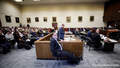
| Selectmen Chairwoman Debora LeFave explains Article 5. |
Article 5 on the warrant raised some stipends and lowered others; it added about $435 to the town's budget for the coming fiscal year. It was put forth by both the Selectmen and Finance Committee. Less than three dozen of the town's 1,052 voters bothered to attend.
The small group of board members, many of whom had served for decades, claimed the measure was slighting hard-working officials.
"This is not a salary. It's just a way of giving you something for being in these positions," said Selectmen Chairwoman Debora LeFave. "They were all over the board; some very low for people who did a lot of work and some very high for people who met once a year."
But Board of Health Chairman Joseph Mondia objected to the proposal, which saw his stipend cut from $806 to $560 and his colleagues from $724 to $460.
His board had requested $967 and $869 for chairman and members, respectively.
Mondia wanted to know what the basis for the new stipends was, "how did you do the math? How did you decide these boards here are very high and these are very low?"
He strenuously objected to the decision to make the bulk of the stipend based on attendance at meetings. With the exception of the Selectmen (at $400 and $200), elected board chairs will receive $200 and members, $100. After that, all members will receive $30 per meeting based on the board's normal schedule.
Each board would decide itself what constituted an "unexcused absence" and denial of the meeting stipend; the minutes would determine who was — and who wasn't — there.
LeFave and Selectmen Carl McKinney said getting the meeting minutes was a matter of accountability to town's citizens and that both the Planning and Health boards had the ability to raise fees to cover their services if needed.
"We're trying to get uniformity and to provide the town with the minutes of those meetings, of what was discussed, what votes were taken, who was there," said McKinney. "We've have instances were people have been elected — I'm not pointing any fingers or naming any names — who have not shown up for years."
"You're punishing rest of us for a couple people," said Mondia, arguing that "people making decent money ... making decent benefits" weren't putting in their hours at Town Hall. He also claimed the Selectmen "closed down for a month in the summer."
McKinney responded that there were only two salaried people working in Town Hall — that everyone else was elected and didn't have to be there every day.
"If they're elected they don't have to do anything," he said. "They don't have to show up at all. That's the whole crux of the issue. Once they're elected they're there for the whole term ... we can't do anything to them."
His voice growing angry, he said there were instances during the summer months when nothing was going on and there was no reason but meet, but that the board spends long hours working on the budget during the winter. "Your' TV goes off at 7 o'clock and we're still there."
"I bust my but for this town. I take calls from my house for this town," said McKinney, adding that the Selectmen and Finance Committee don't get a lot thanks. "We try we make do with what we got. I take offense, I've never missed a meeting. Never."
Timothy Shea of the Planning Board said the stipend structure would hurt the town's ability to find candidates, a problem and reiterated Mondia's complaint that serving on boards required a lot of time.
Moderator Bryan Tanner called the question to vote over the objections of the men. It passed by a count of hands, 18-7.
Passed by voice vote:
- A town budget of $962,068
- A school budget of $2.3 million
- An assessment to McCann Technical School of $156,000
- A $2,000 line item to remove the little bridge to the town field and reconfigure the pathway