MCLA Eager to Start Science Building
 |
"I'll know it's a done deal when we're standing out there with shovels in the ground," said Grant on Wednesday, "and if I had my way, we'd be out there tomorrow."
She won't have to wait long. The money is in a $2.2 billion higher education bond bill that was signed by Gov. Deval Patrick today. He said on Tuesday night that he was a firm supporter of the center. "I've talked with Mary about this," he said, after a town meeting in Great Barrington.
MCLA plans to use the funding to build a state-of-the-art Center for Science and Innovation that will house its science and research programs and bring them into the 21st century.
"To have the number get to this level, $54.5 million, is just so exciting and so significant for the college, for the community, for the county, for the commonwealth," said Grant.
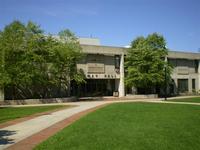
Although the right level for resources, in Grant's opinion, is $60 million, she acknowledged that the school is much closer than when the funding was at approximately $22.8 million. At the time, the college planned to renovate and add on to a building already on campus, considering an addition to Bowman Hall. The school's Web site still contains an architectual rendering from its 2007 master plan. Those plans changed after the increase in funding. Now, the school would like to construct a stand-alone building.
James Stakenas, vice president of administration and finance, credits Grant for the increase in funding. He believes that she "has done a fabulous job for the institution" bringing the college's needs to the Legislature.
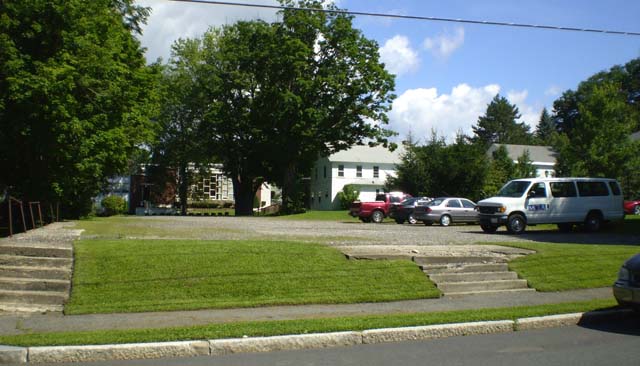 One possible site for the new MCLA science center is the vacant lot next to the admissions office. One possible site for the new MCLA science center is the vacant lot next to the admissions office. |
It's still early and the timeline isn't yet clear, but the school wants to get started as soon as possible. The first hurdle will be getting on the priority list, as public colleges across the state will also be trying to get their projects done.
"We need to work as hard as we have to this point to get our project to the front of the pack," Grant stressed.
Now the bill is signed, the next step is the design phase. The president believes that work could begin on design as early as fall. The school will be working in partnership with the Division of Capital Asset Management, or DCAM, a state agency.
Affect on the College and the Community
"This will be the single largest investment in public higher education in Berkshire County ever," said Grant.
She believes the new center will allow the region to be competative. The programs will aim to prepare MCLA students for growing life-science fields in the workplace and in graduate schools.
For the liberal arts college, the center will provide a place to have all the science programs under one roof. Stakenas said the Center for Science and Innovation gets its name from the innovative way of giving the connected departments — biology, chemistry, environmental studies, math, physics and psychology — a space to collaborate.
There will also be an opportunity to develop the spaces where the laboratories used to reside. (Labs currently are in Bowman and Venable halls.) After the center is built, those former lab rooms will support other programs on campus, such as more student-centered spaces. But Grant maintains that part of the project would come later, and that these are "multiyear projects."
Both Grant and Stakenas want the science center to look modern and to capture attention while complementing the campus environment. The administrators plan to use what other colleges of the same size have done as models. Faculty and students have already given input on what they would like to see in the new science center.
English professor Harris Elder, who has been at MCLA since 1978, isn't sure what innovation means in the new science center's name, but he recognizes the importance the center will have on the college. "We need the sciences."
He also spoke about the school's outdated labs and the need for improvements. "We'd be a better college because of it," said Elder.
Grant is also concerned with energy conservation and wants the new building to be a "model of green technology."
The college has yet to decide where to build the new center. Once the project gets under way, the school will conduct a feasability study to help identify an appropriate space, taking into acount factors such as utilities and traffic flow. Grant and Stakenas discussed possible sites and suggested that the parking lots past Smith House on Church Street or the dirt lot next to admissions might be used.
The higher education institution has seen the sciences as one of its strongest growing enrollment areas. It plans to offer new courses; existing curriculum will also be affected, with science programs, such as environmental studies and the athletic training program, expanding their course offerings. The college will also look to re-establish a chemistry major.
"We have a pretty clear picture of what we think we need in the building," said Stakenas. Those needs include state-of-the-art laboratories, research areas, student study spaces, conference rooms and classrooms.
Along with labs, MCLA, a partner with the Berkshire STEM (Science, Technology, Engineering and Math network) project, envisions the new center having a STEM resource library available for area K-12 partners and for students and teachers. Grant emphasized, "We all need to be working together."
Update on Berkshire Towers Construction
MCLA is renovating the Berkshire Towers residence hall, located on Church Street. Passers-by will notice the large amount of exterior work being done during the next three weeks.
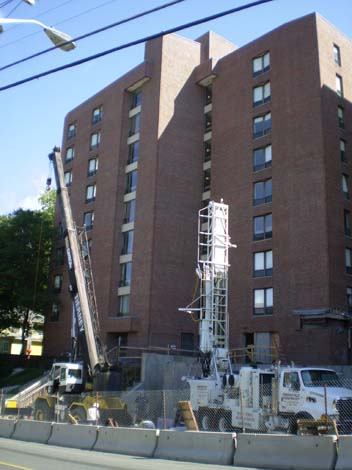 Work is continuing on the Berkshire Towers; below is an artist's rendering of the completed project. Work is continuing on the Berkshire Towers; below is an artist's rendering of the completed project. |
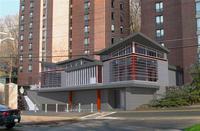 |
Construction crews are working on the building's new entryway and plan to have a safe entrance available for students who start moving in on Aug. 31. Part of the work will be aimed at making an easier drop-off area for cars, which previously had to double park on the street.
The interior work will be done during the semester and students will undoubtedly be affected. It will be "a little clumsy," said Grant, but she is confident that the students will appreciate the results. Along with a new entryway, undergrads will see new programming space, meeting rooms and improved common areas and laundry facilities. Also, both towers will now be occupied completely by students. (Some faculty offices were being housed in B Tower because of the renovation of Murdock Hall.) Grant expects that any problems from the construction will be handled smoothly by the residence hall staff.
The president forsees construction being finished by the first of the year and said the towers will have a more modern look and feel.
The residence hall isn't the only campus area with contruction going on. Last year, the school's library was renovated and it will continue to be worked on. In addition, MCLA recently purchased the old Notre Dame rectory in downtown North Adams to be the new alumni building. Offices in Eldridge Hall, where the president's office is located, is seeing yet more work.
"Being in construction challenges an institution, but that's a good challenge," said Grant.