image description

Bridge Work At Hand; Hadley Overpass Ready for Its Makeover
By Tammy DanielsiBerkshires Staff
Print Story | Email Story
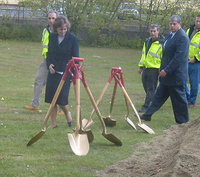
MassHighway Commissioner Luisa Paiewonsky and Mayor John Barrett III at Thursday's groundbreaking.
NORTH ADAMS — Deval Patrick wasn't even governor when he got his first tour of North Adams' own crumbling "Green Monster" — the Hadley Overpass.

"He wants to shake hands in Pittsfield and the mayor and I got him climbing around underneath the bridge and telling him we can't have any of this falling down on the Freight Yard Pub," laughed state Rep. Daniel E. Bosley, D-North Adams, on Thursday. "I'd see him afterward and he'd say, 'I've been thinking about that bridge,' and I'd say, 'Yeah, sure ya have.'"

Fast forward two years, and the $24 million bridge project is being touted as a model by the Patrick administration for moving such construction faster and more efficiently through the bureaucratic pipeline.

From February 2007, when Massachusetts Highway Commissioner Luisa Paiewonsky first surveyed Berkshire County's longest span to the ceremonial groundbreaking on Thursday afternoon, was a matter of 19 months.

Paiewonsky said the transportation agencywide initiative is designed to fast-track highway and bridge projects by reviewing and analyzing designs and questioning better ways to make them happen. The state hopes to cut planning time by 40 percent and save millions in inflationary costs. Paiewonsky estimated it cut the development time for the Hadley Overpass in half.

"It takes a lot of time and a lot of effort and this is an example of what we can do when we set our minds to it," she said, noting that the bridge is the first project ready for construction through the streamlining process.

Photos by Tammy Daniels
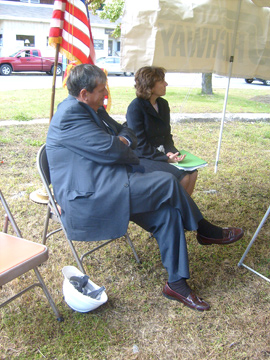
The mayor, with his MassHighway hard hat, and Paiewonsky.
Over the past 18 months, the city and state officials, consultants and designers have worked closely to move the project forward, a turnaround from past disappointments. "We kept the lines of communication flowing," said Paiewonsky.

Her commitment to the bridge earned glowing praise from Mayor John Barrett III. "She's my favorite highway commissioner," he said, noting she was at least the fourth he'd known since the state had been approached about fixing the massive span almost two decades ago. "When we started talking about streamlining the process, that was back in February 2007. That's remarkable in the state of Massachusetts ... it took 10 years from start to end for the Veterans Memorial Bridge."

Paiewonsky returned the compliment, thanking the mayor for his contributions to the bridge's decorative design. She named him an honorary project member and presented him with a MassHighway hard hat. She later described the bridge as the mayor's — "Once we're done with it."

The last significant work on the nearly 68-year-old bridge was back in the late 1970s, when the deck was replaced. Since then, plans to tear it down and replace it were abandoned as too difficult (the city took apartment houses down just south of the bridge years ago to make way for a temporary bridge that went nowhere) and various proposals for repairs never got far.

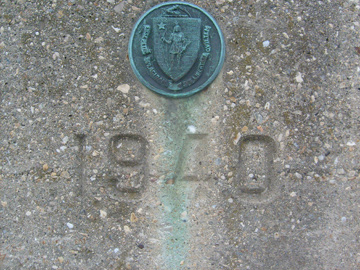
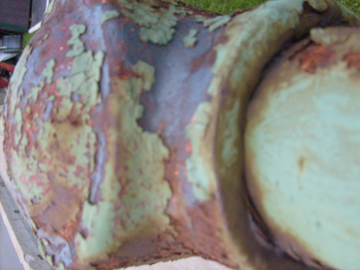
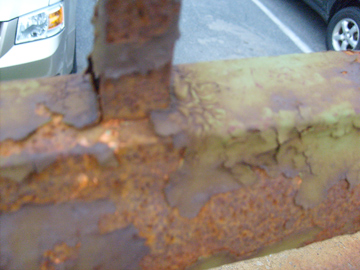
This despite aggressive lobbying by the mayor and local lawmakers as the bridge continued to deteriorate. A few years ago, the state began wrapping the underside because pieces were falling off, the pedestrian stairs had to be closed off for safety purposes and the green paint is peeling, turning the 940-foot span into rusty eyesore.


Scenes from
the Bridge
"This has been really an embarrassment to the city," said Barrett, describing it as a distraction from the views of the city's famous steeples and the work that has gone into beautifying the downtown. "Image is so important when you talk about economic development, when you talk about bringing people to your city."The groundbreaking event was held under a canopy at the corner of Christopher Columbus Drive. City and state officials and representatives from various companies involved in the project were in attendance, including state Sen. Benjamin B. Downing, D-Pittsfield, Highway District 1 Director Peter Niles, James Maxymillian of contractor J.H. Maxymillian Co., and Freight Yard Pub owner Colleen Reinhard, who's eager for the bridge above her parking lot to be fixed.

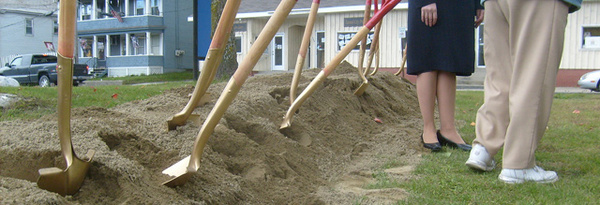
About a dozen officials pitched in with the traditional golden shovels to toss some dirt piled up for the occasion.

"MassHighway has a very special feeling about bridges," said Paiewonsky. "They're not just steel and concrete structures — they are important community links, often historic community links ... they are not just there to carry traffic."

Some 12,000 vehicles pass over the state-owned bridge daily. Categorized as "functionally obselete," MassHighway plans to restore and upgrade the structure that spans the Hoosic River and B&M Railroad in stages over the next 3 to 4 years. The bridge will not be closed; traffic will use one lane. It is to be funded through the 2008 Transportation Improvement Program for the Berkshire Metropolitan Planning Organization.

Paiewonsky and Barrett said they were confident that Maxymillian would be able to complete the project ahead of schedule based on past performance. The designer is the internationally known Louis Berger Group. Project manager is Tracy Wu.

Barrett said the bridge's industrial green will be replaced by a "nice maroon" with some black decorative elements and pole lighting. "It's going to be beautiful."

Work will not begin until after the Fall Foliage Festival Parade on Sunday. The annual event travels over the bridge, which connects Route 8 to the downtown.

Barrett said it was possible the governor would make the parade and get a chance to march over the old bridge before construction begins. "We have to give a great deal of credit to the Patrick administration," he said, adding less than 3 percent of the state's total vote is in Berkshire County.

"I can't wait to see it completed," said Paiewonsky. "I look forward to seeing you all at the ribbon cutting."

Updated on Oct. 4 to clarify the Hadley Overpass will not close during reconstruction.

If you would like to contribute information on this article, contact us at info@iberkshires.com.

Why the Massachusetts Art Community Is Worth Continued Investment

By James BirgeGuest Column
How do we quantify the value of art on society and culture? Even eye-popping figures, like the $100 million estimate for the jewels stolen from the Louvre, or the record auction last fall that saw a piece by Gustav Klimt sell for more than $236 million can't fully account for the value of the history, stories, and emotions behind the creations themselves. But beyond that, there is a measurable financial, cultural and social benefit of the arts that is often taken for granted. 

Closer to home, arts and cultural production in the Commonwealth of Massachusetts totals nearly $30 billion annually, representing more than 4 percent of the state's economic output, according to the Mass Cultural Council. All told, more than 130,000 jobs are spread across the commonwealth creating a vibrant and thriving artistic community for us all to enjoy. 

Despite the obvious impact, these figures are under threat. A recent survey by MassCreative compiled recent federal cuts to the National Endowment for the Arts, the National Endowment for the Humanities and the Institute of Museum and Library Services and identified 63 grants canceled and $4.2 million in grant funding rescinded across New England so far this year. 

The dollars, of course, are important. But they also only scratch the surface on what they bring to the community. Today, we risk losing part of the culture and identity many now take for granted. 

While others choose to look past these less tangible, but just as vital benefits, we're doing the opposite. Massachusetts College of Liberal Arts is all in to ensure the next generation retains their access to works of art, while also being empowered to create themselves. 

Last fall, MCLA officially broke ground on the new Campagna Kleefeld Center for Creativity in the Arts, which will serve as a new hub for the campus and the local community for arts programming. When complete in fall of 2027, our students will benefit, but so will all of Berkshire County and artists in the surrounding area. 

This exciting new facility is just one of the many forthcomings our region can enjoy in the coming years. Just a few miles away, anticipation builds for the Fall 2027 anticipated opening for the Williams College Museum of Art. Years in the making, the museum likewise grows from an enduring commitment to the arts, both in curriculum and in practice. Exciting times are also underway for the Clark Art Institute with the construction of a new facility to house a collection of 331 works of art, including paintings, sculptures, drawings and other works. Their wing is scheduled for completion in 2028. And listeners will no doubt enjoy the sounds and melodies from Mass MoCA Records, the latest endeavor to foster creativity and artistic pursuits through music launched in October as well. Of course, many are also awaiting the reopening of the Berkshire Museum anticipated this summer, after a tremendous renovation process to rejuvenate the experience for visitors. 

So much time, energy, and yes, dollars, have already been invested in taking these facilities from ideas and sketches and making them reality. But they represent much more than new buildings. They represent new opportunities to cultivate and accelerate the thriving arts community in Massachusetts and the northern Berkshires. 

Art, regardless of the medium, is a reflection of who we are, where we've been, and what we aspire to be. It can be inspired by hopes or fears and chronicle collective triumphs as well as tribulations. The goal of art is not only to document history, but to inspire those positioned to change it and to feel something new or even to provoke us to revisit our own assumptions or misconceptions. 

As unfathomable of a number as $30 billion can seem, boiling down the impact to any number inherently discounts the unknowable downstream effects our graduates will bring to the community and the broader world after they leave our institutions. Likewise, rescinding $4.2 million now removes a huge chunk of that growth potential.  

Justification for making these investments today when simply boiled down to dollars and cents still places us on solid ground strictly from a financial perspective that forgoes all of the intangible, but no less valuable, benefits as well.  

The arts are still worth our support. And our community will be richer for it. 

James Birge, PhD, is president of Massachusetts College of Liberal Arts in North Adams.  


View Full Story

More North Adams Stories