Downing: 'No Legs' for Mileage Tax
 |
WILLIAMSTOWN, Mass. — There are a number of changes proposed to repair the state's ailing transportation system but a controversial plan to tax mileage use through "chipped" inspection stickers won't be one of them.
State Sen. Benjamin B. Downing assured constituents gathered at Williamstown Town Hall on Friday morning that mileage tax doesn't "have any legs in the Legislature whatsoever."
The proposal floated by Gov. Deval Patrick and based on experiments in other states would charge drivers a quarter-cent a mile by tracking their mileage use through a global positioning system. Advocates say the system would protect privacy but others describe it as Orwellian. It's even been raised by the new U.S. Secretary of Transportation Ray LaHood — only to be immediately shot down by the White House.
"I think you are encroaching upon our right to be free to travel where we want without Big Brother looking over my shoulder," said Robert Cardimino of North Adams. "They talk about [President] Bush and wiretapping, but the governor's going to do the same thing."
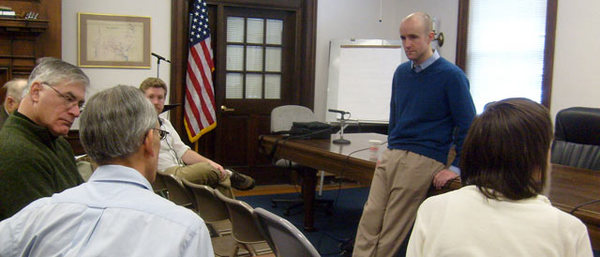
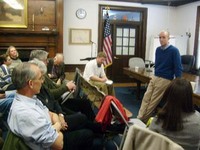
Speaking to about a dozen people gathered for one of the senator's "Coffee & Conversation" meetings, Downing said he's fielded calls from constituents wondering why the governor would even propose such a thing.
The Pittsfield Democrat believed the governor floated the improbable plan in response to the projected decline in gasoline use: "People are driving more fuel efficient cars because of public policy."
 iBerkshires
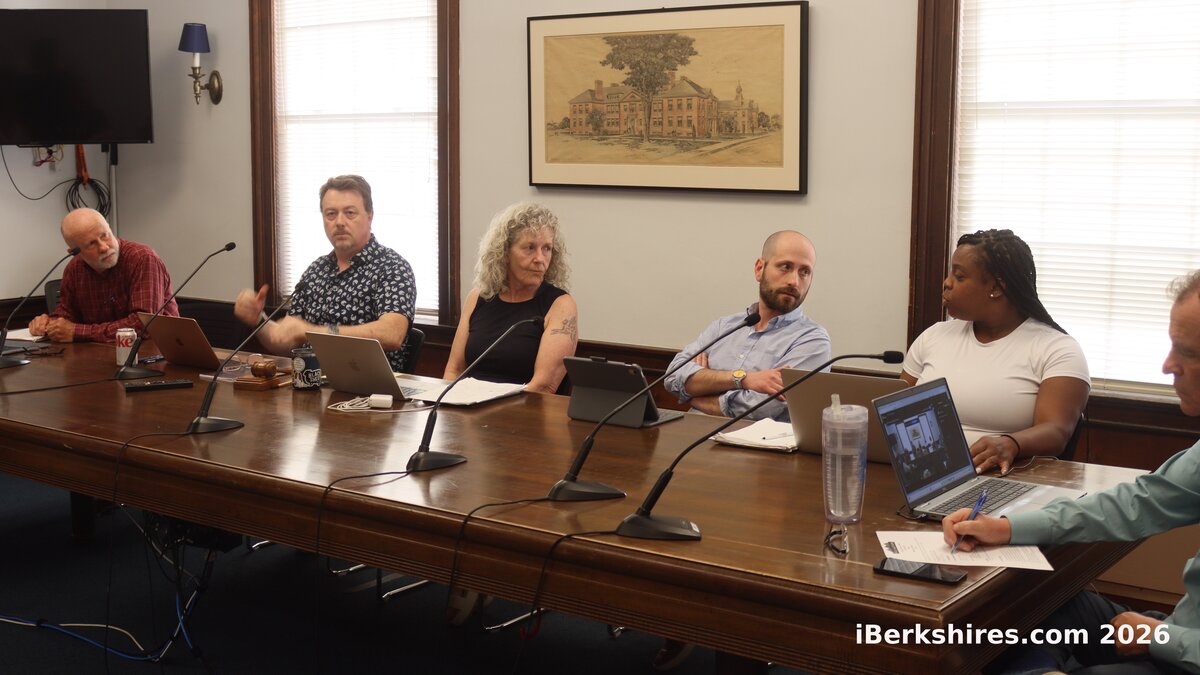
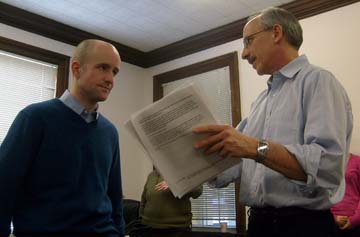
Sen. Benjamin B. Downing discusses health care with local chiropractor Peter May at a meeting with constituents Friday in Williamstown. |
The restructuring plan would streamline the multiple tranportation agencies into four departments all overseen by an Executive Office of Transportation and shed 300 jobs. The governor also pledged changes to the Massachusetts Bay Transporation Agency's "23 and out" retirement program, the use of police as flaggers, eliminating toll takers and other structural reforms that could save $2.5 billion over 20 years. (For more on transportation reform, click here.)
"Cost overruns and shoddy oversight on the Big Dig have shattered the public's confidence in the public transportation system in Massachusetts," Patrick said in prepared remarks. "And every time we hear another story about a toll taker pocketing tolls or a police officer protesting civilian flaggers or a state worker collecting one pension from the T while earning another in state government, the average citizen just gets madder."
Downing, chairman of the Senate Revenue Committee, said reform had to come before revenue. For instance, paying people to collect tolls is costly and outmoded, but the state has to find another way to collect those tolls. It also has to find a way to pay for the system without impinging on people's privacy.
"It's not happening tomorrow and it's not happening this session," he said of the mileage fee. "However, we are going to have to come up with a more reliable source of revenue for our roads and bridges in the long term."
Downing also touched on a host of issues, including health care reform, budget troubles, broadband and the possibility of casinos again being raised in the Legislature. He acknowledged that the loss of Rep. Daniel E. Bosley as House chairman of the Joint Committee on Economic Development and Emerging Technologies was a blow to the casino opponents and that in the Senate, he was in the minority.
Still, the economic downturn hasn't helped gambling advocates' position: Connecticut casinos that had promised more jobs through expansion haven't lived up to the hype. The region, he said, "is soaked when it comes to casinos ... you're not going to see the thousands and thousand of jobs or revenue — promises made around the issue can't be made in this economy."
The entire conversation was recorded by Willinet.