Organic Farmer Touts Benefits of Soil-Building
 |
It sounds like apostasy but Bill Duesing says it's more important to feed what's under them.
"Feed the soil not the plants and the soil will feed the plants," the executive director of the Northeast Organic Farming Association told a roomful of gardeners searching for the secret to safely growing luxuriant flora.
The session last week at Massachusetts College of Liberal Arts was the seventh workshop in the "Green Living" seminars being presented by the college's Berkshire Environmental Resource Center. Held on Thursdays in Murdock Hall, the workshops focus on sustainable issues.
Some 25 students and local residents were at Duesing's "Soil Building Techniques" workshop, and the organic farmer seemed pleased with the turnout. Duesing, of Connecticut, has been involved in organic farming and sustainable agriculture for more than 35 years and has lectured and written about it throughout the region.
"It is great to see your interest in things green," he said, adding he would begin with a "big picture" overview because "the Earth is the only place we can live."
Back in the 1960s, the planet's population as a whole only used about half what the Earth produced. Now, the nearly 7 billion use about 25 percent more than what is produced each year, said Duesing, which is causing global warming and other problems.
To understand the United State's large ecological footprint, the home-gardening advocate referred attendees to www.rprogress.org and similar sites. And understanding how everything fits together in ecological terms aids is in imperative in organic farming.
"Organic principles are a holistic method that pays attention to the whole system — where things come from, where they go and the effects at both ends," he said. The basic principle in working with soil is "to learn from nature, disturb as little as possible and keep the soil covered with a diversity of plants."
There's life in soil — more than 6 million organisms can be found in a handful of good dirt. It has the ability to store resources, he said. "Simple fertilizers added to soil will not get the same nutrients out of the soil as when you use organic ... Nature creates beauty even in decay."
That means avoiding pesticides and chemical fertilizers that kill the microorganisms; instead, natural composting should be feeding the life in the soil, which will help provide the nutrients required by plants. Chemicals can also be absorbed by the plant and into our food chain.
Many of those attending the hourlong talk questioned Duesing about their own gardens, an aspect of the series that Katherine Montgomery of North Adams found particularly helpful.
"I only missed one of the series this year. It is a very interesting series that allows you to also ask specific questions like I asked tonight about turning a grassy area into a garden," she said. "[It] excites me in looking ahead for my gardening, which I have been expanding these past few years."
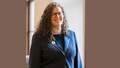
 Taking notes as Duesing, top right, lectures on building up soil. |
The seminars may be changing the way people look at living green, and it's guaranteed in at least one instance.
Josh Williams of Lanesborough graduated from MCLA a year ago, but he's become so interested in environmental studies after attending the "Green Living" workshops last year for credit and all but one this year that he's changed his career focus.
Now he's planning to get hands-on experience in a farming program out west. "[The series] is a great asset to the community that is free," he said. "Anyone can attend and it offers local people a chance to learn how to do [sustainable living]."
Plus, Williams said, it's a chance to network and meet people in the field like the local beekeeper, Tony Pisano, and hear about more events.
Elena Traister, an instructor in environmental science and coordinator of the series, said she's pleased with the success of the series.
"Students are exploring ways of increasing the sustainability of our food system while at the same time working on proposals to expand the MCLA campus garden and composing programs as well as working collaboratively with Reach for Community Health on its community garden program," she said. "We are also reaching out beyond the student body to local residents in new ways through not only our publicity for this series but also by broadcasting the series on local television and posting podcasts of the events online."
The next workshop, on genetically modified crops, will be held Thursday, March 26, at 5:30 p.m. in Murdock Hall's Room 218.
Podcasts can be found by clicking on the desired Green Living seminar on the right side of this page. Sessions are also broadcast on Northern Berkshire Community Television Corp.