School Project Takes Abbott Kids Into Deep Water
 Photos by Kathy Keeser
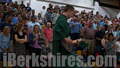
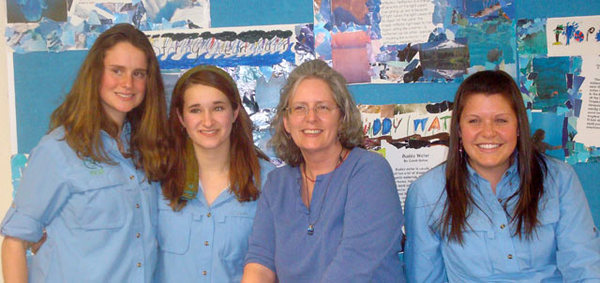
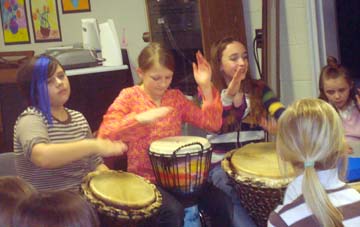
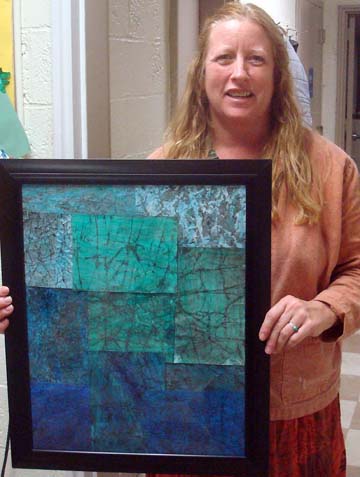 Gabriel Abbott School kids try their hands at African drumming, part of the school project on water issues in West Africa. Right, Principal Heidi Dugal and the collage masterpiece she won at an auction to raise funds to drill a well in Burkino Faso. Top, teacher Lori Austin, center, with three Americorps volunteers. Gabriel Abbott School kids try their hands at African drumming, part of the school project on water issues in West Africa. Right, Principal Heidi Dugal and the collage masterpiece she won at an auction to raise funds to drill a well in Burkino Faso. Top, teacher Lori Austin, center, with three Americorps volunteers. |
A schoolwide project at Gabriel Abbott Memorial School to raise awareness about water usage in the United States helped raise funds to build a well in an impoverished village in Burkino Faso, a nation in the western part of Africa.
Completed on March 20, the project raised a little more than $1,200 to be used directly for building the well, said fourth-grade teacher Lori Austin, coordinator of the project.
"We are solving the water crisis one well at a time," she said. "Everyone at the school is so excited that we did so well, we went beyond our expectations in our fundraising for this important project."
Burkina Faso is a small, arid, landlocked country of approximately 14 million, which UNESCO cites as the third poorest in the world. The people there experience "economic water scarcity" — fresh water is physically present in the land but the citizens do not have the economic means to obtain it.
Students in the seventh and eighth grades found in their research that water sources are few and far between and, as a result, women and children devote many hours of their day (an average of 26 percent of their time) walking a distance of three to five miles, often several times a day, to collect water.
The water is often polluted or contaminated and they have to carry it in buckets that weigh up to 40 pounds.
It's not just Burkino Faso that's feeling dry; there is a worldwide water crisis. Although three-quarters of the Earth's surface is made up of water, only 2.8 percent of the world's water is available for human consumption.
In fact, each year more than 3 million people die from water-related diseases. Sadly, most — 84 percent — of deaths are in children ages infant to 14. These are some of the facts brought out in a poignant documentary made by three eighth-graders: Brandon Field, Kyle Crosier and Joshua Kanitrut.
Their work was shown to the more than 100 people on the evening of March 20 and premiered at the Technology Conference at Massachusetts College of Liberal Arts earlier that Friday.
The project, "Water, Water Everywhere and Not a Drop to Drink," was spearheaded by Austin after she heard a presentation at the North Adams Public Schools' 10th annual Service-Learning Conference at Massachusetts College of Liberal Arts last November.
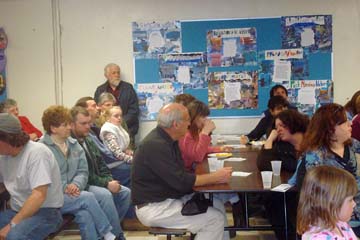 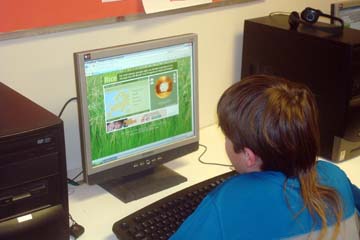 Community members listen to results of the water project; left, doing research on the computer. Community members listen to results of the water project; left, doing research on the computer. |
The schoolwide project was developed after research and further contacts with the Anahatas, who live in the Berkshires and raise awareness and funds when not in Burkina Faso working directly on their well drilling and other projects.
Pupils from preschool to eighth grade were involved in the project with oversight by Austin and the help of three Americorps/Student Conservation Association members assigned to the school through the state Department of Conservation and Recreation.
Lindsey Campana, Laurie Terry and Aja Mathews worked with the school's teachers and staff and in classrooms on projects including African batik painting; water-filtration systems; a bottled water challenge; posters about the color of water; writing invitations to the culminating event; PowerPoint presentations; brochures on local water conservation and bulletin board and poster displays.
Terry said this project stands out for her because she never had a good global sense when in elementary school while these children were given perspectives that helped them understand a faraway situation.
"The sixth-graders' eyes were really opened through a simulation exercise of carrying buckets of water and what that would feel like if they had to do it themselves," she said.
"It's good to connect the global with the local as we did in this project by going to the water treatment facility in Williamstown and looking at the devastating process of our use of bottled water," said Mathews. "Especially in the shipping and transporting phases of the process."
Pupils in Austin's class said they learned a lot about bottled water. "A lot goes into making bottled water," said Jacob Oakes. Makenzie Wright said, "It's a good thing to show people how drinking water in bottles gets to them, that the steps in the getting bottled water [energy and resource use] is seven times greater than it is in getting tap water to us."
Emily DePietro added, "it is important for people to know that if they don't recycle the bottles, they can stay in the landfill for thousands of years."
Austin said the overall importance of the project is for the "kids to gain a realization that they can become involved citizens and can help to change the world."
The final event began with a meal of West African food prepared by Austin's class with help from Americorps volunteers and school staff. The evening concluded with an auction of collages put together and framed by the Americorps volunteers from the batik paintings created by kindergartener through fourth-graders.
The auction was lively with bids for individual artwork often running to $50 or more. The largest collage went fittingly to top bidder Principal Heidi Dugal for $65. The entire $1,200 collected from the evening's event will be used by the Barka Foundation directly for the drilling of a well in a village in Burkino Faso.
"Sometimes it takes a school to raise a village," said Austin.
For more information and facts used by the Grades 7 and 8 in their presentation, go to World Water Day.