High-Tech Holds Opportunities for Bay State Farmers
 |
Both the Legislature and Gov. Deval Patrick have made advances in alternative energy and other technology, green and otherwise, high priorities for the state.
"I think it's a complementary blend for agricultural," said Assistant Agricultural Commissioner Scott Soares recently. "There's myriad opportunities around not only for farmers but for farmers to convey to consumers."
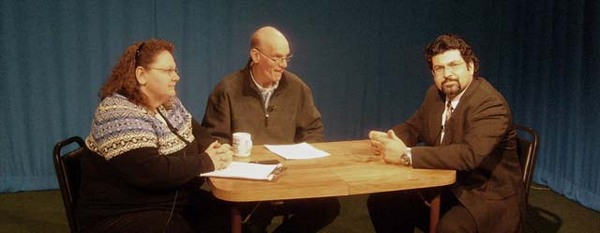
Soares was making his first visit to Northern Berkshire to discuss local farm issues on public-access television at the invitation of Joseph Nowak, chairman of the Adams Agricultural Commission.
During a half-hour interview at Northern Berkshire Community Television's offices, Soares spoke on how the state's engineering expertise is being applied to modern farming methods.
The centerpiece is the Agricultural Innovation Center, which awarded last year some $1 million in grant funding, providing assistance to farms and helping them navigate the complex red tape around federal grants.
Production costs are the No. 1 challenge for farmers, he said, in large part because of spiking fuel costs that have mirrored the wild swings on Wall Street.
Most of the funding from the Massachusetts Farm Energy Program so far has been for providing technical and installation assistance for photovoltaic systems but more effort is being put into exploring wind power, methane generators and biofuels.
"We're looking at really expanding this program with the Berkshire-Pioneer Resource Conservation and Development Area," said Soares.
One area of interest is harvesting biofuels such as switchgrass from marginal lands, doing late cutting that wouldn't disrupt habitats. Clearing deadwood for cellulosic fuels, such as in the forestland heavily damaged by the recent ice storm in Western Mass., is another option.
"We're doing a lot work with the Department of Recreation and Conservation to look at limited use," said Soares. "Preserving the conservation ethic but looking at efficient exploitation — get maximum yield for farmers while still conserving the land for habitat."
The Green Communities Act passed last year by the Legislature and legislation to stave off a crisis in the dairy industry the year before contained additional components to help the state's agricultural field such as allowing wind turbines to be reclassified as farm equipment in certain instances, allowing towns to waive excise taxes on farm equipment, providing capital investment for farms with agricultural preservation restrictions and adding farmers in creating business plans.
But technological advances aren't just aiding in conservation, they're making farming less physically demanding and, hopefully, more attractive for younger generations to pursue.
That's a concern since the average farmer's age is 55.
In the eastern end of the state, the state is helping cranberry growers with wireless laptops that turn on pumps and spray plants with water when the temperature drops to a certain degree. The cranberry grower who used to get up in the middle of the night to go from bog to bog turning on pumps can now check his laptop and go back to bed.
At a dairy farm, the cows are tagged with microchips to track when the eat and when they've been milked by a robotic milker, widely used in Europe.
It's a matter, in most cases, of adapting existing software for agricultural uses. Not only can the technology promote efficiency, it promotes the social and mental health of the farmer.
"We're seeing costs come down in technology so we can take advantage of that technology," Soares said. "We can use that for the kind of things we're doing on the farm now, especially as labor becomes a concern, and maintain the family structure on the farm."
It may become even more important as farmers continue to diversify their products to stay afloat, taking on more labor intensive ventures.
"If money was determined by hard work, dairy farmers would be millionaires," said Nowak.