County Forum Looks at Strategies to Combat Underage Drinking
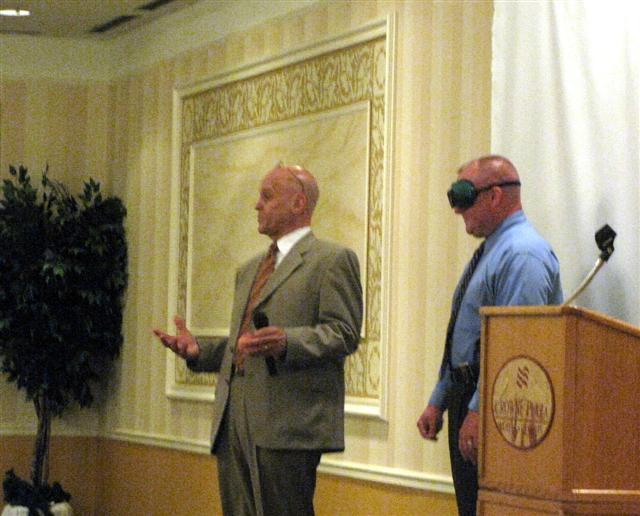 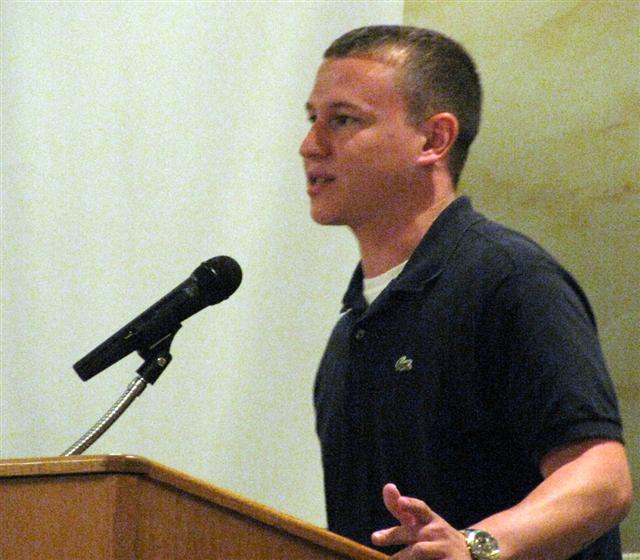 Above: Bill Phillips, left, demonstrates 'pot' goggles on an attendee at Tuesday's drug awareness forum. Top, the state police BAT Mobile; left, Nick Levine talks about his battle with drugs. Above: Bill Phillips, left, demonstrates 'pot' goggles on an attendee at Tuesday's drug awareness forum. Top, the state police BAT Mobile; left, Nick Levine talks about his battle with drugs. |
He had a loving home, good grades, a girlfriend. He played sports and was looking forward to college. He didn't do drugs, he didn't drink. But by age 25, he was struggling with drug addiction, and woke up in the intensive care unit at Beth Israel Deaconess Medical Center in Boston after overdosing on heroin.
Levine's journey from high school standout to college drug-dropout was precipitous — and not unusual.
"It was very classic situation: It was peer pressure," Levine, now 27, told a room full of law-enforcement officers, teachers and social service and community organization representatives. Moving from small-town high school to the University of Massachusetts was jarring, and he was trying to fit in. "They did drinking, they did drugs ... I did what people around me did to fit in.
Working to prevent cases like Levine was at the core of the "Preventing Underage Drinking: A Community Approach" conference a the Crowne Plaza on Tuesday that was attended by some 200 people.
Presented by the district attorney's office in collaboration with the state Executive Office of Public Safety and Security, it included presentations on alcohol's effect on adolescent brains, leadership, community strategies, chemical dependency and the state police "BAT" Mobile, or Breath Alcohol Test.
Planning for the conference began a year ago and was made possible by a U.S. Department of Justice grant through the state Office of Public Safety.
"We've been thinking about doing this for a long time," said Berkshire District Attorney David F. Capeless, who credited his staff, particularly Carol Mulcahey, for making it happen. "I'm very pleased with the variety of speakers we had who gave some very informative and positive messages. ... I think [the attendees] got an awful lot out of it."
Corinne Case, team leader for Adams Mobilizing for Change on Alcohol, liked that the presentation covered a wide range topics. "I took notes for some of the projects we're working on that I think I can plug in immediately."
Studies have shown that adolescent brains may be more conducive to addiction; teens can also drink longer than adults before the body shuts down by sleeping, and be less inhibited more impulsive, according to Dr. Jennifer Michaels of the Brien Center. Alcohol consumption during the teens year can actually damage the brain's wiring.
 Williams College athletic director Harry Sheehy discusses team building. |
"You're standing alone, you see three guys over there and they're all laughing, you want be like them, right?" asked Bill Phillips of New Beginnings, a Framingham program give presentations on substance abuse to organizations and schools, including the one Levine attended. "But when it comes to drugs and alcohol you cannot win - there are no success stories."
Parents need to be more involved, although too often they can be the root of the problem, he said, holding up a bong taken from a fifth-grader — who'd received it from his father. "Most kids who drink and drug and get in trouble have something wrong at home."
It was also important, said Williams College athletic director Harry Sheehy, to make youngsters understand that sometimes things don't work out, and that's OK.
"We need to create the freedom to fail," he said. "Kids are petrified to fail but it's a great way for kids to grow confidence by failing and trying again."
They and other presenters stressed the need to not only listen to children but to become aware of the underlying issues that may make them more susceptible to drug abuse.
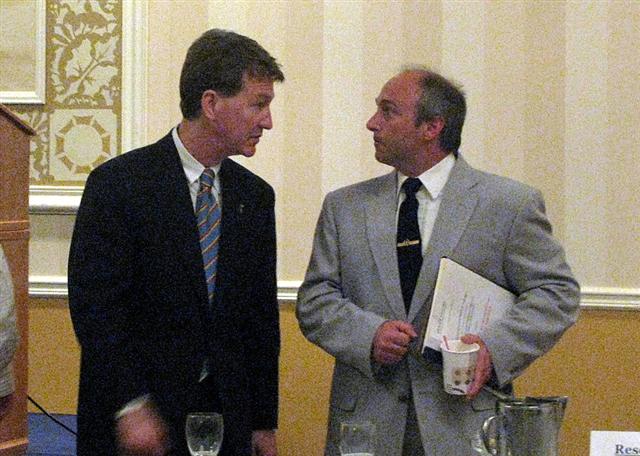 District Attorney David F. Capeless, left, speaks with Clarksburg Police Chief Michael Williams. |
Clean for two years, Levine has been attending presentations with Phillips, whose message he'd ignored in high school, to help children and adults understand that even kids from good homes can get in trouble.
"I'm a 27-year-old who's been to way to many funerals [for drug and alcohol-related deaths] than I should have," said Levine. "It is possible to beat it and I want to serve as an example of that."