John Glenn to Speak at Williams College
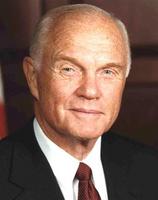 |
The event is scheduled for Saturday, June 6, at 11 a.m. on the MainStage in the '62 Center for Theatre and Dance. The event is free and the public is cordially invited to attend.
Glenn attended Muskingum College, where he received his private pilot's license at age 21, months before Pearl Harbor was bombed. After the attack, Glenn enlisted in the Army Air Corps, but served with the Navy as an aviation cadet, earning his wings as second lieutenant by 1943. He was assigned to serve in the Pacific theater, seeing action at Midway and the Marshall Islands. He served for the next decade, earning the nickname "MiG Mad Marine" for shooting down three enemy MiG jet fighters on a Korean War border patrol.
After returning from Korea in 1953, Glenn served for six years as a test pilot and rose to national fame, receiving the fifth of his six Distinguished Flying Crosses for completing the first transcontinental flight to average supersonic speed.
In 1954, Glenn won an assignment as a Marine test pilot and, in 1957, set a transcontinental speed record for the first flight to average supersonic speeds from Los Angeles to New York. In 1959, he was selected to be one of seven NASA Mercury astronauts from an original pool of 508. Three years later, on February 20, 1962, he made history as the first American to orbit the earth, completing three orbits in a five-hour flight and returning to a hero's welcome.
Glenn retired from the Marine Corps as a colonel in 1965, becoming a business executive with Royal Crown and serving first as a member of the board of directors and then as president of Royal Crown International. During this time, he took an active part in Democratic politics and early environmental protection efforts in Ohio.
In 1974, the Ohio Democrat was elected to the Senate, carrying all 88 counties in the state. He was reelected in 1980 with the largest margin of votes in Ohio history. Ohioans returned him to the Senate for the third time in 1986, and, in 1992, he again made history by being the first popularly elected senator from Ohio to win four consecutive terms. He retired from the Senate in 1999.
Glenn returned to space from Oct. 29 to Nov. 7, 1998, as a member of NASA's Shuttle STS-95 Discovery mission during which the crew supported 83 research payloads and investigations on space flight and aging. He is the oldest person to have flown in space. During that mission, Glenn made 134 Earth orbits in 213 hours and 44 minutes.
In October 1997, Glenn announced that his papers, documenting his full career, would be archived at Ohio State University. In September 1998, Ohio State announced the establishment of the John Glenn Institute for Public Service and Public Policy at the university and in July of 2006, the institute merged with Ohio State's School of Public Policy and Management to form the John Glenn School of Public Affairs.
More recently, Glenn has been concerned with transforming negative perceptions of careers in public service. In October 1998, Glenn joined with Ohio State University to create and chair the John Glenn Institute for Public Service and Public Policy. He is adjutant professor in the department of political science and the School of Public Policy and Management at Ohio State.
He holds the Air Medal with 18 clusters for his combat service and is the recipient of numerous other honors, including the Congressional Space Medal of Honor.
Kwitter is the author or co-author of more than 50 scientific papers and four books, including "Force and Motion," "Our Solar System," and "Atmosphere and Weather" for the Hands-On Science series.
At Williams since 1979, she regularly teaches the introductory astrophysics course, in addition to observational cosmology and the seminar "Between the Stars: The Interstellar Medium."
She is a fellow of the American Association for the Advancement of Science, a member of the Observatories Council of Associated Universities for Research in Astronomy, the American Astronomical Society, Sigma Xi, the Astronomical Society of the Pacific, and the International Astronomical Union.
Kwitter received her bachelor's degree from Wellesley College and her doctorate in astronomy from the University of California at Los Angeles.