State Commission Battling OxyContin-Abuse Epidemic
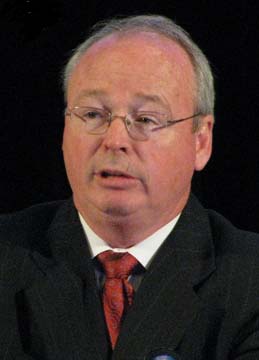 state Sen. Steven Tolman
|
"OxyContin and heroin abuse are destroying lives and tearing families apart throughout Massachusetts and the nation," said state Sen. Steven Tolman, heading up a public hearing on drug abuse held Friday at Berkshire Community College. "It does not discriminate based on age, race sex or geographic region."
The 13-member Massachusetts OxyContin and Heroin Commission led by the Boston Democrat was established in the 2007-2008 legislative session to study and recommend solutions to the growing problem of opiate abuse in the state. Friday's session was the third held by commission since beginning this spring.
The statistics are eye-opening: over 10 years, the abuse of prescription OxyContin jumped 1,000 percent and heroin abuse, 52 percent. Accidental overdoses have surpassed car crashes as a leading cause of death in the state.
"You think the addict is the guy on the street who doesn't work," said Lorraine Robinson of Adams, testifying about her difficulties in getting help for her daughter, who died of an accidental overdose in 2005. "But it's regular people who get hooked on prescription medication."
Pittsfield saw 2,048 individuals enter substance-abuse treatment programs in fiscal 2007. Chronic use of prescribed opiates, Schedule II drugs such as OxyContin, can lead to addiction.
"We do have a situation here in Berkshire County," said Berkshire District Attorney David F. Capeless, who joined the several attending commission members at the hearing along with state Sen. Benjamin B. Downing and state Rep. Christopher Speranzo. "I know the commission members had time to see the beauty of the Berkshires on their way to the college, yet at the same time, we can go off the main street and you will find we have a problem not only with heroin but with other opiate and prescription medications."
The powerful prescription painkiller, one of a number of medications that contain oxycodone, can command a $1 a milligram or more on the street.
Capeless said his office is seeing more situations in which people with legitimate prescriptions are selling the drugs on the black market and forgoing their medication in response to economic conditions. "Our senior population is turning to criminal activity."
Monitoring Program
One initiative is to make better use of the data collected and reviewed through the 17-year-old Prescription Monitoring Progam. The agency has since reviewed more than 2,000 cases of illicit or inappropriate prescriptions, so-called doctor shopping, forgery and pharmacy diversion. Its reports have primarily been used by law enforcement agencies.
Deputy Director Grant Carrow said new regulations have expanded its goals to provide information on Schedule II dispensements to practitioners and pharmacies, requires pharmacies to report additional information and require consumers have proper identification for prescriptions.
A $400,000 federal grant is aiding the agency in implementing certain efforts, such as searching for correlations between doctor shopping and overdoses in geographical areas, technical enhancements and data-sharing with other monitoring programs.
 The dark areas show higher degrees of 'questionable activity' in regard to prescriptions of OxyContin, according to the state Prescription Monitoring Program. |
"Those states that are producing unsolicited reports and are able to do so have lowered substance abuse in their states more than those state that don't have that capacity," he said.
However, the monitoring program, like so many state programs, has seen its budget cut and its staff reduced. Carrow said no one on staff is available to compile unsolicited reports although the two-year federal grant has allowed for a consultant to do it. In contrast, New York state spends some $20 million on its monitoring program but has saved more than $100 million by preventing fraud.
"We're looking to try save money for the commonwealth," said Tolman, who indictated he would look into the funding issue. "There were 18,000 overdoses across the state in 2005 costing $200 million."
HIPAA Obstruction
If the program had been able supply geographical data reports earlier, it might have caught the activity of Carlen Robinson.
Carlen was prescribed OxyContin after painful complications from surgery in 2003, said her mother, Lorraine Robinson. Over the next year, her daughter's personality and appearance would change for the worse as she was repeatedly prescribed OxyContin and Percoset to deal with the pain, said her mother.
Robinson said she tried to talk with her daughter's doctors, nurses and caregivers about her concerns but ran into the federal Health Insurance Portability and Accountability Act, or HIPAA, which severely restricts the dissemination of patient information.
"I think that HIPAA law goes too far and a lot of doctors hide behind it," she told the commission. "Even if you have a concern about one of your family, they won't talk to you about it."
Carlen died Nov. 11, 2005, from a fentanyl patch she allegedly bought from another woman to whom it had been prescribed. The alleged seller as been charged with manslaughter.
Robinson discovered her daughter had had multiple prescriptions from different doctors at various pharmacies locally and out of town. Why, she asked, didn't the insurance company notice it? Why didn't the pharmacies and the multiple doctors know?
"I called for help, I called the counseling centers, but you can't just put people in the hospital anymore ... they told me to join Al-Anon," said Robinson. "All of this wouldn't have happened if the HIPAA law wasn't in place."
 Berkshire District Attorney David F. Capeless and Tolman share a moment of levity during testimony of Grant Carrow. |
The commission will be holding more hearings into August in an effort to find collaborative ways to combat substance abuse and to listen to people like Robinson to understand how addiction is affecting citizens. The scope of the problem can't be underestimated, said Tolman.
"Between 2002 and 2007, we lost 78 soldiers on the streets and battlefields of Iraq and Afghanistan, but buried 3,265 citizens during that same period [because of overdoses], breaking mom's and dad's hearst all over Massachusetts," he said. "Folks, that's 42-1 to what we're losing in war. ... We need to chage the way we address this problem and, most importantly, we need to find solutions rather than pretend it isn't going on."