Q&A with Pittsfield Defenders Coach Carroll Land
PITTSFIELD, Mass.
 Photos by Jonathon DelSordo
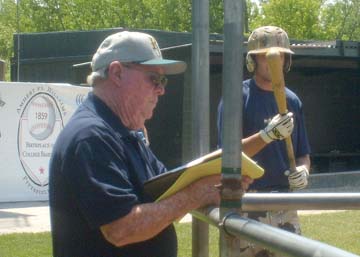
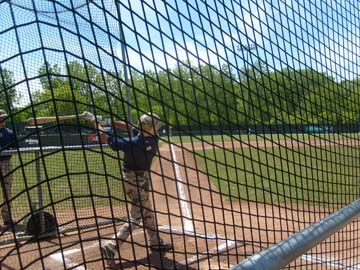
Coach Carroll Land looks over the roster at a recent Defenders practice. |
This is a Q&A on about his managerial experiences and his thoughts on the upcoming season.
This the Defenders first year in Pittsfield. The NECBL team replaced the Pittsfield Dukes, another college-league team that played at Wahconah Park for two years.
Question: When did you first start playing baseball?
Answer: In Englewood, Calif., at the age of 10.
Q:Where did you attend college?
A: Pasadena College/Point Loma Nazerene University in California.
Q: When did you first get into coaching?
A: In 1961. I was the player-coach as a senior in college. We lost our coach the year before. Prior to that, I decided I wanted to be in physical education and coaching because I had spent five years between my freshman and sophomore years with the Marines Corps and the working world and decided I wanted to be on the grassy field rather than anywhere else.
Q: What are some of the pressures of being a coach?
A: Well, I think the biggest thing here is to get acquainted with our players. To make adequate proper judgments of the players' skills and how they can fit in as a team is probably the biggest pressure we face, and to not shortchange the ball club, the community or the kids that are playing here with us.
Q: What manager do you think most resembles your coaching strategies?
A: Probably Walter Alston, way back in the Dodgers era. I knew Walter a little bit, but I admired his work very much.
Q: What were your coaches like growing up in the baseball realm?
A: Unfortunately, I didn't have really good coaches, and that was part of my motivation to get involved. I worked very hard in spite of some of the coaches I have had over the years.
 Q: What is the most difficult thing for you as a coach?
A: In this particular situation, we don't really see any ball clubs before we play them, there's no real scouting that takes place, and we don't have a good feel for what opponents are going to be coming into the park, so trying to learn part way through the game what we can do as far as reading pitches and following the fundamentals is a big part of our game plan right now.
Q: What do you see in the Defenders that are different from anything you've ever managed before?
A: The concept that the team is trying to put forth in terms of support of the troops regardless of political posture, and the awareness that we do have people out there protecting our country to keep us in a safe environment. Although I have managed the Military All-Stars five or six times in the past, making others aware of what the Defenders are trying to do is the most important thing here.
Q: What is your main goal for the upcoming season?
A: I'm looking forward for us to come together as a unit and playing the game hard with the kind of integrity that it really needs to be played with, and that's the fun part playing with college kids because you get that out of college kids in that they really work hard at this game; they wanna keep improving, they wanna make themselves visible to get to the next level.
Q: What are your thoughts on steroid use in baseball and its effects on the new generation of ballplayers?
A: I think we are coming into an era where the recognition that [steroid use] should not be done is stronger; I think these kids work really, really hard at the natural way of gaining strength and I guess there are no guarantees to not have a player taking some short cuts. But I believe that the awareness of what's going on in our society and its detrimental effects of not only the physical, but the betrayal of what people believed in to be legitimate."
Q: What aspects of baseball do you love/admire the most?
A: I have a deep appreciation for all the aspects of the game but making these kids learn the right way and seeing hard work pay off is the most exciting thing.
Q: What intrigues you the most in being the manager of the Defenders?
A: I just retired from 48 years teaching, being a coach and an athletic director, although I haven't coached a college baseball team in the past 10 years, it just seemed like, why go off to a rocking chair when there's a opportunity to work with these determined college kids? The change of scenery and having fun on the diamond again also helped my decision.
 Q: How important is winning to you?
A: I don't want to belittle the concept of winning, but to bring a team together of 26 players that you've never seen or worked with before, and to cut out a goal to win a really, really high percentage of games, that may be a detrimental concept to what we are trying to accomplish here. Don't get me wrong, I want to win every day, but we need to rely on the fundamentals and the molding process of becoming a team first and then, hopefully, be successful along the way.
Q: Who's your favorite ball club?
A: Seeing as how I've lived in San Diego since '71, I'd have to say I side with the Padres. They are doing fairly well with a scrappy team, minus the enormous payroll other squads have nowadays.