Local Leaders Give State Listening Tour an Earful
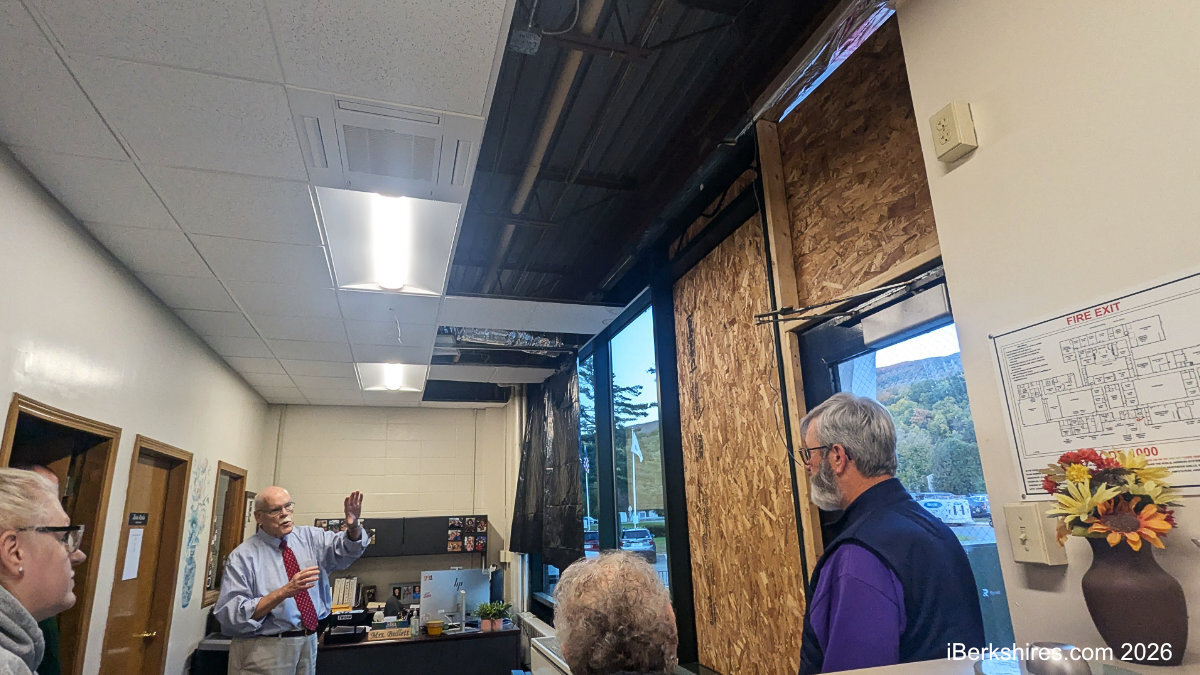
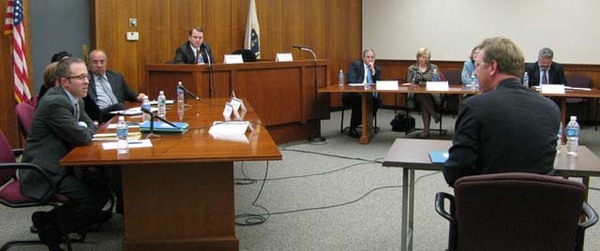
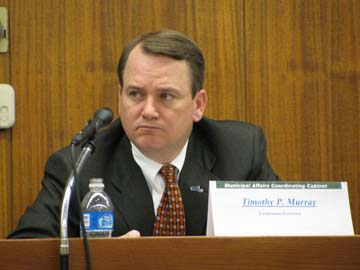 Lt. Gov. Timothy Murray listens to the discussion at the Municipal Affairs Coordinating Cabinet, which gathered at City Hall on Thursday morning. |
The Massachusetts Museum of Contemporary Arts has seen its annual energy costs jump from $200,000 at its opening 10 years to $800,000, Joseph C. Thompson told Lt. Gov. Timothy Murray and the Municipal Affairs Coordinating Cabinet, while its annual operating budget has rising from $5.6 million to $5.8 million over the same period.
Past entities in the sprawling complex were Arnold Printworks, once the biggest textile maker in America, and then Sprague Electric Co., one of the largest manufacturers of capacitors. Both were done in in large part, said Thompson, "because of this end-of-the-pipeline energy-cost problem here in New England and particularly Western Massachusetts."
The state has been doling out little bits of money to encourage green energy, he told Mark Sylvia, head of the state's Green Communities Division, but it should think about doing large, significant projects. The museum is seeking funding for a 500-kilowatt solar array for its 16-acre complex.
Sylvia said Gov. Deval Patrick has set a number of good initiatives toward green energy and that the utilities will be playing a significant role in those endeavors. Mayor John Barrett III reminded Sylvia that the museum property was municipally owned and has a direct impact on the economic health of the region. The Mass MoCA this year will bring in around 145,000 visitors and some $20 million in regional economic impact.
"I don't want Mass MoCA to go the way of the two previous tenants of that site that were the heart and soul of the economic life of this community," said Thompson. "I think [energy] is the single most important issue and challenge facing my institution."
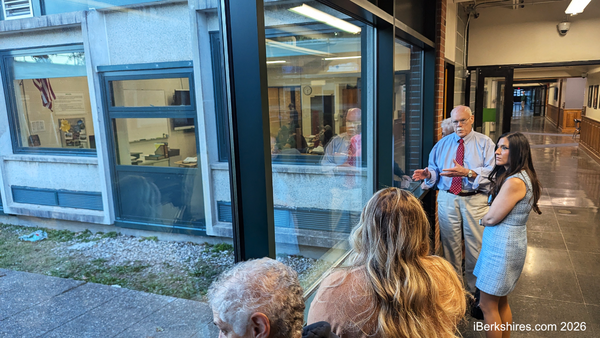
 Alan Bashevkin, right, and Rabbi Jeffrey Goldwasser ask that Northern Berkshire Community Coalition not be forgotten. |
The state's purchasing agent, Ellen Bickelman, spoke of how cities and towns could take advantage of the state's procurement process; Linda Hamel, a former city resident and general counsel for the Information Technology Division, how municipalities can find help for online security and other technical issues.
A few, including Thompson, expressed their frustrations with elements of state policy and processes. Richard Palmisano, president and chief executive officer of Northern Berkshire Healthcare, said the state's insurance "tiering" criteria put North Adams Regional Hospital on the bottom only because it lacked 24-hour intensivists.
That's costing public employees covered by the state's Group Insurance Commission more in co-pays and deductibles, he said. "That doesn't assist the members of the plan to get care at the lowest cost hospital. Blue Cross Blue Shield has recently certified us as the lowest cost hospital in the county. They're giving their members lower deductables to come to our facility."
Danielle Chaplick, representing the GIC, said the criteria was set to promote better care but that she would bring Palmisano's reasoning to the commission.
Northern Berkshire Community Coalition Executive Director Al Bashevkin and board President Rabbi Jeffrey Goldwasser expressed concern that funding for community groups was endangered; Denise Richardello of Massachusetts College of Liberal Arts that the worthy investment of higher education be kept in mind.
Murray said that while the administration understood the importance of education and community leadership, governor would be discussing his plans later on Thursday to close another $600,000 budget shortfall. "I hope we can come to the table and try to be as creative as you are."
Indeed, Barrett, as host, asked if any other town leaders wanted to "come up tell this fine group of people and the lieutenant governor how broke we are."
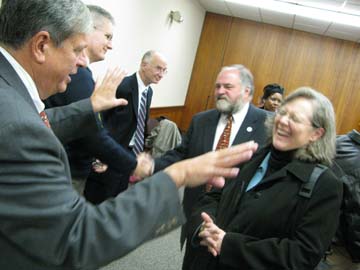 Mayor John Barrett III shares a laugh with Linda Hamel of the Information Technology Division. Hamel, whose family left the city when she was 10, planned to visit some childhood haunts before leaving the city. |
Blair asked if there was a way to amortize the massive cost of last year's ice storm cleanup that's left a big dent in the small town's budget; Nunes said he could help.
Butler asked if there was away to get firmer state aid numbers earlier in the year while towns and school districts were crafting their budgets. While the town had escaped mostly unscathed from the late budget cuts by the Legislature, the Adams-Cheshire Regional School had been forced to slash $300,000 from an approved budget.