Economic Development Dominates North Adams Council Debate
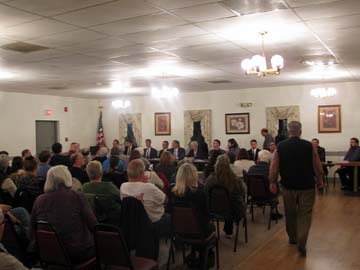 Around 70 people attended Wednesday's debate to hear the 14 candidates. The blow by blow can be read on our live blog. Audio of the debate should be available later today. |
| Audio Part 1 |
| Audio Part 2 |
The forum, sponsored by the North Adams Transcript at the American Legion, also touched on the role of the council, sewer fees, and the commercial tax rate, but the sheer size of this year's field — 15 — and the time limit prevented too many topics from being discussed. The moderator was Transcript Editor Glenn Drohan.
Six of the incumbents were there: Lisa Blackmer, Michael Bloom, Ronald Boucher, Gailanne Cariddi, Alan Marden and Robert Moulton Jr. Councilor Marie Harpin, who is running for a seventh term, was absent with the flu. But all eight of the challengers showed up: Michael Boland, Keith Bona, David Bond, Eric Buddington, Brian Flagg, David Lamarre, Greg Roach and Dennis Whitney.
The 15 candidates are vying for nine at-large council seats on Nov. 3. At least two challengers are assured seats on the council because of the resignation of Clark H. Billings in August and the run for mayor by Councilor Richard Alcombright.
There was little disagreement on what makes a good councilor — preparation, ability to listen, being informed and doing their own research, willing to bring forward the interests of the public. But economic development and job creation dominated the evening, not surprisingly. (A completely unscientific poll by iBerkshires over several weeks found those were the top issues important to our readers.)
All the candidates also went on record against a sewer fee with the exception of Bloom, chairman of the Finance Committee, who is remaining neutral until his committee's review of the issue is complete.
"Currently our system works well what is being proposed would potentially hurt [Massachusetts College of Liberal Arts] and North Adams Regional Hospital and residential taxes would not go down," said Roach.
Many candidates said commercial taxes should be reduced but not at the expense of residential taxpayers.
"We do have a low tax rate when it comes to residential property and we do have a very high rate when it comes to commercial property, we have one of the highest in the state," said Keith Bona, a former councilor and a local businessman, saying taxes have more than doubled in five years.
Blackmer said the city needs a bigger pie — more commercial business — which drop the tax-rate burden on businesses without affecting the residential side.
|
The commercial has incrementally risen over the past couple years, but actually dropped "substantially" in 2006 and, in 2009, went up on 10 cents.
"As a business owner I do pay that rate," said David Bond, owner of The Range. The question is whether the rate was inhibiting small and middle-size businesses from locating here, he said. "We need to talk to the business owners and find out if it is affecting their bottom line."
Bond also advocated an aggressive approach to marketing the city by updating the Web site to be more accessible and provide more information, along with packets of what the city has to offer in workforce, training, space and housing. "If we sit here and wait for a business to show up, it may not happen. ... We need to go get them."
The city needs to work with neighboring communities to work together, said Boland, cautioning that keeping jobs that are already here was as important as gaining new one. Whitney agreed, that "we want to hve positive growth but we don't wnat to have negative growth."
Roach added that current employers should be seen as economic development. "We are creating jobs that didn't exist before," he said of his workplace, Wild Oats, which has grown significantly over the past few years. That's exactly the type of places we should be positionin, not just looking for the next big thing to come and build a plant."
Both Whitney and Lamarre said the city should be thinking regionally, if not globally, pointing to the GlobalFoundries' construction in Malta, N.Y., of the largest microchip manufacturing plant in the nation.
"We have to start looking at things on a more national and more global level and not just about what happens day to day in North Adams," said Lamarre.
The city needs to work on foundation issues before it goes after big business, said Flagg, who ran for council in 2001. "Guess what the issues were in 2001? Job creation, economic development, blighted neighborhoods, crime, drugs, poor education and dilapetated buildings. We have to assess and prioritize. ... what we want and what we can achive are two different issues."
Buddington, who repeated his call for the city to place its budgets and ordinances online, said the artists should not be forgotten as a economic generators.
"There's a huge amount of extremely good art that's still hidden in studios because there's no space to show all of it," said Buddington. "That's a huge economic opporunity if we have somebody or the council to market [the city]."
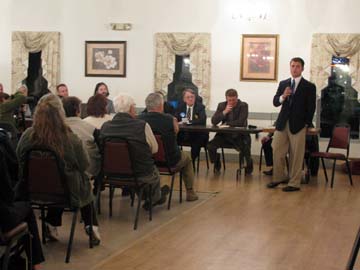 Several councilors stood so the audience could see them better but David Bond came right out to the audience. |
What exactly could the council do to create jobs?
Boucher said the council can work to ensure good schools and services, both that can attract new business. Meanwhile, people may be hurting now from the economic downturn through job loss and housing trouble. "Those are real issues in front of the city," he said. "We need to plan for the future but we need to look at today, too."
The council can work best by being the deliberative body it is, said Bloom, by working with ordinances and zoning issues that help businesses succeed. More directly, the council and city could work toward making the properties directly under its control — such as the skating rink, ballfields and Western Gateway Heritage State Park — that also attract tourist and recreational dollars.
"I would support initiatives along those lines at budget time and to make this a more attractive city and I guess it would help the creative economy," he said.
The council can also support tax incentives to give new businesses a break, said Moulton, who also advocated for greater regional cooperation. "If we work as a whole we'd be a whole lot better and a whole lot stronger."
Cariddi pointed to a resolution she brought forward some years ago to ensure that citizens were given priority in public service jobs. "That's something I've done personally."
"What can a councilor do? We can be supportive of the mayor and help provide a climate that makes this community attractive," said Marden. "The council has to be supportive role, somewhat cheerleaders."
Blackmer, however, said the council needed to do more, especially when hundreds of jobs were at stake. Synthespian Studios owner Jeff Kleiser had told Sen. Benjamin B. Downing at a tax policy hearing on Wednesday morning that the state's 12-month limit on film tax credits could kill a plan to bring upwards of 300 jobs to the area to work on a full-length animated picture.
"I think we do need to market the city and advocate," she said. "We need to be on the phone with [Rep.] Dan Bosley and Ben Downing, the whole Berkshire [delegation], saying you need to give them an exemption or you need to change the law because that's something the council can do."
The debate will be broadcast on Northern Berkshire Community Television on Thursday, Oct. 22, at 8 p.m.; Friday, Oct. 23, at 7 p.m. and Saturday, Oct. 24, at 6 p.m.