Election 2009: Roach Sees Future Potential in City's Past

Print Story | Email Story
Common Threads: North Adams' Risk Takers, Visionaries and the Future of our City

NORTH ADAMS, Mass. — A little over a year ago, I posed the question on my blog wondering aloud what North Adams will look like in 10 years. The future is an even more fascinating question if you take the time to look at the various evolutions of our city since it's inception.

I am 100 percent positive that North Adams will continue to bloom in various fashions and I personally believe that we are within a decade of our latest renaissance. We are a college town, a museum town, an arts mini-mecca and potentially one of the best places in America to raise a family.

We have so many things going for us that with just a little bit of optimism, investment and fortitude we will begin to see the fruits that have long been promised. Don't believe me? Look around. The energy of the current generation of young adults is palpable. I see it every day. And as these 20, 30 and 40 somethings come into their own, there are few bounds on what the future holds.

There are so many incredible things about North Adams that our biggest mistake would be to play it too cautious. Over their history, Massachusetts and North Adams has produced and attracted many who took the risks and reaped the rewards. It has been the perfect place for those who believed as Mark Twain did - that courage is not the absence of fear, but rather the management of it.

I say it is time to revive that ethos! In fact, North Adams is named after a remarkable risk taker. Nationally he is known as guy who has a brand of beer named in his honor. (How many other cities can claim that?) What we, as residents of the Massachusetts know is that Sam Adams was a Revolutionary War hero, signer of the Declaration of Independence and governor of the commonwealth. Take that Budweiser!

My neighborhood is named after a shrewd grocer and businessman, W.E. Brayton, who saw the potential of the town long before it was a city. He bought and sold the products of the local farms, selling the goods locally and shipping to the cities. His type of trade was what earned us the label of the Gateway City. Those who worked their fingers to the bone in the mills of 100 years ago laid the groundwork for the incarnation of our industrial age identity.


That period was epitomized by Bob Sprague and the role he and his company played in from Neil Armstrong landing on the moon to the TVs and appliances in almost every home in America. Over the past 25 years we have seen the emergence of North Adams' Education and Cultural Age, a spot that is a natural evolution for a city in the Berkshires.

People like Tom Krens, Joe Thompson, Eric Rudd, John Barrett, Jane Swift, Dan Bosley, etc. ... all share some of the credit for laying the ground work for what we are still in the process of becoming. Which leads me back to the question of what will North Adams look like in 10, 20, 50 years. We will certainly be a more entrepreneurial city.

We will be a destination for even more than the hundreds of thousands of visitors a year. Our museum and college will have finally been embraced by the city as a whole. I think it is likely that we will have a more walkable and bustling downtown but at the same time we will be part of a much larger regional rebirth.

While it is impossible to know exactly what shape things will take, I know one thing for certain: We will be a strong community with boundless potential. We were 200 years ago. We are one today, and we will definitely be one well beyond the foreseeable future.

Greg Roach is a father, husband, chef and writer. He is a candidate for North Adams City Council and urges you to contact him at greg@gregoryroach.com or visit VoteRoach.com.

If you would like to contribute information on this article, contact us at info@iberkshires.com.

Why the Massachusetts Art Community Is Worth Continued Investment

By James BirgeGuest Column
How do we quantify the value of art on society and culture? Even eye-popping figures, like the $100 million estimate for the jewels stolen from the Louvre, or the record auction last fall that saw a piece by Gustav Klimt sell for more than $236 million can't fully account for the value of the history, stories, and emotions behind the creations themselves. But beyond that, there is a measurable financial, cultural and social benefit of the arts that is often taken for granted. 

Closer to home, arts and cultural production in the Commonwealth of Massachusetts totals nearly $30 billion annually, representing more than 4 percent of the state's economic output, according to the Mass Cultural Council. All told, more than 130,000 jobs are spread across the commonwealth creating a vibrant and thriving artistic community for us all to enjoy. 

Despite the obvious impact, these figures are under threat. A recent survey by MassCreative compiled recent federal cuts to the National Endowment for the Arts, the National Endowment for the Humanities and the Institute of Museum and Library Services and identified 63 grants canceled and $4.2 million in grant funding rescinded across New England so far this year. 

The dollars, of course, are important. But they also only scratch the surface on what they bring to the community. Today, we risk losing part of the culture and identity many now take for granted. 

While others choose to look past these less tangible, but just as vital benefits, we're doing the opposite. Massachusetts College of Liberal Arts is all in to ensure the next generation retains their access to works of art, while also being empowered to create themselves. 

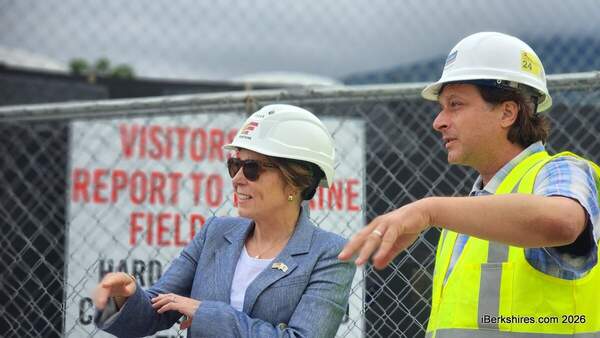
Last fall, MCLA officially broke ground on the new Campagna Kleefeld Center for Creativity in the Arts, which will serve as a new hub for the campus and the local community for arts programming. When complete in fall of 2027, our students will benefit, but so will all of Berkshire County and artists in the surrounding area. 

This exciting new facility is just one of the many forthcomings our region can enjoy in the coming years. Just a few miles away, anticipation builds for the Fall 2027 anticipated opening for the Williams College Museum of Art. Years in the making, the museum likewise grows from an enduring commitment to the arts, both in curriculum and in practice. Exciting times are also underway for the Clark Art Institute with the construction of a new facility to house a collection of 331 works of art, including paintings, sculptures, drawings and other works. Their wing is scheduled for completion in 2028. And listeners will no doubt enjoy the sounds and melodies from Mass MoCA Records, the latest endeavor to foster creativity and artistic pursuits through music launched in October as well. Of course, many are also awaiting the reopening of the Berkshire Museum anticipated this summer, after a tremendous renovation process to rejuvenate the experience for visitors. 

So much time, energy, and yes, dollars, have already been invested in taking these facilities from ideas and sketches and making them reality. But they represent much more than new buildings. They represent new opportunities to cultivate and accelerate the thriving arts community in Massachusetts and the northern Berkshires. 

Art, regardless of the medium, is a reflection of who we are, where we've been, and what we aspire to be. It can be inspired by hopes or fears and chronicle collective triumphs as well as tribulations. The goal of art is not only to document history, but to inspire those positioned to change it and to feel something new or even to provoke us to revisit our own assumptions or misconceptions. 

As unfathomable of a number as $30 billion can seem, boiling down the impact to any number inherently discounts the unknowable downstream effects our graduates will bring to the community and the broader world after they leave our institutions. Likewise, rescinding $4.2 million now removes a huge chunk of that growth potential.  

Justification for making these investments today when simply boiled down to dollars and cents still places us on solid ground strictly from a financial perspective that forgoes all of the intangible, but no less valuable, benefits as well.  

The arts are still worth our support. And our community will be richer for it. 

James Birge, PhD, is president of Massachusetts College of Liberal Arts in North Adams.  


View Full Story

More North Adams Stories