St. Stan's Vigilkeepers Keep Spirit of Parish Going
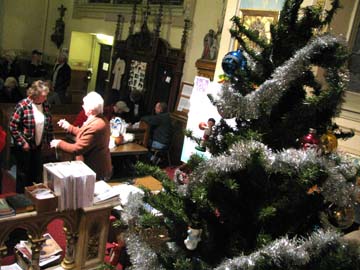 The St. Stanislaus Kostk vigilkeepers meet regularly to share news. The group of 60 or more regulars have been keeping a round-the-clock vigil in the historic church for nearly a year. |
It was the waning of Day 326 and the regular Monday night meeting of the vigilkeepers at St. Stanislaus Kostka Church. The goal of their vigil is simple: Keep the historic and fabulously decorated Polish church open as a place of worship.
The church isn't really a church anymore; the parishioners no longer members of a St. Stan's parish. At least that's what the Roman Catholic Diocese of Springfield says. The 200-odd faithful who've been sitting, dozing and praying night and day under its painted ceiling and massive chandeliers say don't believe it.
"We're here indefinitely," said Laurin Zepka, before leading a prayer to remember souls caught in purgatory.
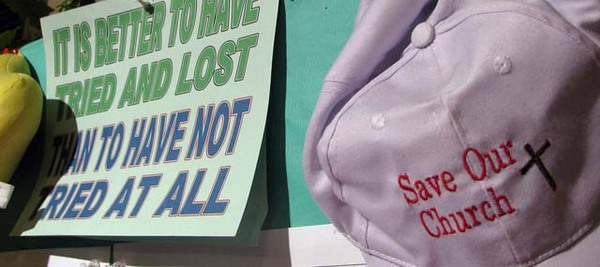
St. Stan's was ordered closed at the end of last year, part of a consolidation in the Springfield Diocese and a trend in Catholic communities across the nation. St. Stan's members immediately protested the decision, establishing an around-the-clock vigil days before the final Mass.
The vigilkeepers are pinning their hopes on the Vatican and praying for a rare reversal of a diocesan decision.
St. Stan's has joined with eight other parishes, including in the Boston area, to appeal their closures.
In August, they received a letter from the Congregation of Clergy delaying a decision on their appeal for a second time. Msgr. J. Anthony McDaid wrote that the appeal's time limit had been extended to Nov. 25, 2009, "in order to reach a studied decision in this matter."
That date has again been extended and meeting attendees were somewhat relieved to learn that the Boston churches also appealing had not been placed on the Apostolic Signatory's agenda for its next meeting on Dec. 1. The Signatory is the last step in the appeals process.
No one's quite sure what the postponements mean.
Francis Hajda, the group's spokesman, said Peter Borre, an activist trying to save churches in the Boston area, was in Rome to "rattle some cages and find out what's going on."
The group's not certain what the coming weeks will hold but they haven't given up hope or their spiritual kinship. If anything that adversity has made them stronger than ever, said Dola Lipinski.
"We've always had a close group at St. Stanislaus Kostka," she said. "The bishop doesn't know what he's done ... now we're so close and so bonded, we call each other up, we go out together ... We're a great big, bonded family.
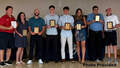
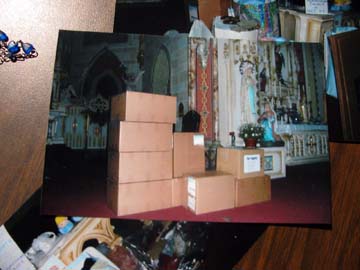 Pictures from the group's Appalachia project. They've been collecting and sending warm clothes and supplies to an impoverished Kentucky town. |
The members continue to function as a parish, if without a priest. A corner of the church has turned into an office with card tables covered with papers and snacks. A large board is posted with announcements and the meticulously maintained schedule that ensures at least three people remain in the church at any time — thus preventing the doors from being locked against them.
It's not all sitting around. The members have been more active than ever in taking on projects to help the ailing and the needy. They've been knitting caps and booties for premature infants, sending boxes of warm clothing and other needs to an impoverished Appalachian town, collecting more than 700 pounds of can pull-tabs (over a million tabs) for Shriner's Children's Hospital. There's also Project Polonaise, for sending clothing and supplies to a Polish orphanage.
They're preparing for the holidays as they always have. A small Christmas tree stands near the pulpit, a lone "wish card" from the Berkshire Community Action North left to be plucked. Hajda said the donations are already rolling in for the annual decoration of the alter with dozens — if not hundreds — of poinsettia plants. They'll sing carols and have readings, but go to another church for Mass.
The group is dedicated to preserving the Polish traditions of St. Stanislaus and holding tight to the hope that their pleas will be heard in Rome. Or on high.
Zepka opens and closes each meeting with a prayer to save the church's 100-year-old heritage and maintain it as a temple of God.
"Anyone who can help us, pray for us."
Edited on Dec. 7, 2009, to clarify elements of the appeal process.