Stimulus Funds Will Help Pittsfield Plant Cut Energy Costs
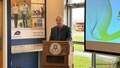
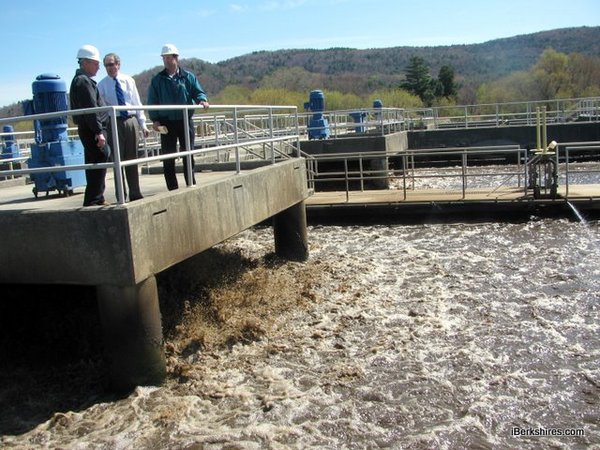
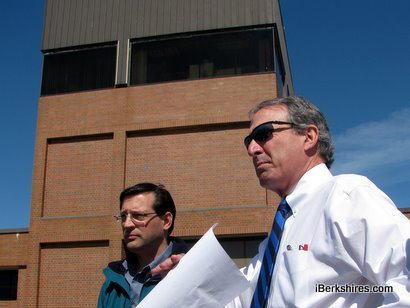 Commissioner of Public Works Bruce Collingwood, left, and Jeffrey Simon, director of Mass Recovery, in front 'The Tower' at waste-water treatment plant. |
The plant uses about 1,000 kilowatts a day to process 28.7 million gallons. An $8 million photovoltaic array to be constructed this summer and a $2.5 million combined heat and power system (using methane produced through the facility's natural processes) could cut the energy costs by 75 to 90 percent.
"It will make us very unique when we're done," said Bruce Collingwood, commissioner of public works, of the methane-powered generator on Thursday.
The construction of the CHP system is particularly noteworthy, agree Jeffrey Simons, director of the state's Recovery and Reinvestment Agency, who was on hand for a closeup look at the plant. Simon said treatment and water plants are the biggest energy costs for cities.
"I don't expect to put much back into the grid," said Bruce Collingwood, commissioner of public works, of the energy to be produced on site. "It will make this very energy efficient. I think we'll see a savings of 75 percent."
New systems will also include a $3 million aeration system to replace the old mechanical paddles being used to oxygenate the influent water and juvenate the bacteria that breaks down the sludge.
The final piece is a replacement of the 1960s bar racks that filter out the large solids and which Collingwood described as "vintage." Stimulus funds will pay nearly 12 percent of the $2.3 million cost.
|
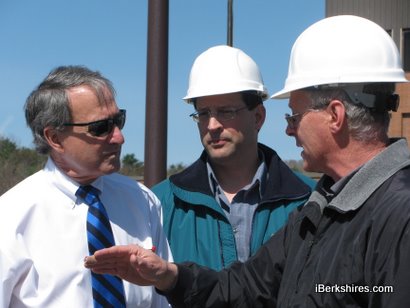
With that much investment, Simon, whose agency is coordinating between the many entities involved, has been on the road to see how it's being used.
"There's no way quite frankly that sitting at my desk in my office that I'm going to get a good feel of what's working unless I'm out talking to the people who are actually making it all work," said Simon, before getting a brief tour of the treatment plant Thursday. "The governor is interested in getting us to see as much as we can."
He spent two days in the Berkshires, looking at social service agencies on Wednesday and talking with officials Thursday involved with the Berkshire Mall Road reconstruction, Lenox's West Street project and brownfields cleanup in Great Barrington.
"I don't want go and to spend 5 minutes on 20 projects," said Simon, an Ipswich real estate developer who oversaw the redevelopment of Fort Devens. "What's really important to me that we spend enough time talking with the people who are doing the projects so I can make sure that there's nothing that we in state government, particularly bureaucracy, that is impeding any project from moving forward."
The city also received $715,000, or 20 percent, toward a $3.5 million project to replace the Coltsville flow station; $189,000, or 20 percent, toward a $1.3 million water and sewer project; $2.4 million toward street improvements to Valentine Road and Barker Road; $69,000 for water quality assessments of Windsor and Cady brooks; $107,000 for five brownfields sites; $70,000 toward a lead paint program; $401,000 toward demolition of a dozen blighted structures; $613,000 homeless prevention; and $189,000 for lighting, energy management and heaters in several public buildings.
The funding is being filtered through a number of state and federal programs.
Simon said there's a misconception that the governor can write a check when he feels like it, but ARRA projects have to be funded through specific categories. In other words, you can't use paving money for solar projects.
"It's doing a tremendous amount of good but sometimes it's frustrating because you have to meet the priorities within that category," he said.