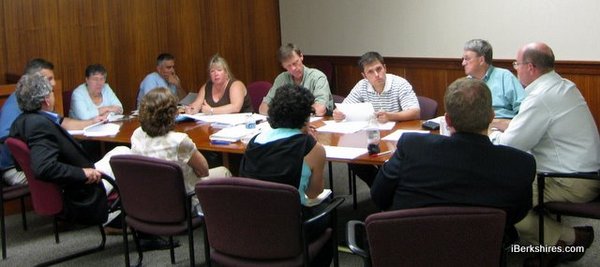
North Adams Finance Committee Begins Budget Review
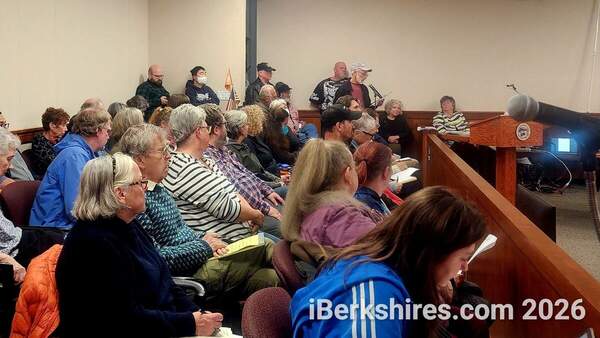
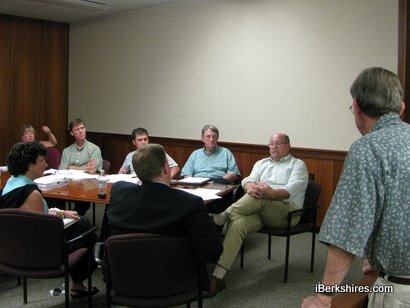 Resident Louis Chalifoux asks city officials to get creative before raising taxes. |
City officials have been trying to find ways to reduce costs without sacrificing programs in the face of another round of reductions in state aid and requirement to fully fund the Medical Insurance Trust. While Mayor Richard Alcombright said the revenue side of the budget is still "a moving target," the numbers aren't expected to change dramatically over the last six weeks of the fiscal year.
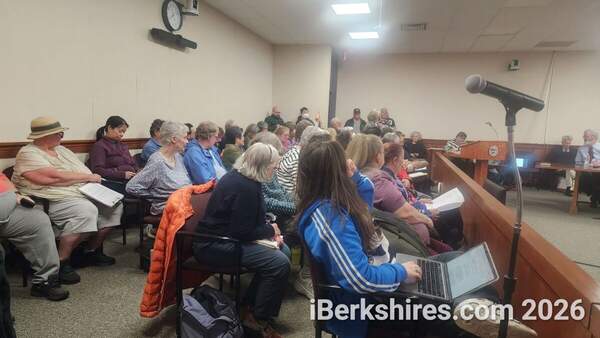
The committee of Chairman Michael C. Bloom, Alan Marden and David Bond were joined by Councilors Marie Harpin, Lisa Blackmer and President Ronald Boucher in asking questions of Alcombright and department heads.
The average taxpayer can expect at minimum an increase of about $313 in the coming year, based on current projections. That includes a 10 percent increase in property taxes — $180 for the average homeowner — as the city taxes to its full levy capacity as mandated by the state to deal with the insurance settlement and runout and $133 for a 10 percent water fee hike and the implementation of a sewer fee (42 percent of your water bill).
The school budget is up 1.4 percent and the operational budget is up .9 percent. State aid cuts come to about $1.4 million.
But after listening to 90 minutes of discussion over cutbacks and revenue, resident Louis Chalifoux thought officials were missing one important component: The taxpayer.
"There doesn't seem to be any concern or sensitivity here for the taxpayer," he said. "I haven't heard any concern or any comment toward the taxpayer."
Bloom took umbrage at the comments, noting Superintendent of Schools James Montepare had just explained how he'd cut nearly $750,000 from the school budget.
"I think every person in this entire room is concerned about the taxpayers," said Bloom, adding the state has mandated the city tax to full capacity and, without fees, the city would have a half-million dollar deficit. "It's kind of insulting to say no one cares about the taxpayer."
Chalifoux said he just wanted to officials to consider other ways of using assets.
"I understand about the commitment we have to our community and our schools and departments," he said. "What I'm talking about is I think the council and mayor need to get more creative in using what we already do have."
Alcombright said municipalities are far more regulated than the private sector — they can't remortgage city hall, they can't borrow against pensions plans. "All we can work with is the cash we have and we're limited in the way we can use it by statute."
The current draft includes $800,000 from the $1.3 million land sale account to balance the budget; but that will hinge on approval from the state because use of those funds may be limited. The city used $2.5 million last year and nearly $900,000 the year before in free cash to balance budgets — there's not much left, said Alcombright.
The mayor made a public presentation on the city's fiscal health and options for next year, including a possible request for a Proposition 2 1/2 override, a sparsely attended gathering last week.
Biting more into the budget will begin to decimate programs, particularly in the school system. Alcombright again vowed not to cut any more services. However, he is looking into selling off the 70 to 80 parcels the city owns as well as the Windsor Mill, but that will take time.
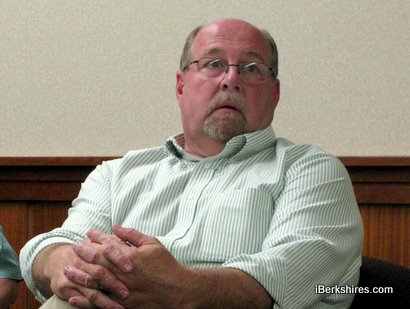 In response to Chalifoux's questions, Mayor Richard Alcombright said the city was obligated to fully fund the Medical Insurance Trust. |
Chalifoux had been invited to the meeting by Boucher and Bloom encouraged him to attend the next meeting on Wednesday, June 2, at 4 p.m., saying he was sure that once Chalifoux understand the numbers he'd be convinced they were doing their best. And might even offer some good suggestions.
"I don't think people understand the magnitude of the problems that we're facing ... how short we are with money," he said. "I don't know where we can find any further reductions ...
"I think this keeps all of us up at night trying to figure out how to do it properly and realizing some people can't afford it."
Note: The incorrect date for the Finance Committee has been fixed.
North Adams Budget 2011: Receipts