Clarksburg Company Told to Pay Up For Permit
 |
R.I. Baker received the permit for H.A. George to remove an 18,000-gallon propane tank on its property and replace it with a maximum of five 1,000-gallon tanks but only on the condition that the businesses listed on the permit connecting to it were in compliance with town bylaws. Baker, Ribco and Period Lighting are getting gas; M&G Metal Inc. isn't even getting fumes.
That's because the building at 161 River Road in which M&G has been operating has more than $20,000 in back property taxes and sewer fees held against it. The town filed a tax taking in Land Court in March against the company that had been operating there: Berkshire Metal Spinning. Under a state law adopted by Clarksburg, anyone who owes back taxes and fees can't get a permit for anything.
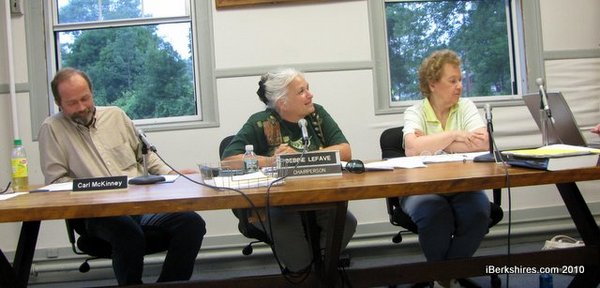
"Right now we have a call-in to our attorney," said Chairwoman Debra LeFave to Kyle George, representing H.A. George. "This is kind of a weird predicament so we're going to have to take it under advisement unless you can guarantee Berkshire Metal Spinning doesn't get hooked up."
George assured that steps would be taken at this point to prevent M&G from tying in.
But Frank Vigna, who said he does maintenance for M&G, protested that Berkshire Metal Spinning doesn't exist - it was dissolved through several bankruptcies. And he doesn't own the building. He doesn't know who does because he doesn't know who the trustee of the bankruptcy is. "Maybe he's dead now."
"How can you deny somebody heating their building?" Vigna asked (It was later learned the building had not been receiving propane from George for at least a year). "How can you deny the town their taxes," Lefave countered.
The Selectmen told him the landlord had to appear before them. At that point, he said, "it's owned by the state of Massachusetts."
"That's not our problem," said LeFave. "Then the state of Massachusetts has to come in. Until those taxes are paid, you're not allowed to get a permit."
Yet Vigna insisted he didn't know who his landlord was despite working in the business there for years. "I take care of the maintenance of the building for our company." LeFave responded, "how can you be in a building not owned by anybody?"
The more Vigna talked, the deeper the hole got. "I'm not renting it from anybody, there's nobody to rent it from." Selectmen Carl McKinney asked if he was squatting in the building. "If that's the case I've been in there so many years ...," he said, only to have McKinney jump in, "if you're claiming ownership, you have to pay the taxes."
Turns out Vigna, who claimed at first to be a former "worker" for Berkshire Metal Spinning, was actually the owner. The company was dissolved, purportedly through a liquidation of assets by bankruptcy, in 1998. Just prior to that, Vigna's new company at 161 River Road, Custom Metal Spinning and Finishing Inc., was created. That was dissolved in 2007 (the state has a lien of $244.90 on it) and a new company, M&G Custom Metal Inc. was filed with the secretary of state's office as operating out of the same building but owned by a Debra A. Blanchard, who shares the same Adams address as Vigna.
Vigna was put out when he discovered the town had taken the property to Land Court; the Selectmen responded that he wasn't the owner so it really wasn't his business, was it?
The roundabout conversation went on for sometime after the hearing but the outcome didn't change. Until somebody, anybody, pays the taxes on 161 River Road, it can't be listed on any permits. M&G's portion of the hearing was continued to Aug. 25 when the town's counsel was expected to offer an opinion.
In other business:
►The town learned that its application for a federal grant for senior housing had been rejected. Canales said a debriefing of the application would be offered to the town in August to determine why it didn't make it in this round. Elder Service of Berkshire County expected to apply again, depending on the debriefing.
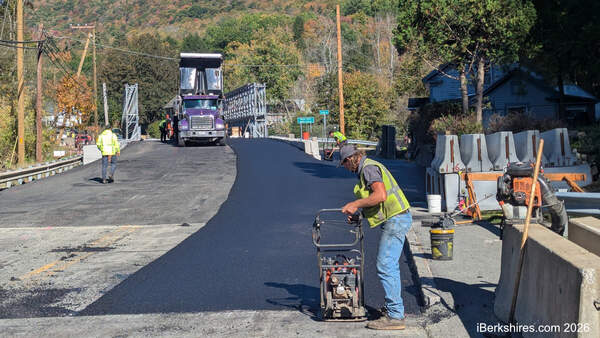
►The East Road bridge will require more reconstruction than expected. Should the town not receive its STRAP, Small Town Road Assistance Program, funding expected for road paving next year will have to be delayed because the town will have to spend an estimated $250,000 to fix the bridge.
►The dam removal project is $128,000 short. The town will solicit bids to determine actual costs before asking the voters if they wish to fund the balance of the project.
►The Planning Board's election of Tom Jammalo to a vacant seat on the board was approved by the Selectmen.
►The board approved a package license for Clarksburg Variety, which reopened last week after being closed since last year. Owner William Kelly said the response has been good. The convenience store will be open from 8 to 9 Monday through Saturday and noon to 6 on Sunday.