Williamstown Eyes Urban Living Units
 Planner Ann K. McCallum envisions townhouses and residential apartments that will fill a housing need and help link Spring and Water streets. |
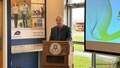
In a presentation to the Selectmen on Monday night that was filmed by WilliNet, Planning Board member Ann K. McCallum, a principal in Burr and McCallum Architects, presented a concept of residential and potential retail that could serve as the lifeline between the town's two commercial districts on Spring and Water streets.
McCallum said her research found "the thing that did cause great excitement — the one thing that everybody wants down here — was housing." She recalled a conversation with the late Donald Westall, a longtime local businessman, in which he'd expressed his own interest in a living in a townhouse development on the property.
Not just local residents were longing for central living, she said. "Another group is Williams College parents, believe it or not, who follow their students to Williams College. ... They want a little pied-a-terre in Williamstown. The alums are also keen to have a little a pied-a-terre where they can walk to the football game or go have a coffee."
Aging people would like flats, to be able to take an elevator up to their floor and not have to deal with stairs; professors were also another group interested in housing that doesn't come with lawns and maintenance. McCallum said there didn't seem to be a lot of call for more commercial space at the moment.
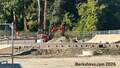
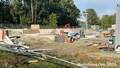
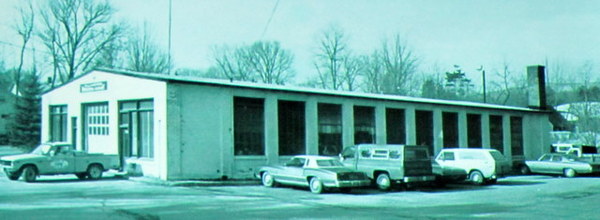
The lot's been vacant since the condemned town garage, a former auto dealership, was torn down in 2003. There has been discussion over the possibilities for the site but only one developer responded to a request for proposals several years ago — and asked for the money to do something with it.
McCallum designed a housing plan that would be framed by a new street linking Water Street to Meacham Street (currently a dead end) on the south and the college's Heating Plant Drive on the north. Ten townhouses with minimal yards would face the new street — about 400 feet of frontage — and a complex of large apartments on three for four floors with opportunities for retail of some type would face Water Street.
"We want this to be a part of our urban fabric, we don't want it to be a little piece of suburbia down there," she said. "That doesn't fit with our idea of what should happen in this part of town."
The challenge would be to link the empty site to Spring Street over an area now strewn with very large Williams College facilities. "It has all the charm of a Costco parking lot," said McCallum.
 Pedestrian paths across Williams College-owned land would connect Spring Street to the new development. |
Should Williams re-embark on the building frenzy cut short by the Great Recession, McCallum said it could potentially free up the space were the facilities building is currently located and move the activities now in the 1902 heating plant building, leaving that structure for development.
"If you took the paving away from right in front of it, set it out on a lawn, it could become the centerpiece of the block ... where five different routes converge ... with the smokestack as the beacon in the center," she said. "And then you're halfway to Water Street."
Selectman David Rempell questioned the ability to sell any housing because the interest in the Cable Mills project hasn't been as high as hoped. "I agree with what you said about how people might be interested," he said. "My concern is if we are having so much trouble finding interest 100 yards down the block is there significant demand to warrant another residential development?"
Town Manager Peter Fohlin said the price range would be different and any development would likely be closer to the affordable housing happening at the former St. Raphael's Church.
Daniel and Betsy Epstein, who purchased two buildings on Meacham Street and developed them into four condominiums, said they had only sold one unit before the market collapsed. However, they've rented the other three and said they've been happy with the type of tenant they've attracted — people affiliated with Williams College, the Clark Art Institute and the Williamstown Theatre Festival.
 Daniel Epstein said he hasn't been able to sell all four condos he developed on Meacham but has had good luck in renting the units. |
The next step will be to look at zoning issues and options. The Selectmen suggested creating a subcommittee under the Planning Board that would include members outside the board as a way to build consensus toward a more developed plan. McCallum is also planning presentations to various groups in town.
In other business, the town instituted water-use limits during the 9 to 5 daylight hours on the orders of the state. The town has plenty of water, Fohlin said, "this is an unnecesssary ban ... but we are obligated because we have a water-withdrawal permit with [the Departmentof Environmental Protection]."
The state looks at water table depth to determine drought conditions; however, the town has a dual aquifer system in which the wells it's pulling from are not connected to any local bodies of water. Residents will be restricted in nonnecessary water use such as washing cars, water lawns and gardens, and washing exterior buildings, sidewalks and driveways between 9 and 5.
Fohlin also reported that with the private One Care's purchase of Sweet Brook Care Centers and Sweetwood Retirement Community from Northern Berkshire Healthcare, the payment in lieu of taxes in no longer in force. The town sent an estimated bill of $76,601.08. More on the town manager's report can be found here.