Du Bois Center Celebrates Five Years with Awards, Music
.jpg) Randy Weinstein, director of the Du Bois Center in Great Barrington. |
It wasn't pretty: there were charges and countercharges over racism and patriotism, communism and activism. In the end, the NAACP's founder and first leader got a street sign — and a small center dedicated to teaching and preserving his legacy.
The Du Bois Center celebrated its fifth anniversary on Saturday and presented the annual Du Bois Center Pioneer Award to two county residents for their efforts, like Du Bois', to "open the way."
"Five years can feel like an eternity and like the blink of an eye," said director and founder Randy Weinstein at a reception at Bard College at Simon's Rock. "Five years ago, we opened the center with crossed fingers and a shoestring budget. It's time to take stock of our mission and our relevance. We've served thousands of folks with our programs and given them a space for unfettered learning, using the past as a vehicle to understand the present. Du Bois always maintained that education is essential to change and that our progress is made by evolution not revolution."
Scholars, supporters and performers, including singer and actor Nicolle Rochelle and jazz composer and trombonist Craig Harris and his ensemble, gathered at the college's Daniel Arts Center to honor Du Bois and the legacy that is now cemented into the town's identity.
Without a doubt, Du Bois' legacy in the Berkshire has evolved with the center. Until recently, Du Bois, a leading black philosopher, sociologist, historian, civil rights activist and writer (he wrote "The Souls of Black Folks," first published in 1903) has had a turbulent relationship with his hometown and vice versa that continued for decades after his death in 1963.
In more recent years, with the help of scholars and activists, the community seems to have embraced the man best known for his work in trying to remove the "veil" between blacks and whites in America. The center, established in 2006 near the Mahaiwe Cemetery, where Du Bois' first wife and two children are buried, has been an integral part of that effort that now includes a parking area and trail to his homesite. The center annually recognizes two inviduals with its Pioneer Awards, this year recognizing the preservationist and activist efforts of philanthropist Rachel Fletcher and composer and musicologist Maurice Peress.
"I met Du Bois once," Peress said after receiving his award. "I was at one hospital waiting for my daughter to be born and he was at the hospital just across the street waiting for the birth of his great-grandson. I went across the street to check on things; my wife was good friends with his granddaughter. I could tell that there was someone big in that room. And when I moved here to the Berkshires, knowing that he had lived here somewhere, made me feel a little more at home. His heart would have been huge knowing that we have [Barack] Obama as our president."
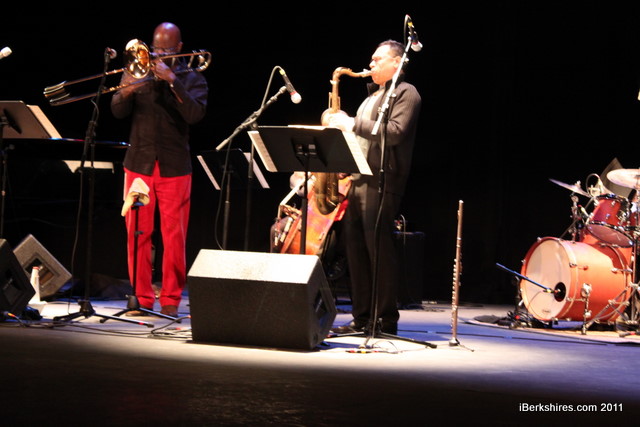 Craig Harris and his ensemble play excerpts from 'Souls Within the Veil.' |
"They were in the process of creating an African-American burial ground there," she said. "And they spoke the names of those people out loud at the ceremony. In some cases it was a nickname. The recitation of these names is a memory that moved me beyond comprehension. Du Bois and other African Americans in this area have a very compelling story. These efforts have brought together scholars, community leaders and community activists."
The ceremony closed with a performance of original songs from Harris' album "Souls Within the Veil," which was inspired by lines and chapter titles from "The Souls of Black Folks." The fifth anniversary celebration will continue with a film viewing and discussion at the center. It is part of a monthlong celebration honoring Du Bois as an educator, coordinated by the Upper Housatonic Valley African American Heritage Trail, which also includes Friends of the Du Bois Homesite, Clinton AME Zion Church, Du Bois Center of the University of Massachusetts at Amherst, Norman Rockwell Museum and Massachusetts College of Liberal Arts, among others.
Updated the same day to include more information on events.