Women's Conference Encourages Justice Through Writing
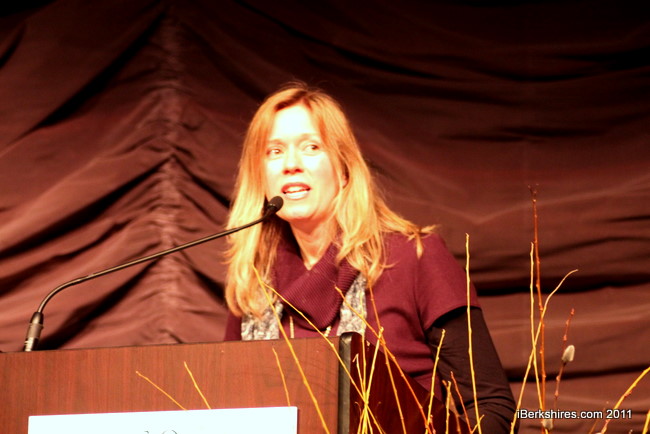 Journalist Christina Asquith talks about women's rights in a 'new' Iraq. |
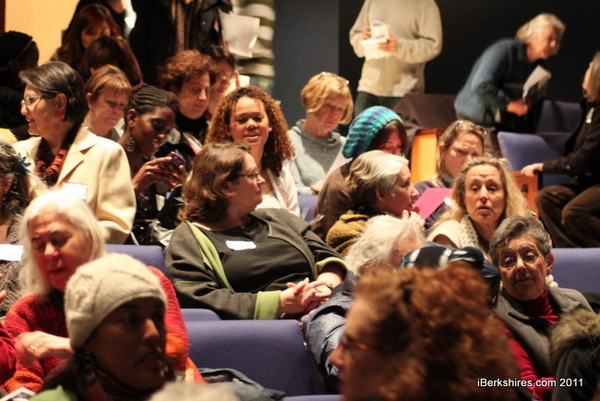
The 10th annual International Women's Day Conference held at Bard College at Simon's Rock on Saturday hosted a packed house of students, teachers, business owners, writers and artists from across the county.
The conference theme "Women Write the World" drew presenters from literary genres including American Indian poet Deborah A. Miranda, journalist Christina Asquith, novelist and essayist Nathalie Etoke, and biologist, author and keynote speaker Sandra Steingraber, to name a few. According to conference founder and Simon's Rock professor Jennifer Browdy de Hernandez, this wide selection of writers do share the common thread of activism in their work and their public voices.
"We have women here from every walk imaginable, so we have a lot to talk about this afternoon," she said on Saturday. "When I first started this conference, I was struck by the fact that International Women's Day was celebrated all over the globe but rarely was it celebrated in the U.S. Yet here in the Berkshires, we have been supported by many local businesses and individuals. This conference contains a double-entendre of 'write' and 'rights' and how women use writing to make the world a better place."
Browdy outlined the many contributions of women's storytelling and writing, beginning with "Sheherezade's 1001" tales to Emma Goldman's unabashed support of socialism and body rights.
"The connection is that a woman, in any time period, was using a pen and her voice to demonstrate that the very personal is political," she said.
For most of the presenters, the personal experience, be it heritage, war, menopause or disease, is often what inspired the call to political action via words and writing. Asquith, a 15-year veteran journalist who spent 18 months as a correspondent in Baghdad, chronicled the her observations of the effects of war on Iraqi women in her book, "Sisters in War: Love, Survival and Family in the New Iraq."
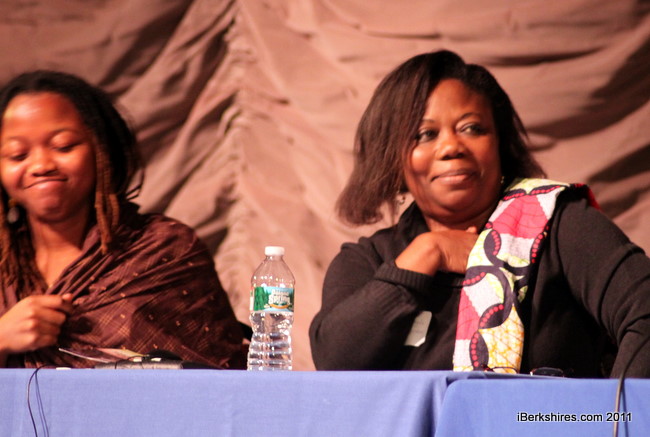 Omotayo Jolaosha and Pauline Dongala address the state of women in Africa. |
Once in Iraq, Asquith discovered that the women there were strongly divided when it came to issues of "liberation."
"Women's rights did not spring forth once the Americans arrived," she said. "In fact, many women I spoke with were afraid to leave their homes because the streets became extremely unsafe. Many also rejected the way that Americans lived and they did not see these choices as expressions of freedom. There were conferences around the country as women discussed what to do in the 'new Iraq.' Some women would be shouting at each other, things got nasty and personal. There was a strong debate amongst Iraqi women."
The outspoken political arena of war presented a stark contrast to the voices of women of Congo-Brazzaville and other parts of Africa, who for years have been silenced by war and a social structure that favors silence over empowerment. Pauline Dongala, a bachelor's degree student at Simon's Rock who fled her native Congo in 2000, said her mission is to break the silence by using her voice and the voice of her 74-year-old mother.
"I am giving voice to those who have not had the chance to be heard," Dongala said. "The last time my mother visited me in Great Barrington, I interviewed her. My purpose was to let my mother speak her own words as a wife and then a widow who raised and supported 14 children on her own in a place where widows have no protection. She said her purpose became to 'see my children focus on their studies. This gave me strength.' She lives in France now, she is 74 years old and she is going to school to learn to read and write."
Overcoming obstacles of gender, race and culture can be, according to Steingraber, an insurmountable task fraught with fear, especially when we ruminate on the future of the environment.
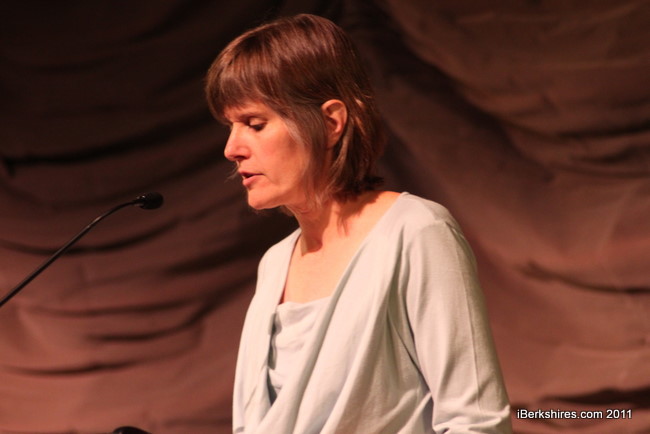 Keynote speaker Sandra Steingraber |
She said that this "well-informed futility syndrome" can only be overcome by "reaching out to the hearts" of people, not with overwhelming numbers and data, but with images and metaphors.
"I rely on story and narrative. It can do things that data can't," she said. "For Halloween, my son at age 4 wanted to be a polar bear. I made him the costume with the knowledge that the costume would outlast the species. And what about all the butterfly, bee and penguin costumes hanging in the closets? Behind every data point is a life."
In fact, according to Steingraber, life even in its beginning stages, is in danger of contamination.
"Women's bodies are the first environment for all of us," she said. "With that knowledge we have a responsibility to action. As parents we have two duties, to keep our kids safe from harm and to protect their future. Climate change and other disasters are robbing us as parents of our sacred duties."