image description
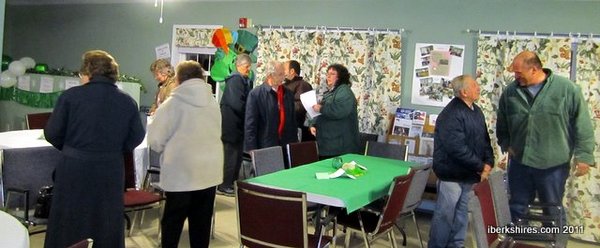
Voters cast ballots at the Senior Center, which was festively decorated in green for St. Patrick's Day.

Florida Approves First Step For Broadband System

By Kathy KeeserSpecial to iBerkshires
Print Story | Email Story

Moderator Stan Brown, Town Clerk Lisa Brown and Town Administrator Christine Dobbert prepare for the special town meeting.
FLORIDA, Mass. — Voters on Wednesday night approved the establishment of a municipal lighting plant, taking the first step in the development of a cooperative broadband system.

About 30 voters took time out to decide four articles at Wednesday's special town meeting, deciding on school repairs, broadband and wind projects.
 
The first two articles gave town approval to the continuance of repairs to Gabriel Abbott Memorial School, including to the roof and to the water main. Both warrants quickly passed 28-0.

The third article continued the town's commitment to the WiredWest initiative. In a ballot vote of 30-1, voters approved the establishment of a municipal lighting plant, in accordance with the provisions of General Laws, Chapter 164, for all purposes including the operation of a telecommunications system and any related services. The law was created more than 100 years ago to allow municipalities to establish electrical utilities and was updated 15 years ago to accommodate telecommunications.
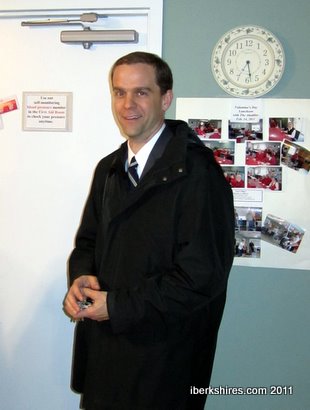

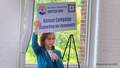
Attorney Jamie Art explained the article on roads to the wind project.
Adopting the article allows the town to join the WiredWest Cooperative and means that Florida will have a voice in the decision-making process as the nonprofit undertakes the capitalization, buildout and operation of a municipal fiber-optic network in participating towns. The hope is all 47 charter towns in Western Massachusetts will approve municipal light plants to buildout the system.


Florida is the 25th charter town to approve a municipal system. All the cooperative towns have to vote twice within 13 months and pass the question with two-thirds votes each time.

The final article gave the next stage of approvals in the Hoosac Wind Project. This article that passed with a majority vote gives the town access to the easement roads to the project. As clarified by Florida's attorney for the Hoosac Wind Project, Jamie Art, in the event of the shutdown of the project, the town would have the rights to any funds left connected with the easements and the right to use the easement roads put in by Hoosac Wind to tear down the wind towers if necessary.

The articles all passed quickly, with only a few brief questions or clarifications. Because Article 3, the WiredWest broadband article, required a ballot vote, it took about 20 minutes for the 31 people to file up, be checked in and cast their ballot. But folks didn't seem to mind and everyone was chatting away with their neighbors while waiting for the ballots to be cast and then continue with the final article.

The town meeting concluded after a little over a half-hour of time from start to finish.
If you would like to contribute information on this article, contact us at info@iberkshires.com.

Pittsfield: Should Park Square Be an Historic District?

By Brittany PolitoiBerkshires Staff

PITTSFIELD, Mass. — The committee drafting a proposed local historic district around Park Square wants to generate interest and participation in the process. 

Members launched the charge during meetings in August and September. A survey and public hearing are planned to gather feedback early on. 

City Planner Kevin Rayner explained they are not just doing this out of a love for historic buildings, but for the timeless sense of place you get when you step into Park Square, which was laid out over 200 years ago and hosted the first-ever agricultural fair in 1810. 

"I think that the main thing that we need to kind of park on is that this is the heart of our community, and it really sets the stage for the sense of place in Pittsfield, and any change to that should have some review and some consensus from folks who have a passion for protecting the history and that character of Pittsfield," he said to the new Local Historic District Study Committee last week. 

"And there's that private property versus historic resource thing, but I’d say that a lot of these buildings on the square belong to the soul of Pittsfield here, and deserve to be protected, and I don't think that the layer of regulation that we're throwing down here is going to be unreasonable or a real boundary." 

In March, the City Council voted to amend the City Code, Chapter 2, to establish the study committee.

Pittsfield has more than 20 locations on the National Register of Historic Places, including the Park Square Historical District, but the designation just allows communities to apply for federal tax credits and doesn't impose restrictions on buildings. The central area was laid out a few decades after Pittsfield was given a town charter in 1761.

A district can be one building, several buildings, or an area. Historic restrictions only apply to the exterior of buildings; the committee has authority to say a building in the district cannot be demolished. 

View Full Story

More Florida Stories