Area Hospitals, Schools Learning Diversity, Sensitivity
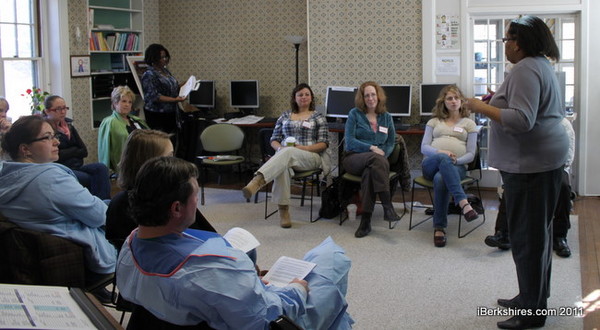
GREAT BARRINGTON, Mass. — Berkshire County is not an area known for its diverse population. However, the recently released 2010 Census shows all of that is changing.To keep up with these demographic changes, many local schools and organizations are employing diversity training as part of their educational programming. Gwendolyn Hampton VanSant, co-founder and director of Multicultural Bridge in Housatonic, said she and her staff are busier than ever before reaching out to schools, hospitals and other businesses in the hopes of promoting cultural awareness.
"This country is going through a major shift right now," VanSant said at a recent training at Fairview Hospital. "The only growing populations in Berkshire County [is] the immigrant population and the African-American population. Look at our governor, look at the president, look at how many people came out to vote. This is a national trend going on. This stuff is very important. I'm happy with the census, it means that more services for Berkshire county. We know our community is changing."
VanSant is not the only one who recognizes the need for cultural sensitivity training. Doreen Hutchinson, vice president of operations and patient care at Fairview, said the much-needed training is a long time coming and can only result in better patient care.
"We've contracted with Bridge for two years," she said in a phone interview. "We did an assessment of our emergency and admitting departments and this was the result of a few recommendations we received. This area is very white and we can all benefit from having cultural sensitivity training. It's very different from the faith-based training we've had in the past. We need to get our staff people to really learn a lot about what it's like to be from a different culture."
Hutchinson said one of the specific challenges at the hospital is knowing when to call for a translator, particularly in the emergency department, where nearly 80 percent of patients are admitted
"The emergency department is sometimes struggling with when to call an interpreter and when to use the interpreter phone," she said.
"There have been a couple of events, even in the treatment of patients, which warranted this training. There is definitely room for improvements. We struggled to find trained interpreters so that we could offer that to people who speak Spanish. I also wrote a grant so that we could offer conversational Spanish and a CPR class in Spanish. The one thing I do know about the Hispanic community here is that they are very tight-knit and news, any kind of news, travels quickly. We need to re-group and look at what we are doing. We care for many Spanish-speaking people and we have to change how we respond and make sure that we are able to treat patients and treat them well."
Fairview is not the only institution in the area that has recognized the need for sensitivity and cultural training. Luci Leonard, board member for the Massachusetts Association of Community Health Workers and outreach worker for CHW Alliance of Berkshire County, said health workers and trainers across the state are making understanding diversity their mission.
"A major piece of diversity and sensitivity training is that we want individuals to check themselves. That does not happen often," she said. "It's not about telling someone to be meeting them where they are. Regardless of who you are you have power. How you use that power is a focal point of the training. We are in a population where gaps already exist — structural gaps, organizational gaps. Culture is not black and white. We need to use community health workers as cultural liaisons to help with ethnic and cultural disparities."
Leonard said she will continue to try to bridge gaps in the community, including schools and workplaces, but that it is up to parents, teachers and employers to take that first step.
"This is only going to work if we own this," she said.
The next event of the CHW Alliance of Berkshire County is May 16, 2011 at Christian Center in Pittsfield beginning at 10 am. This a part of the 7 part series entitled "Unnatural Causes."