Rockwell Painting To Be Exhibited at The White House
Norman Rockwell MuseumPrint Story | Email Story

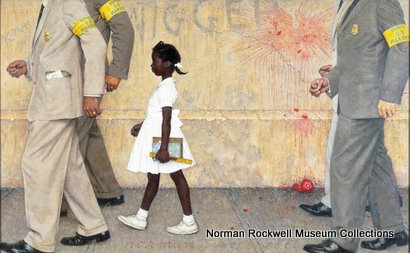
Norman Rockwell's 'The Problem We All Live With,' which appeared in Look in 1964, is being loaned to the White House this summer.
STOCKBRIDGE, Mass. — Norman Rockwell's iconic painting "The Problem We All Live With," part of the permanent collection at the Norman Rockwell Museum, is being loaned to the White House, where it will be exhibited through Oct. 31.

The loan was requested this year by President Obama, in commemoration of the 50th anniversary of Ruby Bridges' history-changing walk integrating the William Frantz Public School in New Orleans on Nov. 14, 1960, that later inspired Rockwell's bold illustration for a 1964 issue of Look Magazine.

"The Problem We All Live With" was the first painting purchased by the museum in 1975. The White House loan was made possible through the support of the Henry Luce Foundation.

"Norman Rockwell Museum is deeply honored that the White House has requested the loan of one of Rockwell's most important paintings," said museum director and CEO Laurie Norton Moffatt. "The painting has come to serve as an important symbol of civil rights, and museum Trustee Ruby Bridges Hall's historic journey. We are enormously grateful for the support of the Luce Foundation, that made the loan possible."

Bridges' historic walk took place six years after the 1954 U.S. Supreme Court's Brown v. Board of Education ruling declared that state laws establishing separate public schools for black and white students were unconstitutional, and represented a definite victory for the American Civil Rights Movement. Among those Americans to take note of the event was Rockwell, a longtime supporter of the goals of equality and tolerance. In his early career, editorial policies governed the placement of minorities in his illustrations (restricting them to service industry positions only).


In 1963, Rockwell confronted the issue of prejudice head-on with one of his most powerful paintings — "The Problem We All Live With." Inspired by the story of Bridges and school integration, the image featured a young African-American girl being escorted to school amidst signs of protest and fearful ignorance. The painting ushered in a new era in Rockwell's career, and remains an important national symbol of the struggle for racial equality.

"I was about 18 or 19 years old the first time that I actually saw it," said Bridges Hall. "It confirmed what I had been thinking all along — that this was very important and you did this, and it should be talked about ... At that point in time, that's what the country was going through, and here was a man who had been doing lots of work — painting family images — and all of the sudden decided this is what I am going to do ... it's wrong and I'm going to say that it's wrong."

The illustration appeared in the Jan. 14, 1964, issue of Look, and earned Rockwell letters of both praise and criticism from readers unused to such direct social commentary from the illustrator. Rockwell would revisit the theme of civil rights in several other illustrations from the period and, in 1970, received the Million Dollar Club Award from The National Association for the Advancement of Colored People (NAACP), for having contributed $1,000 to the organization.

Bridges Hall, who founded the Ruby Bridges Foundation in 1999 to promote the values of tolerance, respect, and appreciation of all differences, commends Rockwell for having "enough courage to step up to the plate and say I'm going to make a statement, and he did it in a very powerful way."

Tags: Rockwell Museum,   White House,   

If you would like to contribute information on this article, contact us at info@iberkshires.com.

West Nile Virus Confirmed in Mosquitoes From Pittsfield

Staff Reports

PITTSFIELD, Mass. — The Massachusetts Department of Public Health (MDPH) announced today that West Nile virus (WNV) has been detected in mosquitoes collected from Pittsfield.

The City of Pittsfield has confirmed two isolations at the Pittsfield-Richmond town line on Route 41 and the other at Garland Avenue.

WNV is most commonly transmitted to humans by the bite of an infected mosquito. The mosquitoes that carry this virus are common throughout the state and are found in urban as well as more rural areas. While WNV can infect people of all ages, people over the age of 50 are at higher risk for severe infection. 

At the time, there are no confirmed human cases of WNV, but residents are encouraged to take the following actions:

Avoid Mosquito Bites

  • Apply Insect Repellent when you go outdoors. Use a repellent with DEET (N, N-diethyl-m-toluamide), permethrin, picaridin (KBR 3023), IR3535 or oil of lemon eucalyptus [p-methane 3, 8-diol (PMD)] according to the instructions on the product label. DEET products should not be used on infants under two months of age and should be used in concentrations of 30 percent or less on older children. Oil of lemon eucalyptus should not be used on children under three years of age. Permethrin products are intended for use on items such as clothing, shoes, bed nets and camping gear and should not be applied to skin. 
  • Clothing Can Help reduce mosquito bites. Although it may be difficult to do when it’s hot, wearing long-sleeves, long pants and socks when outdoors will help keep mosquitoes away from your skin.
  • Be Aware of Peak Mosquito Hours - The hours from dusk to dawn are peak biting times for many mosquitoes. When risk is increased, consider rescheduling outdoor activities that occur during evening or early morning. If you are outdoors at any time and notice mosquitoes around you, take steps to avoid being bitten by moving indoors, covering up and/or wearing repellant.

Mosquito-Proof Your Home

  • Drain Standing Water – Many mosquitoes lay their eggs in standing water. Limit the number of places around your home for mosquitoes to breed by either draining or getting rid of items that hold water. Check rain gutters and drains. Empty any unused flowerpots and wading pools and change water in birdbaths frequently. 
  • Install or Repair Screens - Some mosquitoes like to come indoors. Keep them outside by having tightly-fitting screens on all your windows and doors.

While the City of Pittsfield and Berkshire County Mosquito Control project continue to work closely with the MDPH and other agencies, locally we are taking the following actions: larvicide application, conducting targeted education programs, distribution of fact sheets on WNV and on reducing exposure to mosquitos and treating catch basins.

Additional information about WNV and reports on current and historical WNV virus activity in Massachusetts can be found on the MDPH website at: www.mass.gov/dph/mosquito.

View Full Story

More Stockbridge Stories