'Asher Lev' a Heartfelt Struggle Between Faith & Art
PITTSFIELD, Mass.
What an amazing amount of wisdom and insight has been packed into the 90-minute play "My Name is Asher Lev" about a young Jewish painter growing up in a very orthodox household. This play is about being an orthodox Jewish boy, but it could be about any child being talented in a non-nurturing home. Anyone can relate to the story without needing to be Jewish. And if you are, well, then you are in for a real theatrical treat.
 This is a play that is likely to hit a nerve, after all. How many of you heard discouraging words about careers in the arts or humanities or other career choices when you were younger. "Be a doctor," we were told, "or a lawyer, ditch digger, anything, but not an artist!" Especially if you were male, which meant your whole manhood was often called into question when uncomprehending fathers were terrified out of their wits about the prospect of an "artistic" son. At least with Asher Lev, it was more a question of drawing simply being dismissed as a foolish waste of time better left to the goyim.
I was raised in a conservative Roman Catholic household with a disciplinarian father, and attended parochial school run by doctrinaire Dominican nuns. So I have some things in common with Asher Lev. That's why, from the moment the lights came up it was impossible not to became totally mesmerized by this story, adapted from the novel by Chaim Potok. His tale grabbed my heart and never let go.
With a stern Hasidic father (the Hasidim are the most conservative of the Jewish sects) and a mother who always reminded him to honor his father (and by proxy his every judgment) his home life was stifling, at least to the idea of being an artist. For Lev, art was something that grew, like a seed, from childhood on. Of course, he grew and blossomed throughout his childhood and teen years into a great artist.
Somehow he also managed — through a feat of juggling — to stay true to both his art and his religious tradition. On stage with all the players and situations it becomes a balancing act of amazing dexterity.
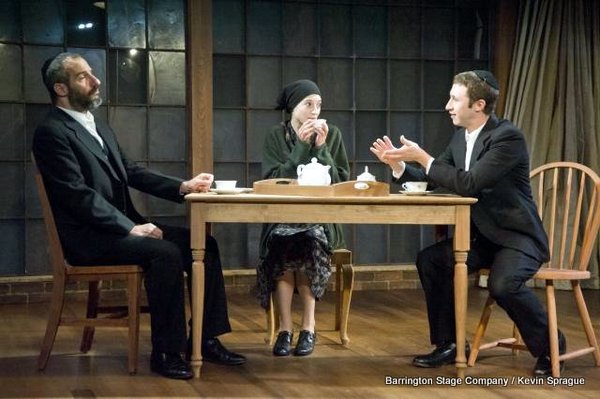
Adam Green plays Asher Lev as only a virtuoso actor can. Since the play details the early years in which his interest in drawing first developed, and then takes us by the hand through his long journey into a fully formed artist, Green has a lot of ground to cover. There are moments in which his acting is all internal, as when listening to his father or rabbi. Then there are the physical moments in which he first contemplates painting a nude, or is besieged at the gallery opening in which he reveals his mother upon a cross. His portrayal is so real, so organic it did not feel like acting at all, but simply the artist speaking to the audience. Green's every blink, every look was 100 percent in character. Being on stage for its full duration, there is not even a moment to scratch an itch for him. This is an actor with incredible control, and a total mastery of his character.
With Daniel Cantor as The Men (Aryeh the father, the uncle Yitzchok, the rebbe, the mentor Jacob Kahn) and Renata Friedman as The Women (mother Rivkeh, Anna Shaeffer and Rachel) three actors effectively portray eight important people in Asher Lev's life. The interchanges are intense.
|
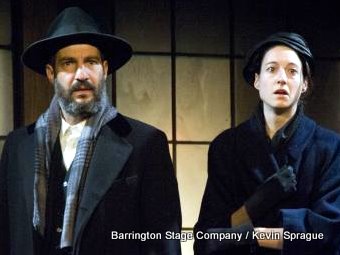
Directed by Aaron Posner, the actors had more focus than seen in the average play, utilizing an efficiency of movement and sense of purpose on the smallish stage. Perhaps that is why it seemed to open up, with effective lighting techniques by John Hoey and a truly flexible set with a bank of windows upstage that served as gallery, studio, museum, office and home depending on the backlighting.
As playwright and director, Posner weaves the various elements of this sweeping tale into a simple narrative biography. The drama and the tension comes from the clash of ideas with a culture, a religion, and it reverberates even today. When a religion tells you one thing but you are convinced it is wrong, do you discard your heritage or do you try to find ways to embrace both. In "My Name is Asher Lev," our young artist is seen to agonize over being true to his art, his feelings and his heritage.
Chaim Potok (1929-2002) wrote "My Name is Asher Lev" in 1972 and like his earlier book, "The Chosen" (1967), it was widely read. It created controversy then, and it still engenders very hostile reactions to this day. The struggle against repressive religions is still ongoing, whether Jewish, Islamic, Mormon or conservative Christianity.
In some circles it was condemned and is frowned upon to this day by those who place religion before self-fulfillment. To be obedient or to be creative seems to be a choice many have to make. Art is still seen by some as an egotistic and foolish impulse that is to be resisted in the name of conformity.
In fact, I was not shocked when I found that one Amazon book reviewer wrote: "I don't understand why there are so many people who liked this book. It's depressing, and gives a warped look into the life of Hasidic Jews, as seen through the eyes of a selfish, spoiled, willful child. At the end of it all, this child has hurt everyone who has loved and supported him — except for his 'mentor' and the gallery owner who became richer off of him. And he departs with the 'knowledge' that he will continue to hurt people, and why? Because he just HAS to paint ugly, tormented feelings. Sick."
This is indeed one of the messages that Asher Lev receives as the play draws to its conclusion and his artistic success is assured.
Asher: "People turned their backs on me at the synagogue. No one would speak to me or even look at me. The Rebbe called me to his office and told me it was time to leave. To leave Brooklyn. He was being asked questions he could not answer and I had crossed a line."
The play encompasses almost every important element found in the original book. Once again Barrington Stage has found and delivered a profound and powerful example of literate drama that stirs both heart and mind. In the heartbreaking struggle between art and faith, "My Name is Asher Lev" shows that there is no simple answer, or perfect balance. There only is the creative impulse, and our need to be true to it. It is a must-see for everyone.
Larry Murray is a contributor to iBerkshires.com and offers reviews and arts news from around the region at Berkshire On Stage.
Tags: Barrington Stage,