Greylock Glen Finds No Interest From Developers
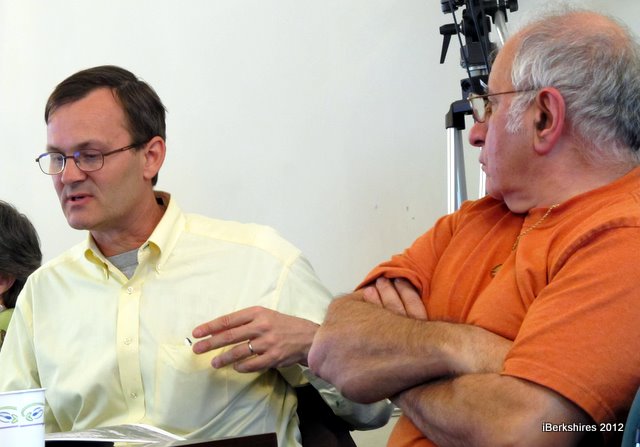 On the left, Edward Whatley, project manager for the building infrastructure at the Greylock Glen gave a detailed presentation on the work that is planned. |
In September, the committee blanketed developers, consultants, The New York Times, The Wall Street Journal, architects and real estate agencies asking for interest in developing a lodging and conference center on the 50 acres and received just one lonely response.
Now the committee is shifting focus back to developing campgrounds and hiking trails first in hopes to attract a developer in the future.
"We received a poor response," Donna Cesan, director of community development, said on Thursday. "I'm suggesting we focus more on the campground and put the conference center to the side for now."
The committee had originally planned to build a campground on the site first, followed by an amphitheater and lastly the conference center. Last year, the committee refocused on trying to generate support and finding an anchor for the project.
In September, the town sent out a request for expressions of interest to 30 developers, 30 developing consultants, advertised it in publications including New England Real Estate Journal and Boston Globe, and asked 25 other architectures, real estate and other development firms to share it with all of their contacts.
After receiving only one response by the Dec. 2 deadline, the committee had a consultant follow up with the developers to find out why there was no interest and the No. 1 reason was the economy.
"It is extremely difficult to secure private capital in this current economy," Cesan said. "About half of the respondents expressed concern about the location. They indicated that in this point in time, many firms can only secure financial backing in proven and primary markets like New York City or Boston."
Thirdly, developers shied away from the project because of a lack of nearby amenities, such as spas or fitness center, and the developer would have to construct those themselves and that it would not be possible without significant incentives from the town and state.
Committee member George Haddad said he wasn't surprised in the response because the of the size of the project.
"This is not going to be a quick and easy project," Haddad said. "I'm disappointed but I'm not surprised."
Without interest in the center, the committee will now try to make the land as "shovel ready" as possible by finishing permits, developing hiking trails and installing infrastructure. However, adding insult to injury, the project did not receive a $4.5 million MassWorks grant for the water, sewer, electric and road infrastructure but did receive $2 million from the state supplemental budget bill last year.
The committee planned $4.3 million in upgrades and the $2 million must be constructed by mid-2013. The committee will either have to scale back its infrastructure plan or find the additional funding. Cesan said the town has applied for $2 million through the federal Economic Development Administration and will continue to look at other funding option.
"I am confident it will all be paid by grants," Cesan said.
Edward Whatley, a project manager with the engineering firm Vanasse Hangen Brustlin hired for the infrastructure, suggested the project should focus this $2 million on digging as much of the roads as possible and installing water and sewer because the above-ground electric would not interfere with a possible development. A water tank that would provide fire protection to the campground would have to be scrapped this time around.
The series of setbacks for the project triggered fears of the same type of failure the town has seen on that land for years. Former Selectman Edward Driscoll got into a passionate back and forth with Haddad about the project. Driscoll said he feared the campground would be the end of development and the town will be stuck paying to maintain the area. Haddad responded by saying it was too important to the town to stop there. Development could last 30 years and the town will need to be careful and keep plugging away because it would reap benefits beyond the tax rolls, Haddad said.
"I think we're doing it the right way," Haddad said.
The plans for the infrastructure improvements are available below.
Greylock Glen Infrastructure Plans 2012
Tags: campground, Greylock Glen,