image description
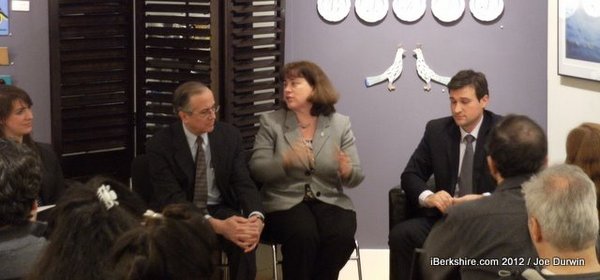
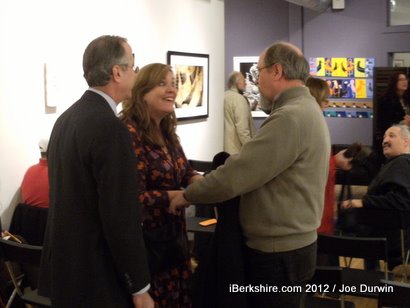
Mayor Daniel Bianchi, state Rep. Tricia Farley-Bouvier and Ward 6 Councilor John Krol talked art at the Ferrin Gallery on Wednesday night.

Pittsfield Solons Talk Art, Culture and Politics At Forum
By Joe DurwinSpecial to iBerkshires
Print Story | Email Story

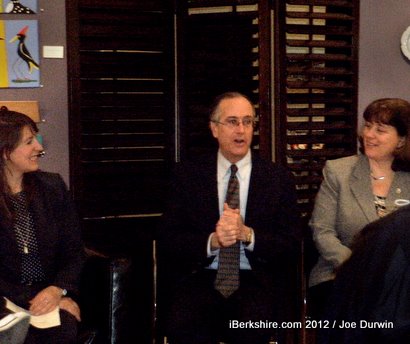
Former Berkshire Creative director and now the state's Creative Economy Industry Director Helena Fruscio, at left, attended the forum at Ferrin Gallery.
PITTSFIELD, Mass. — While local politicians have slightly different perspectives about the cultural scene, they all support the city's creative economy.

Mayor Daniel Bianchi, state Rep. Tricia Farley-Bouvier, and Ward 6 City Councilor John Krol fielded questions on Wednesday about the role of cultural scene at a panel discussion on "Art and Community" at North Street's Ferrin Gallery. The talk was moderated by Helena Fruscio, former Berkshire Creative director recently appointed as the state's "cultural czar," and at times touched on key political issues and recent controversies. 

In his first remarks, the city's new mayor was quick to dispel concerns that his administration would oppose the kind of cultural development that, as Fruscio put it, "has become a model throughout the state."

"While I was running for this office, one of my opponents' campaigns had dubbed me as the cultural Attila the Hun," said Bianchi, "While that makes a provocative image, it's ultimately inaccurate."

While Bianchi felt the main role of a mayor was to run a "safe, clean, efficient city," while attracting new business, he acknowledged that "a community that embraces the arts is one that's going to be attractive," to such enterprises.

Krol, who also participated in the downtown cultural push of recent years as the city's public affairs coordinator and as host of the "Good Morning Pittsfield" radio talk show, talked about obstacles overcome in making Pittsfield a more culture-savvy city. 

"It didn't just happen. It was really hard work," he said. "When we decided to put a $1 million to make the Colonial Theatre happen, that was a good decision. We invested a half-million dollars in Barrington Stage Company, and ultimately a loan for the Beacon Cinema. Those were decisions where each one became easier after we made the first hard one. The first hard one, of course, was the Colonial."

Krol's specific endorsement of the Colonial Theatre allocation highlighted one of the most politically contested issues in the history of Pittsfield's cultural growth in the past decade. Bianchi, while a councilor, voted in favor of both the Barrington Stage and Beacon Cinema, but opposed the $1 million funding to the Colonial. Krol, who first took office in 2010, was not on the council at the time these measures were approved.

As Berkshire County's most junior state legislator, newly elected Farley-Bouvier said she has spent a lot of her first few weeks in office meeting with groups and individuals, including those in the cultural sector, to hear their concerns. She urged members of the arts community to take charge of advocating for their issues and educating their elected representatives.

"Teaching your elected officials about your issues, and your needs is critical," said Farley-Bouvier. "Don't underestimate how effective you can be."

"Come to me with information, and teach me about what you do," the legislator told the 40 or so attendees, representing a multitude of different interests in the local cultural economy. "Be organized, and advocate. When it comes times for funding for issues, don't sit back and think someone else is going to do it for you. Be aggressive."


A discussion of cultural and city planning in other Northeastern cities meandered through other recent hot-button issues in local government, including Pittsfield's ongoing parking issues, PEDA, and methadone clinics.

Krol, in particular, pointed to the city of Saratoga, N.Y., as an example of solid modern city planning, and referenced his own proposal to prohibit methadone and Suboxone clinics in the downtown area as the type of measures of foresight that yielded successful downtown revitalization.

The councilor also briefly mentioned the Pittsfield Economic Development Authority, whose proposed plan to introduce retail into the former General Electric industrial properties has met fire recently, "planning, and sometimes patience, are critical."

When asked to pick their favorite cultural institution, the officials picked a trio that covered a range of the new enterprises and initiatives that have sprung up in the city over the past six years. 

Bianchi, who said he "wrestled with a lot of the initiatives," the city funded, pointed to Barrington Stage Company as a particular success story, in part because of its youth mentoring program. When approving the half-million for BSC on the City Council, Bianchi said he pressed director Julianne Boyd at the time for a commitment to help disadvantaged youth. 
"We've got challenges that other communities around us don't have," he said, and that Boyd "performed above and beyond" in responding to this need with the current youth programs.

Farley-Bouvier chose 3rd Thursday as her favorite new development. 

"It brings everyone together," she said, including the city's youth, and many families that would not ordinarily consider themselves part of the "arts and culture crowd."

Krol gave the nod to downtown nightspot Mission Bar and Tapas, which opened in 2008 and has since spawned a vastly increased local music and literary performance scene around it's activities there and in other venues. Krol cited Mission as a focal point for "the kind of youthful energy that we need... the more that we can drive that sort of idea, I'm in favor of that."

The "Art and Community" discussion was one of three hosted this week as part of the ongoing Tricks of the Trade series. Tricks of the Trade is a professional development series for artists and creatives who are looking to build a career and engage with the community, developed by MCLA’s Berkshire Cultural Resource Center in partnership with IS 183 Art School in Stockbridge and Ferrin Gallery in Pittsfield.

Tags: creative economy,   cultural economy,   forums,   MCLA,   
If you would like to contribute information on this article, contact us at info@iberkshires.com.

Pittsfield 2025 Year in Review

By Brittany PolitoiBerkshires Staff

PITTSFIELD, Mass. — The city continued to grapple with homelessness in 2025 while seeing a glimmer of hope in upcoming supportive housing projects. 

The Berkshire Carousel also began spinning again over the summer with a new patio and volunteer effort behind it.  The ride has been closed since 2018. 

Founders James Shulman and his wife, Jackie, offered it to the city through a conveyance and donation of property, which was met with some hesitation before it was withdrawn. 

Now, a group of more than 50 volunteers learned everything from running the ride to detailing the horses, and it is run by nonprofit Berkshire Carousel Inc., with the Shulmans supporting operating costs. 

Median and Camping Petitions 

Conversations about homelessness resumed in Council Chambers when Mayor Peter Marchetti proposed a median standing and public camping ban to curb negative behaviors in the downtown area.  Neither of the ordinances reached the finish line, and community members swarmed the public comment podium to urge the city to lead with compassion and housing-first solutions. 

In February, the City Council saw Marchetti's request to add a section in the City Code for median safety and pedestrian regulation in public roadways.  In March, the Ordinances and Rules subcommittee decided it was not the time to impose median safety regulations on community members and filed the petition. 

"If you look at this as a public safety issue, which I will grant that this is entirely put forward as a public safety issue, there are other issues that might rate higher that need our attention more with limited resources," said former Ward 7 councilor Rhonda Serre. 

The proposal even ignited a protest in Park Square

Protesters and public commenters said the ordinance may be framed as a public safety ordinance, but actually targets poor and vulnerable community members, and that criminalizing activities such as panhandling and protesting infringes on First Amendment rights and freedom of speech. 

In May, the City Council sent a proposed ordinance that bans encampments on any street, sidewalk, park, open space, waterway, or banks of a waterway to the Ordinances and Rules Subcommittee, the Homelessness Advisory Committee, and the Mental Health and Substance Abuse Task Force.

Several community members at the meeting asked city officials, "Where do unhoused people go if they are banned from camping on public property?"

It was referred back to the City Council with the removal of criminalization language, a new fine structure, and some exceptions for people sleeping in cars or escaping danger, and then put in the Board of Health’s hands

Housing 

Some housing solutions came online in 2025 amidst the discourse about housing insecurity in Pittsfield. 

The city celebrated nearly 40 new supportive units earlier in December.  This includes nine units at "The First" located within the Zion Lutheran Church, and 28 on West Housatonic Street. A ceremony was held in the new Housing Resource Center on First Street, which was funded by the American Rescue Plan Act. 

These units are permanent supportive housing, a model that combines affordable housing with voluntary social services. 

Terrace 592 also began leasing apartments in the formerly blighted building that has seen a couple of serious fires.  The housing complex includes 41 units: 25 one-bedrooms, 16 two-bedrooms, and three fully accessible units. 

Pittsfield supported the effort with $750,000 in American Rescue Plan Act funds and some Community Development Block Grant funds. Hearthway, formerly Berkshire Housing Development Corp., is managing the apartments and currently accepting applications.

Allegrone Construction Co. also made significant progress with its $18 million overhaul of the historic Wright Building and the Jim's House of Shoes property.  The project combines the two buildings into one development, retaining the commercial storefronts on North Street and providing 35 new rental units, 28 market-rate and seven affordable.  

Other housing projects materialized in 2025 as well, including a proposal for nearly 50 new units on the former site of the Polish Community Club, and more than 20 units at 24 North St., the former Berkshire County Savings Bank, as well as 30-34 North St.

Wahconah Park 

After the Wahconah Park Restoration Committee completed its work with a formal recommendation in 2024, news about the park was quiet while the city planned its next move.  

That changed when it was announced that the city would bring outdoor ice skating back with a temporary rink on the baseball park’s lawn.  By the end of the year, Pittsfield had signed an exclusive negotiating agreement with the Pittsfield Suns baseball team.  

The ice rink was originally proposed for Clapp Park, but when the project was put out to bid, the system came back $75,000 higher than the cost estimate, and the cost estimates for temporary utilities were over budget.  The city received a total of $200,000 in donations from five local organizations for the effort. 

The more than 100-year-old grandstand’s demolition was also approved in 2025.  Planners are looking at a more compact version of the $28.4 million rebuild that the restoration committee recommended.

Last year, there was $18 million committed between grant funding and capital borrowing. 

The Parks Commission recently accepted a negotiating rights agreement between the city and longtime summer collegiate baseball team, the Pittsfield Suns, that solidifies that the two will work together when the historic ballpark is renovated. 

It remains in effect until the end of 2027, or when a license or lease agreement is signed. Terms will be automatically extended to the end of 2028 if it appears the facility won't be complete by then. 

William Stanley Business Park 

Site 9, the William Stanley Business Park parcel, formerly described to have looked like the face of the moon, was finished in early 2025, and the Pittsfield Economic Development Authority continues to prepare for new tenants

Mill Town Capital is planning to develop a mixed-use building on the 16.5-acre site, and housing across Woodlawn Avenue on an empty parcel.  About 25,000 cubic yards of concrete slabs, foundations, and pavements had to be removed and greened over. 

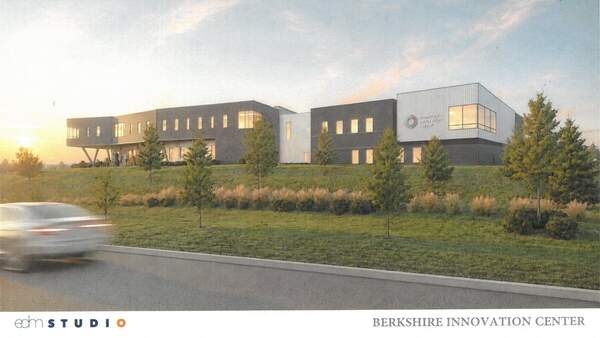
There is also movement at the Berkshire Innovation Center as it begins a 7,000-square-foot  expansion to add an Advanced Manufacturing for Advanced Optics Tech Hub and bring a new company, Myrias, to Pittsfield. 

The City Council voted to support the project with a total of $1 million in Pittsfield Economic Development Funds, and the state awarded the BIC with a $5.2 million transformation grant. 

Election 

Voters chose new City Council members and a largely new School Committee during the municipal election in November.  The council will be largely the same, as only two councilors will be new. 

Earl Persip III, Peter White, Alisa Costa, and Kathleen Amuso held their seats as councilors at large.  There were no races for wards 1, 3, and 4. Patrick Kavey was re-elected to Ward 5 after winning the race against Michael Grady, and Lampiasi was re-elected to Ward 6 after winning the race against Walter Powell. 

Nine candidates ran to fill the six-seat committee.  Ciara Batory, Sarah Muil, Daniel Elias, Katherine Yon, Heather McNeice, and Carolyn Barry were elected for two-year terms. 

Katherine Nagy Moody secured representation of Ward 7 over Anthony Maffuccio, and Cameron Cunningham won the Ward 2 seat over Corey Walker. Both are new to the council. 

In October, Ward 7 Councilor Rhonda Serre stepped down to work for the Pittsfield Public Schools. 


View Full Story

More Pittsfield Stories