Advocate Says Women Must 'Break Code of Silence'
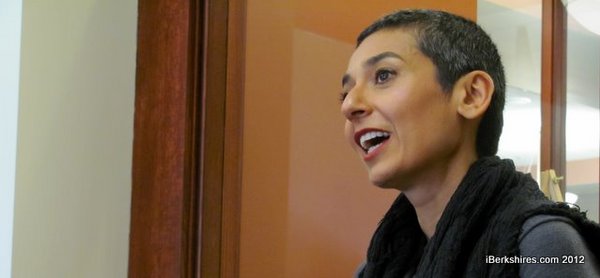
 Zainab Salbi was at MCLA to speak about war and the plight of civilians. |
"This is not a Third World issue, this is a women's issue that we are raised and being told to keep these stories of silence," said Salbi, who has spent years advocating for women in developing and war-striven nations. A Congolese woman told her, "If I can tell the whole world what happened to me, others will not have to go through what I've gone through, but I can't — you can go tell the world my story."
Salbi took a few minutes to speak with reporters during her visit to Massachusetts College of Liberal Arts on Tuesday. In addition to speaking on the plight of civilians in wartime in the college's Public Policy Lecture Series in the evening, Salbi appeared on the school's television roundtable and had a question-and-answer with students.
She said women are only "halfway" up the mountain to equality and while American women are sometimes viewed as "super women" by their sisters in other parts of the world, communicating their struggles can inspire others.
"I'm a big advocate for [an] American woman to sort of show leadership by showing her ability ... but they still have lots of challenges, women are underrepresented in many sectors," said Salbi, noting the level of domestic violence in the United States has not decreased over the past 30 years. "When I talk about domestic violence in America [other women] are not only touched but it encourages them to open up."
She described it as a "sisterhood through vulnerability" that gets women talking and provides inspiration. The recent discussions and language used about women's health and choices here is a case in point.
"I am appalled that women's bodies continue to actually be an issue," said Salbi. "I believe that all I'm driving or I'm advocating for is for every woman to make any choices she wants to have. That should not just relate to her fertility. If she wants to cover her head that's her choice; if she wants to have a child, that's her choice."
Since 1993, Women for Woman International has aided more than 300,000 women to improve their lives and their communities through entrepreneurship and skills training. Salbi, who grew up under the reign of Saddam Hussein in Iraq, has also worked to shed light on the lives of civilians caught up in wars — from Bosnia, to Iraq, to the Congo, to Colombia.
Salbi said biggest failings of the intelligence communities when it comes to conflict is failing to understand the "emotional intelligence" from the civilian population.
"I find it amazing that there is such little understanding of the emotional intelligence that goes on in the streets of, say, Iraq," said Salbi, who was among the first civilians into that country after the invasion by the U.S. in 2003. "There's no understanding of the nuances of what the civilians are saying."
Getting a bead on what civilians are thinking, and what their cultures are going through, makes for better policy decisions, she said, and all you have to do is talk to them.
"You don't need a big degree to understand them."