Board Upholds Demoliton Delay for Old Plunkett School
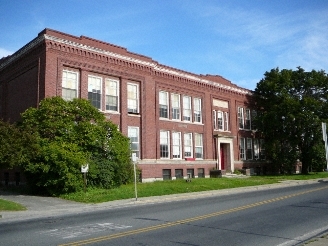
PITTSFIELD, Mass. — An order to delay demolition of a historic building where developers hope to construct a new doughnut shop was upheld by the Community Development Board on Tuesday night, following appeals from multiple residents.
James Scalise of SK Design spoke in representation of the property owners and Cafua Management Co., which seeks to clear the old Plunkett School to make way for what is expected to be a replacement for the current First Street Dunkin' Donuts. The shop drew fire from the City Council last year over continued traffic issues at its location.
Following the Historic Commission's determination that the century-old Plunkett building merited a delay, Cafua Management was required to present a plan to the Community Development Board before it enacted the six-month delay.
"Structurally it's in very good shape. It has a granite foundation, it's not cracked, it's not broken," Scalise told the board, based on a site tour he conducted on Monday.
He reported that there are some minor leaks in the roof, and because it is not heated, there's hardwood flooring within the building that is buckling.
"It could be saved. The structure is there, there's nothing that tells me that this building is imminently in disrepair or going to fall down."
Built during the population boom at the turn of the 20th century, the Fenn Street building served for 68 years as Plunkett Elementary School, which closed in 1977.
It was purchased in 1982 by its current owner, who closed its light industrial operation in 1986. During the 25 years since, several small businesses have used portions of the building. It has been vacant since 2009.
"The owner has made a bona fide effort to sell this building since 1986," Scalise contended, and in that time, "During the past 25 years there's been no reasonable offers to purchase that building."
Furthermore, things like its classroom configuration, wide hallways, and lack of handicapped accessibility to the second floor, make repurposing of the structure difficult.
"In my opinion this building is a challenge at best, and is impossible at worst, to reuse," said Scalise. "There's no reasonable likelihood that anyone is going to purchase, preserve, rehabilite or restore this structure in the next six months."
Given these facts, Scalise said, the owners and developers involved feel that the demolition delay order should be removed so that they may begin a special permitting process which would allow them to begin demolition in as little as 90 days.
"The purpose of the delay is so that the public can have a chance to weigh in," countered Kathleen Riley, of the Pittsfield Historical Commission. "That we would have hearings, and the public would have a chance to look at this issue and look at the building."
"We many times have had people say 'What happened to our train station?' 'What happened to this building, or that building?'" said Riley. "This is the reason that the demolition delay bylaw was created, to give a chance for the public to weigh in."
Her colleague on the Historical Commission, Tom Martin, agreed.
"It's my hope, since Pittsfield is kind of known for destroying historic buildings over time, that there be some kind of consideration of reuse of this building before it's torn down, as we continue to suburbanize downtown," he said.
Betsy Sherman of the Berkshire Historical Society also spoke in favor of the delay, citing the building's decisive presence on that corner and its origins.
"This building was actually designed by a very famous architect, Mr. Seever, who has a long history in Pittsfield, and a long history in Massachusetts, and I think before you just unilaterally decide to take it down I think it should have some more consideration."
Todd Burdick, also on the Historical Commission, described "a swell" of interest among various social service and faith-based organizations he is involved with in acquiring and reusing just this type of building.
Ward 2 City Councilor Kevin Morandi also supported the demolition delay, encouraging residents to contact him with ideas for this site.
"We've lost a lot of buildings over the years in this city, and certainly would not like to see that demolished if we can put something in there."
The temporary delay enacted Tuesday by the board in no way precludes the company's eventual demolition, and the development is expected to go through unless a feasible alternate proposal comes forth within that time.
After voting unanimously to go forward with the delay, the board asked Scalise to arrange a planned joint tour of the facility with members of the Historical Commission.
Tags: Dunkin' Donuts, historical building, school building, vacant building,