Japanese Scholar Studying New England Town Meeting
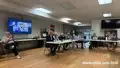
 Professor Kazunori Oshima is studying the New England town meeting. He attended Lenox's annual meeting and will be at Williamstown's next week to watch the democratic process. |
And like his 19th-century predecessor, the Japanese scholar found democracy in the New England town meeting.
Oshima, a former professor at Kyoto's Doshisha University, is in North Berkshire this month to study how Americans in general and New Englanders in particular are engaged in the democratic process.
"I have been studying self-governing associations in Japan for the past 10 years, and in the process I have found democracy in Japan to be somewhat problematic," Oshima said this week in an interview at the Williamstown Motel.
"In this process, I've come to feel that I need to study the town meeting in the United States, which is a model for democracy in action. That is the reason I am here."
In 1835, Alexis de Tocqueville had high praise for the town meeting in his landmark treatise "Democracy in America":
"Town meetings are to liberty what primary schools are to science; they bring it within the people's reach, they teach men how to use and how to enjoy it."
It is a lesson from which Oshima's countrymen might benefit.
"I'm not trying to degrade the Japanese people but simply present what is actually in society," he said. "Democracy in Japan has not been established, in my point of view. Although legal regulations stipulate it is a democratic country."
Part of the problem is that the Japanese constitution, drawn up during the Allied occupation after World War II, is a stark departure from the feudal system that ruled the island nation for centuries.
"Since (1947), a great change has occurred," Oshima said. "But still time has been quite limited.
"I think it's going to improve, but very slowly."
Japanese culture with its emphasis on decorum and etiquette is almost antithetical to the free-wheeling debate that is associated with town meeting.
"The fundamental problem in my view is that if some problem occurs, different groups would not like to discuss the matter," Oshima said. "They would like to avoid discussing the problem. That is, I think, a fundamental problem: the desire to avoid, disregard or escape the situation."
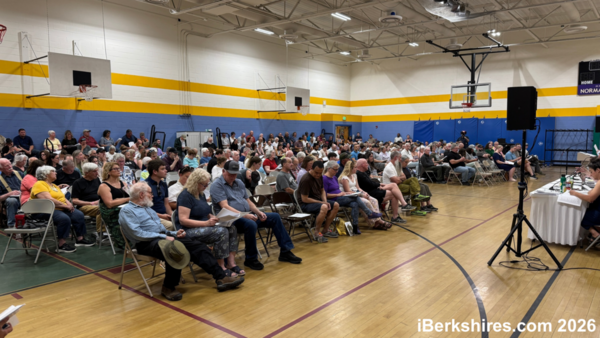
Oshima drew a sharp contrast between that desire and the Lenox Town Meeting he attended earlier this month.
"I found lively discussions from the administration and the people on the floor — an exchange of ideas coming to a conclusion," he said. "That, I think, is the democratic process — even if there are different opinions among the people. That kind of custom, that kind of procedure, in my view, as far as I know, has not been established in Japan.
"[In Lenox], it was an open discussion, an open forum. Everything is up there for debate. That leads to intensive discussions about problems. They also come to conclusions.
"This should be how the democratic process is."
Oshima visited Lenox along with Williamstown Town Manager Peter Fohlin, who was introduced to Oshima through University at Albany political science professor Joseph Zimmerman.
Oshima approached Fohlin to ask if he could observe next Tuesday's Williamstown Town Meeting and talk with town officials. Fohlin suggested the side trip to Lenox to see a second meeting.
"Every New England town meeting is as different as it is similar to other town meetings," Fohlin said. "The Lenox Town Meeting this year was very subtle because there were a lot of background issues. For me, it was fascinating to watch, but if you didn't know the back story, it looked pretty straightforward and mundane.
"What impressed [Oshima] the most was the willingness of New Englanders to walk up to the microphone and state their opinion and expose themselves to examination by their fellow voters."
The closest equivalent in Japan to the town meeting is the self-governing association, which Oshima analyzed in a paper he presented last year to the Joint International Conference of the Association for Asia Pacific Studies and Anthropology of Japan at Ritsumeikan Asia Pacific University.
In it, he wrote: "I have found that there is a great dissociation between the ideals stipulated in the Constitution of Japan ... and the realities in the field. ... The problem is triple. Old-timers hold to the vested interest, newcomers are evidencing apathy, and some public officers demonstrate inertia."
A trained linguist, Oshima became interested in the relationship between semantics and political power while studying under S.I. Hayakawa at San Francisco State University in the 1960s.
Although he has been interested in the New England town meeting for some time, this trip has given him his first opportunity to see it in person.
"Until we see the actual processes of town meeting, only reading about it in books is not sufficient — even though they are very excellent books," he said. "That is the reason I am here."
Tags: town meeting,