Pittsfield Cuts Ribbon on Upstreet Cultural District
 |
|
 |
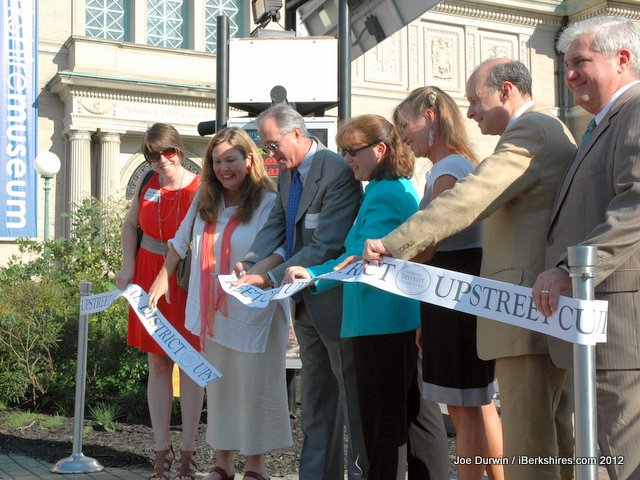
Laura Roudabush, of Barrington Stage, left, Megan Whilden, Mayor Daniel Bianchi, Rep. Tricia Farley-Bouvier, MCC Director Anita Walker, Sen. Stan Rosenberg and Berkshire Museum Director Van Shields cut the ribbon on the new cultural district. |
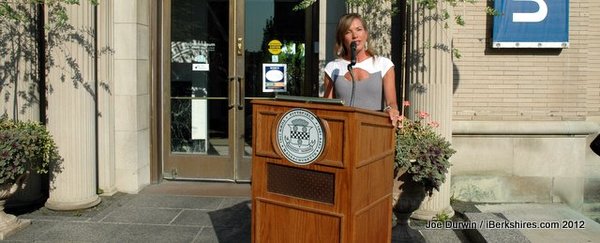
Though Mayor Daniel Bianchi accepted the designation on behalf of Pittsfield at a Massachusetts Cultural Council event in March, this marked the first celebration of the the Upstreet moniker in the city itself.
"It's about creating a quality of life for people living in a community, but it's also about giving people a way to be proud, to have a sense of place," said Anita Walker, head of the Massachusetts Cultural Council.
The downtown district was one of only five areas selected out of a pool of about a 100 towns and cities that applied for the status, a new designation created by the Legislature in 2010. This sector of Pittsfield, demarcated as the area between Linden Street and East and West Housatonic streets and between Center Street and First, in recent years has seen the addition of the Colonial Theatre, Barrington Stage, the Beacon Cinema and at least two lasting art galleries to such longtime cultural attractions as the Berkshire Museum and the Lichtenstein Center for the Arts.
The legislation included no new funds for the Massachusetts Cultural Council, which is tasked with approving new cultural districts, instead directing the MCC to cooperate with other state government agencies to "identify state incentives and resources to enhance cultural districts."
"Cultural Districts have a very specific function and focus," said state Senate President Pro Tem Stan Rosenberg, who congratulated Pittsfield on its new Upstreet status. "It is about either breathing new life and new vision into a neighborhood or a part of a community where one does not yet exist, or accelerate the same in a community like Pittsfield where it's already in play, and already happening."
Local arts advocates say the designation may enhance the ability of institutions to secure new additional grants and other funding sources for programming, not only from government sources but from businesses and foundations as well. Such funding sources are key, experts say, at a time when the state's funding to the MCC is nearly $3.5 million less than the 2009 budget.
An amendment passed in the state's House of Representatives this spring sought to restore $250,000 of the slashed funding to Gov. Deval Patrick's budget, but was struck down in the Senate, leaving the arts budget at $9.25 million, far below its high of $12.7 million three years ago.
According to Rosenberg, though, there will be more money coming for projects in cultural districts in the future.
"It's only a matter of time until we can take the next step," said Rosenberg, citing a recent attempt to add cultural district funding to the MassWorks program. "We're going to have to go on together to create the resources so it's more than just a name, and more than just an opportunity, but it becomes a reality."
 |
|
"What it takes is an atmosphere to let all these people with these great ideas have the chance to implement them, and that's where government comes in," said Farley-Bouvier, "Government's job is to lay the foundation and to create the place where people with the good ideas, smart people can come in and get these things done."
Pittsfield's cultural base has sought new ways to celebrate and advertise the designation since it was awarded five months ago. The Upstreet district was first named honorary grand marshal of the July 4 parade, but was later replaced when Dr. Ruth Westheimer agreed to accept this distinction while in Pittsfield for the world debut of "Dr Ruth, All the Way," at Barrington Stage Company.
With Thursday's event, the city was able to hold its official launch in conjunction with its most popular social event, 3rd Thursdays, which this month is combined with the 4th annual WordXWord Festival being held throughout downtown this week. One of its most prominently feature poets, Gabriel Squailia, was asked to read a poem he composed titled "The Passion of North Street," a surprisingly frank examination of urban dualities in a neighborhood he called "standing between what was, and what will be."
Tags: creative economy, cultural district, Mass Cultural Council, Upstreet,