North Adams Cracking Down on School-Lunch Tabs
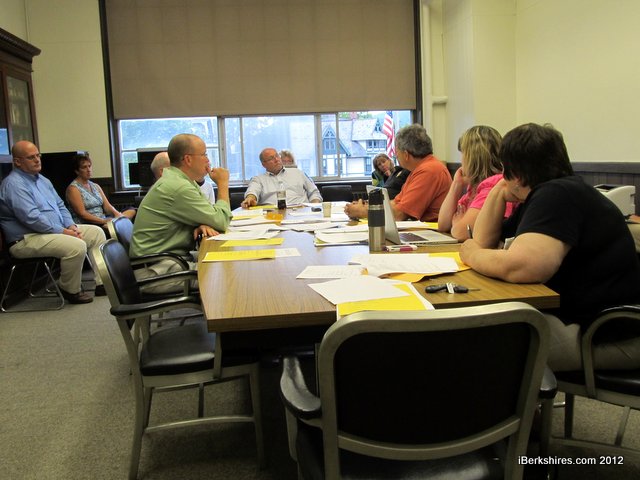 The North Adams School Committee |
"We are not in the bill collecting business, we are not in the advertising business," Superintendent of Schools James Montepare told the School Committee on Monday night.
He said the School Department is carrying $3,000 to $4,000 in delinquent lunch accounts by November that are becoming a significant issue as budgets have been slashed.
"We have an ongoing problem with some parties who just don't send their kids in with lunch money," said Montepare. "It's usually those folks who have the ability to pay."
The cafeteria supervisor works with parents having financial difficulties to develop payment plans, and the department has made an effort to allow parents to pay online, by credit card and check. Sometimes kids just forget their lunch money on occasion, he said, but a handful of parents have run up tabs despite continual letters and calls.
"To come up with an extra $4,000 to $5,000 for something that hasn't budgeted is pretty dramatic," said Montepare. "It's a bill collecting nightmare."
In response to questions from the committee, Montepare said some school districts do not allow "charging" when parents fail to pay. Instead, students are provided a simpler lunch, like a jelly sandwich.
"What puts us at a disadvantage, is it puts the kid on the spot," said Mayor Richard Alcombright. "There's enough emotional stuff these kids are going through throughout the day."
He did, however, suggest that with school yet to start, now would be a good time to inform those parents who have failed to pay that they would be held responsible.
Committee members David Lamarre suggested that consistently delinquent parents be required to have a credit card on file and Mary Lou Accetta that failure to provide lunch could be a care and neglect issue.
Business manager Nancy Ziter recommended a clear policy be put in place before the committee made any significant moves. Alcombright asked Montepare to return to the committee with a clearly laid out timeline addressing steps for collection, including the possibility of small claims court or filing a care and neglect case with the state.
The committee also approved raising school lunch prices 25 cents, from $1.75 to $2, and adult lunch prices from $3.25 to $3.50. Lunch prices are being slowly raised over several years to comply with federal requirements related to reimbursements for the free and reduced lunch program.
Montepare also was given the go-ahead to craft a policy that could see the tens of thousands of fliers stashed in kids' backpacks each year be reduced to single electronic postings.
The superintendent said the doling out of fliers from outside organizations has become a logistical issue in having to go through an approval process, scheduling and, finally, to classroom teachers who have to hand them out.
"I turn a lot of them down and they get mad," said Montepare. "We get professional advertisers that just badger us with these things."
One organization has delivered an estimated 180,000 fliers through the school system in the last year. The programs may be good and access to students at all income levels must be included, he said, but the sheer volume has become overwhelming.
"We do not use them for things that charge a fee," Montepare said, "but some places use the schools as an advertising agency ... it takes many people and many hours and we are not an advertising agency."
He suggested guiding those agencies to flierboards hosted by local media (iBerkshires has one), cooperating with a third party site or posting fliers somewhere on the city or school websites.
The superintendent will also tighten up the policy on fund raising on school grounds over concerns that too much merchandising and using students to raise money for non-school events is occurring.
"The policy says no, you can't do it without School Committee approval but we have to enforce the policy," the superintendent told the committee. "I want you to be aware that there are going to be phone calls ... I didn't want you to be blind-sided."
In other business, the committee:
• Approved an appropriation of $100,000 from the school-choice account toward the feasibility study for the school building project, which has cost more than anticipated because of forums and independent consultants over the past 10 months.
The funds will be added to the $680,000 bonding authorized four years ago. The state requires "up front" money to cover costs but will reimburse the city 80 percent. The school-choice account will be replenished in full and the $20,000 obligation will fall to the borrowing order. The entire cost to the city is now estimated at $156,000.
• Heard an update on the new E3 Academy set to begin this fall for at-risk high school students. The academy is part of the reorganization of the school district's transitional programs.
• Approved a rash of coaching and teaching appointments, listed below, and amendments related to gender identity that have been added to the anti-discrimination policy.
NA_SchoolCommittee_08202012
Tags: fundraiser, school committee, school lunch,